


Bitumen 20/30 Penetration Grade in Drum, Jumbo Bag, and Bulk
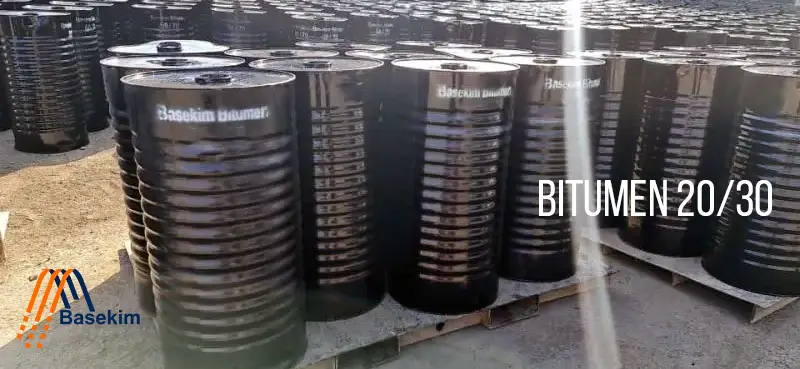
Bitumen 20/30 is one of the stiffest penetration-grade binders used in modern infrastructure, yet it still offers enough workability for demanding applications. Because its penetration value is 20–30 dmm, it delivers strong resistance against rutting, high temperatures, and chemical exposure. For this reason, many engineers and industrial users choose bitumen 20/30 from Basekim, especially when they need a binder that performs reliably in hot climates and heavy-load environments. Moreover, although the material is hard at normal temperatures, it softens predictably during production, which makes it suitable for both paving and waterproofing systems.
Typical Applications and Market Demand of Bitumen 20/30
Because of its stiffness and durability, bitumen 20/30 remains a preferred choice in several industries. First, it performs extremely well in heavy-duty road bases and high-volume intersections, where softer binders often deform. Next, it plays a major role in waterproofing membranes used in tunnels, foundations, and metro systems, since it provides strong resistance against water and pressure.
Moreover, this grade fits perfectly in industrial flooring, especially in areas that face chemical spills, oil exposure, or constant forklift traffic. In addition, industries use it in bituminous mastics, crack sealants, expansion-joint fillers, and protective coatings where high viscosity is required. As a result, governments in the Gulf, North Africa, and South Asia continue specifying this binder for large infrastructure upgrades, which keeps demand strong throughout the year.
Specifications of Bitumen 20/30
Quality-control laboratories verify the following values before approving each batch:
-
Specific Gravity @ 25 °C: 1.01 – 1.06
-
Penetration @ 25 °C: 20 – 30 dmm
-
Softening Point: 55 – 63 °C
-
Ductility @ 25 °C: ≥ 100 cm
-
Flash Point: ≥ 250 °C
-
Solubility in CS₂: ≥ 99.5%
-
Spot Test: Negative
These limits matter because they ensure the binder will not crack under temperature changes or flow during heavy traffic. Moreover, they confirm the product’s safety and stability during hot-mix production.
HS Code and CAS Number Bitumen 20/30
For proper customs documentation, bitumen 20/30 is listed under:
-
HS Code: 27132000
-
CAS Number: 8052-42-4
These identifiers simplify international shipments. Additionally, quoting them on invoices and MSDS sheets prevents delays at ports and ensures compliance with global regulations.
Why Penetration and Softening Point Matter
Penetration shows how deep a needle can sink into a binder under fixed conditions. Because bitumen 20/30 allows only 20–30 dmm, it is naturally stiffer than many other grades. Consequently, it handles high loads and high temperatures better.
Next, the softening point between 55 °C and 63 °C signals the temperature at which the binder begins to flow. Therefore, this range protects pavements and membranes from softening under direct sunlight.
Together, these two properties explain why this grade works extremely well in hot regions such as the Middle East, tropical Asia, and parts of Africa.
Manufacturing Process of Bitumen 20/30 — From Vacuum Bottom to Finished Binder
Refineries begin with vacuum distillation, which removes lighter hydrocarbons. Afterwards, they collect the heavy residue known as vacuum bottom. Then, they blow hot air through the material to increase viscosity without adding chemicals. Consequently, the binder becomes thicker, purer, and more stable.
Finally, each batch undergoes testing to verify compliance with ASTM D946 and EN 12591, ensuring consistent performance in both industrial and paving applications.
Thermoplastic Behavior and Performance Advantages
Although bitumen 20/30 feels rigid at standard temperatures, it softens smoothly when heated and hardens again once cooled — the hallmark of a thermoplastic material. Because of this, mixers can heat the binder to create uniform asphalt blends. Then, after the mixture cools, the binder regains strength and delivers excellent structural stability.
This thermoplastic cycle produces several key benefits:
-
High rutting resistance, especially on heavy-load pavements
-
Superior waterproofing, which is essential for roofing, foundations, and tank linings
-
Long service life, since the binder resists flow and bleeding during summer
Therefore, this grade remains a reliable option for demanding industrial projects.
Quality Assurance, Warranty & Third-Party Inspection
Reliable suppliers provide strict quality assurance. For example, they issue Certificates of Analysis (COA), allow SGS or BV inspectors to verify loading, and offer performance warranties. Furthermore, they document each batch with traceable labels, which helps buyers compare delivered material against data sheet values. In this way, the risk of receiving non-conforming material is minimized.
Packaging, Logistics & Storage Guidelines
Bitumen 20/30 is available in several packaging formats:
-
New or reconditioned steel drums
-
1-ton jumbo bags
-
Bulk tanker loads
-
ISO tank containers
Moreover, drums stack efficiently in 20-foot containers, usually fitting 80–110 drums depending on size. Additionally, jumbo bags allow faster unloading at asphalt plants.
For proper storage:
-
Keep drums upright on pallets
-
Store them in shaded, cool areas
-
Label each drum with grade, batch, and weight
-
Maintain bulk tanks between 140 °C and 160 °C
Consequently, the binder stays clean, stable, and ready for use.
Why Choose a Trusted Supplier
Choosing a reliable supplier ensures on-time delivery, consistent quality, and strong technical support. Moreover, dependable vendors reduce project delays and keep production lines running smoothly.
Finally, Basekim supplies premium bitumen 20/30 with global shipment options, strict quality checks, and complete documentation — giving contractors and industrial users total confidence in every order.
Q1: What is bitumen 20/30 used for?
A1: Bitumen 20/30 is mainly used for heavy-duty asphalt, high-load pavements, and industrial road projects. It provides strong stiffness and excellent resistance to deformation, which helps roads perform under extreme pressure.
Q2: Why is bitumen 20/30 recommended for hot climates?
A2: Bitumen 20/30 works well in high temperatures because its harder structure prevents rutting and softening. Therefore, engineers choose it for regions where pavements must stay stable during intense heat.
Q3: Is bitumen 20/30 suitable for highways and airport runways?
A3: Yes, this grade is ideal for highways, runways, and heavy-traffic zones. It delivers high durability and strong load-bearing capacity, ensuring long-term performance in demanding projects.
Q4: What benefits do contractors get when using bitumen 20/30?
A4: Contractors benefit from its strong adhesion, high stability, and long lifespan. Moreover, bitumen 20/30 improves pavement performance by reducing cracks and deformation, which helps achieve reliable and cost-effective construction results.
Contact Info
Turkey office:No.6 of Fahrettin Pasa Sokak , Galip Erdem steet, Ilkbahar Mah. Turan Gunes Ave. Çankaya Ankara
Phone:00903125147055
Dubai office: 3509 of the Burligton tower, business bay, Dubai-UAE
Phone:0097142369830