- About Us
- Contact Us
- English


Stearic Acid for Cosmetics – A Versatile Ingredient for Modern Industry
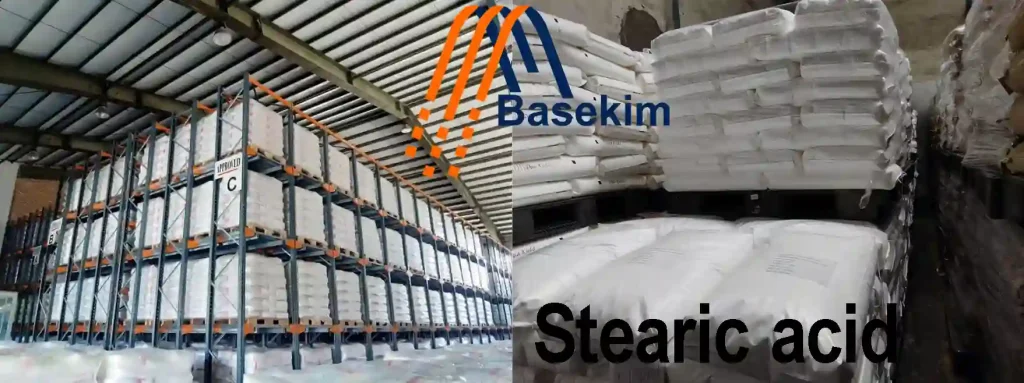
Stearic acid is one of the most widely used fatty acids in manufacturing today. It appears in everything from shampoos and candles to plastics and rubber. Because of its flexibility and chemical stability, it plays a vital role in industrial, cosmetic, and pharmaceutical products.
Moreover, industries value it for its emulsifying, thickening, and stabilizing properties. Whether you’re making detergents or tire compounds, stearic acid ensures performance and consistency.
What Is Stearic Acid?
Stearic acid is a long-chain saturated fatty acid derived mainly from animal fats or vegetable oils. Its chemical structure (C18H36O2) gives it a waxy texture and a melting point around 69°C.
To clarify, it actively is solid at room temperature, non-toxic, and has a mild odor. It is often found in flakes, powder, or beads depending on its intended use. In addition, it blends well with other chemical agents, making it an excellent additive.
Because of this, many manufacturers choose it as a core ingredient in both water-based and oil-based systems.
Applications of Stearic Acid
This acid actively is used across a wide range of industries. For example, it acts as a stabilizer in PVC production, a lubricant in metal processing, and an emulsifier in cosmetics.
Major Applications:
Cosmetics: Acts as a thickener in creams and lotions
Plastics: Stabilizes PVC compounds
Pharmaceuticals: Used in tablet manufacturing
Rubber industry: Aids in vulcanization processes
Metalworking: Serves as a softener and lubricant
Candles & Soaps: Increases hardness and burn quality
In short, few materials are as multi-functional as stearic acid.
Key Benefits
There are many reasons to choose this acid for your processes. Not only is it affordable, but it also delivers consistent results across applications.
Technical Advantages:
Excellent emulsifying power
Maintains viscosity in high and low temperatures
Non-reactive and stable under most pH conditions
Compatible with numerous organic and inorganic compounds
As a result, it improves the texture, shelf life, and usability of finished products.
Grades and Forms
Stearic acid actively is available in multiple grades to suit your production needs. Because each industry requires specific purity levels, the right grade ensures optimal results.
Available Grades:
Technical Grade: For rubber, plastics, and industrial use
Cosmetic Grade: For skincare, makeup, and hair care
Pharma Grade: For medicines and dietary supplements
Physical Forms:
Beads
Powder
Flakes
In addition, Basekim offers customized bulk packaging solutions for every form.
Global Market and Demand
The demand for this C18H36O2 continues to grow worldwide. Consequently, industries are moving toward sustainable and efficient sourcing.
Countries in Europe, the Middle East, and Asia rely on high-quality stearic acid for consistent supply chains. Furthermore, increased demand in eco-friendly cosmetics and bio-lubricants drives the need for purer and greener raw materials.
Why Choose Basekim?
When sourcing stearic acid, quality and reliability are key. That’s why Basekim actively is trusted by manufacturers across Europe, the UAE, and beyond.
What Basekim Offers:
Global logistics coverage
Export documentation and COA provided
Warehousing and supply in Turkey and the UAE
Fast shipment in drums, bags, or custom packs
Moreover, our technical experts ensure every batch meets strict international standards.
Safe Handling and Storage
Stearic acid is generally safe to handle but should be stored properly. Therefore, keeping it in a cool, dry environment is essential.
Handling Tips:
Avoid contact with moisture
Store in sealed containers
Use personal protective gear during bulk handling
To sum up, safety practices preserve material quality and worker safety.
Stearic Acid and Sustainability
Because this product can be plant-derived, it supports eco-friendly manufacturing goals. In fact, many companies now prefer palm-based or other vegetable-derived grades to reduce environmental impact.
As a result, stearic acid supports circular manufacturing, biodegradable product lines, and lower carbon footprints.
Frequently Asked Questions (FAQ)
Is stearic acid safe for cosmetics?
Yes, it actively is approved for use in skincare and makeup. Moreover, it acts as a skin-softening agent.
Can stearic acid be usable for food industry?
Only food-grade stearic acid may be used, and it must comply with national food safety regulations.
Does it come from animals?
It can be derived from either animal fat or vegetable oil. However, vegan and palm-free options are available.
What is the shelf life?
Stored properly, stearic acid has a shelf life of up to two years.
Who supplies bulk stearic acid?
Basekim supplies bulk and packaged stearic acid globally with full technical documentation and logistics support.

Contact Info
Ankara Office
No.6, Fahrettin Pasa St. (613), Ilkbahar, Cankaya – Ankara
Tel: +90 312 514 70 55
Istanbul Office
No. 219, Sogut St., No.20, T4A Block, Maslak, Sariyer – Istanbul
Tel: +90 212 807 22 33
Dubai Office
No.3509, The Burlington Tower, Business Bay, Dubai – UAE
Tel: +971 4 236 98 30