- About Us
- Contact Us
- English


TPO Membrane – Specifications, Thickness & Roofing Uses
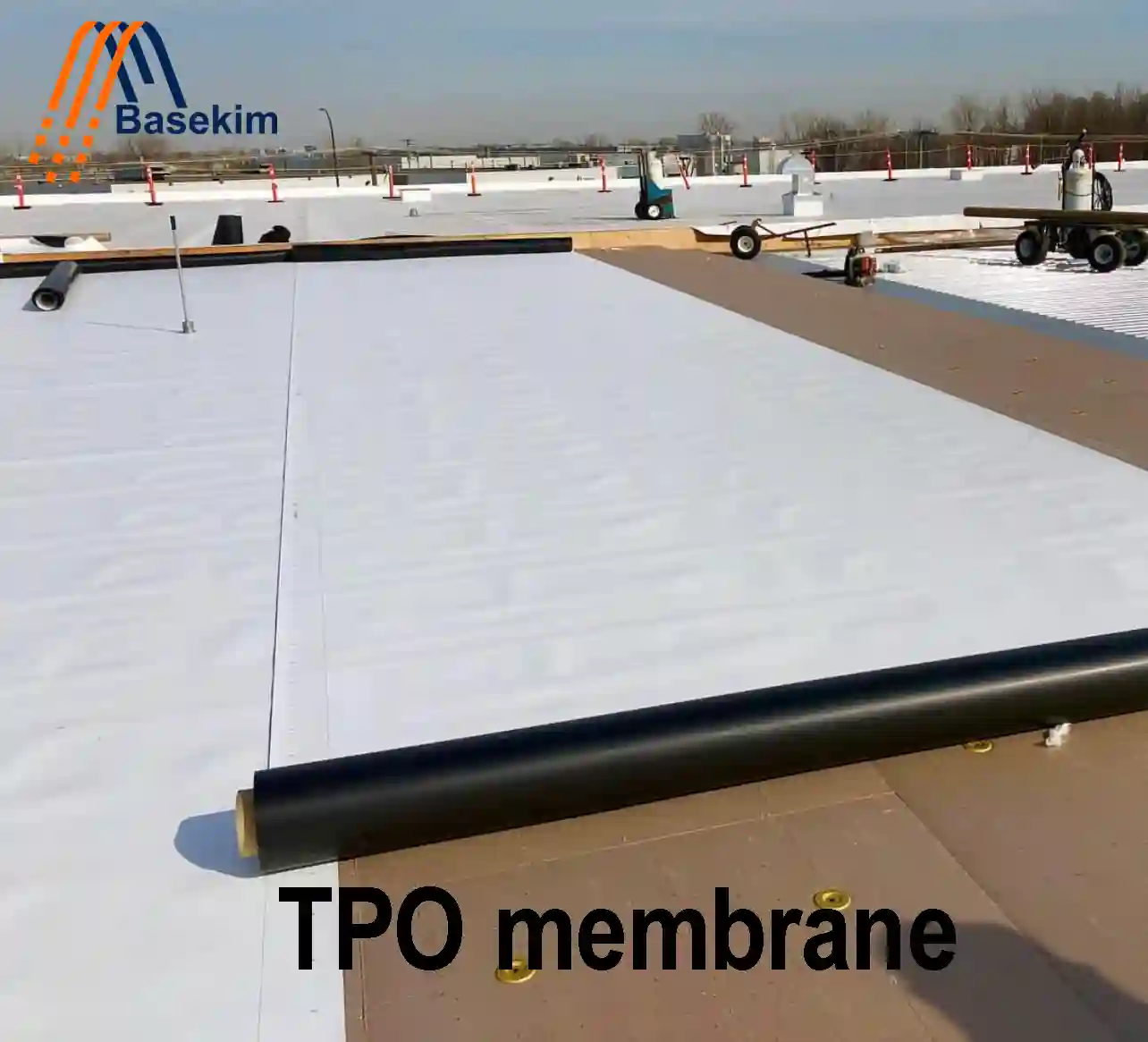
TPO membrane is a single-ply thermoplastic roofing material designed mainly for flat and low-slope roofs. Contractors and building owners use it because it combines a relatively lightweight structure, heat-welded seams, good weather resistance, and a reflective surface that can help reduce roof heat gain in suitable climates.
TPO stands for Thermoplastic Polyolefin. Most reinforced roofing grades combine a weather-resistant top layer, polyester reinforcement, and a lower TPO layer. Manufacturers produce several thicknesses and roll sizes so designers can match the membrane to commercial buildings, warehouses, factories, offices, and other roofing projects.
Basekim supplies TPO membrane for international roofing and waterproofing projects, with specifications and shipment terms selected according to project requirements.
What Is TPO Membrane?
TPO is a flexible thermoplastic sheet used as the waterproof layer in a roofing system.
Unlike traditional bituminous waterproofing products, TPO comes in large rolls and installers join adjacent sheets by hot-air welding. When technicians weld the seams correctly, the membrane creates a continuous waterproof surface across the roof.
A typical reinforced sheet contains three main parts:
Upper weathering layer
Polyester reinforcement
Lower thermoplastic layer
The reinforcement improves dimensional stability and mechanical strength. Meanwhile, the outer layers protect the roofing system from weather, UV exposure, moisture, and normal environmental conditions.
White and light-colored membranes are especially common because they reflect more solar radiation than dark roofing surfaces.
Typical TPO Membrane Specifications
Exact technical values depend on the manufacturer, thickness, reinforcement, and project standard. Therefore, buyers should always check the current TDS before approving a grade.
| Parameter | Typical Option |
|---|---|
| Product Type | Thermoplastic Polyolefin Roofing Membrane |
| Structure | Reinforced / Fleece-Backed |
| Reinforcement | Polyester Scrim |
| Common Thicknesses | 1.2, 1.5, 1.8, 2.0 mm |
| Standard Color | White / Light Gray |
| Surface | Smooth |
| Seam Type | Hot-Air Welded |
| Application | Flat and Low-Slope Roofing |
| Installation | Mechanically Attached / Fully Adhered |
| Roll Width | Grade Dependent |
| Roll Length | Grade Dependent |
| Water Resistance | High |
| UV Resistance | Designed for Exterior Roofing |
| Documentation | TDS / SDS / COA as applicable |
Project engineers should select the membrane according to the complete roof design rather than thickness alone.
How TPO Roofing Membrane Is Constructed
Reinforced roofing grades normally use a layered structure.
Top Weathering Layer
The upper layer faces sunlight, rain, wind, temperature changes, and normal roof exposure.
It also gives the system its visible surface color.
White TPO roofing is popular on commercial buildings because a reflective roof surface may reduce solar heat absorption compared with darker roofing materials.
However, the actual energy effect depends on insulation, climate, building design, roof condition, and HVAC performance.
Polyester Reinforcement
A polyester scrim sits within many commercial roofing membranes.
It improves:
Tensile performance
Dimensional stability
Tear resistance
Mechanical strength
Reinforcement becomes especially important in mechanically attached roofing systems because the membrane must perform around fasteners and stressed areas.
Bottom Layer
The lower thermoplastic layer completes the membrane structure and supports welding and installation.
For fully adhered systems, this side works with the approved adhesive and roof substrate according to the selected roofing system.
TPO Membrane Thickness
Thickness is one of the first specifications buyers compare.
Common commercial options include:
1.2 mm
1.5 mm
1.8 mm
2.0 mm
However, simply choosing the thickest sheet does not automatically create the best roof.
1.2 mm
A thinner grade may suit projects where lower membrane weight and project-specific performance are priorities.
Designers should still check local codes, warranty requirements, wind loads, expected traffic, and roof conditions.
1.5 mm
This thickness is a common choice for many commercial roofing projects.
It offers a practical balance between membrane weight, durability, handling, and cost.
1.8 mm and 2.0 mm
Thicker membranes may provide a greater material margin for demanding roofs, higher traffic areas, or projects with stricter durability requirements.
However, thickness should always be considered together with reinforcement quality, attachment method, detailing, and substrate condition.
Reinforced vs Fleece-Backed TPO
Not every TPO roofing sheet has the same backing.
Reinforced Membrane
Standard reinforced membranes contain polyester scrim within the sheet.
They are widely used in mechanically attached and other commercial roofing systems.
Typical benefits include:
Good mechanical strength
Reliable seam welding
Lower weight than many multi-layer systems
Fast installation on large roof areas
Fleece-Backed Membrane
Fleece-backed TPO has an added fleece layer on the back.
The fleece can support adhesion, improve contact with certain substrates, and provide added separation between the membrane and roof surface.
Contractors may select fleece-backed products for fully adhered systems or renovation projects where the substrate requires additional compatibility.
The correct option depends on roof design and manufacturer instructions.
Main Roofing Applications
TPO membrane is most closely associated with commercial roofing.
Flat Roofs
Large flat roofs need reliable waterproofing and efficient installation.
Because TPO comes in wide rolls, contractors can cover large areas with fewer seams compared with small-format waterproofing materials.
Low-Slope Roofs
Low-slope roofs do not drain water as quickly as steep roofs. Therefore, seam quality, drainage design, penetrations, and waterproofing details become especially important.
Hot-air welded TPO seams help create a continuous roofing surface when installed correctly.
Warehouses and Factories
Industrial buildings often have large roof areas where installation speed and system weight matter.
TPO can provide a practical single-ply solution for these projects.
Commercial Buildings
Shopping centers, office buildings, schools, hospitals, logistics centers, and similar buildings may use TPO roofing as part of the complete roof assembly.
Roof Renovation
Certain TPO systems can also be used in roof renovation projects.
However, contractors should inspect the existing roof and confirm substrate compatibility before installation.
TPO Membrane Installation Methods
Installation quality has a major effect on roofing performance.
The two common systems are mechanically attached and fully adhered.
Mechanically Attached TPO
In a mechanically attached system, approved fasteners secure the membrane or fastening system to the roof deck.
The next sheet overlaps the fastened area, and installers weld the seam with hot air.
This method can offer fast installation on large commercial roofs.
However, designers must calculate fastening patterns according to wind loads, roof height, edge zones, deck type, and applicable standards.
Fully Adhered TPO
A fully adhered system bonds the membrane to an approved substrate with suitable adhesive.
This can produce a smooth finished appearance and may suit projects where the roof design calls for full adhesion.
Surface preparation becomes very important because poor substrate conditions can reduce bond quality.
Hot-Air Welded Seams
One of the main characteristics of TPO roofing is its heat-weldable seam.
Installers use controlled hot air to soften the overlapping thermoplastic surfaces. Pressure then bonds the layers together.
Correct welding depends on:
Surface cleanliness
Welding temperature
Machine speed
Ambient conditions
Membrane condition
Operator technique
Therefore, installers should perform test welds and follow the membrane manufacturer’s instructions.
Poor welding can lead to weak seams, while excessive heat may damage the sheet.
TPO vs PVC vs EPDM
TPO, PVC, and EPDM are all common single-ply roofing membranes, but their material structures differ.
| Feature | TPO | PVC | EPDM |
|---|---|---|---|
| Material Type | Thermoplastic Polyolefin | Polyvinyl Chloride | Synthetic Rubber |
| Seam Method | Hot-Air Welding | Hot-Air Welding | Tape / Adhesive Systems |
| Typical Color | White / Light Colors | White / Various Colors | Usually Black |
| Reinforcement | Common | Common | Depends on System |
| Flexibility | Good | Good | Very High |
| Reflective Roofing | Common | Common | Less common in standard black grades |
| Installation Style | Mechanical / Adhered | Mechanical / Adhered | Mechanical / Adhered / Ballasted |
There is no single best membrane for every project.
Designers should consider climate, roof shape, chemical exposure, substrate, detailing, contractor experience, budget, and required roofing standard before selecting a system.
Benefits of TPO Roofing
TPO has become common in commercial roofing because it offers several practical advantages.
Heat-Welded Seams
Thermoplastic seams allow installers to weld adjacent sheets into a continuous roof surface.
Reflective Surface
White roofing grades can reflect more solar radiation than dark roofing products.
As a result, they may help reduce roof surface temperatures in suitable conditions.
Lightweight System
Single-ply membranes add relatively little weight compared with many multi-layer roofing systems.
Large Roll Format
Large sheets reduce the number of seams required across wide roof areas.
Flexible Installation Options
Depending on the project, contractors can use mechanically attached or fully adhered systems.
Limitations and Project Considerations
TPO roofing still requires good design and skilled installation.
Buyers should consider:
Roof traffic
Penetrations
Drainage
Wind uplift
Climate
Substrate condition
Insulation
Chemical exposure
Required warranty
Installation experience
In addition, membrane thickness alone does not define the quality of the roofing system.
A well-designed 1.5 mm membrane system may perform better than a poorly detailed thicker membrane.
Roll Size and Packaging
TPO roofing membranes are supplied in rolls.
Roll dimensions vary according to production line, thickness, membrane type, and supplier.
When requesting a quotation, buyers should specify:
Required thickness
Roll width
Roll length
Total square meters
Reinforced or fleece-backed grade
Color
Project destination
Required certificates
For international shipments, pallet and container loading should also be confirmed before the order.
TPO Membrane Price
TPO membrane price depends on both technical and commercial factors.
The main price factors include:
Thickness
Reinforcement
Fleece backing
Roll dimensions
Total order volume
Raw material costs
Country of origin
Packaging
Freight
Destination
Incoterm
Therefore, comparing prices only by roll can be misleading.
Buyers should compare the cost per square meter together with thickness and specification.
For example, a lower-cost roll may also contain less material or a different reinforcement structure.
How to Choose the Right TPO Membrane
Before placing an order, buyers should define the actual roof requirements.
Start with the project specification.
Then confirm:
Required thickness
Reinforcement
Attachment method
Roof substrate
Wind requirements
Color
Roll dimensions
Required standard
Total roofing area
Documentation
For complex commercial roofs, the membrane should be selected as part of the entire roofing system rather than as an isolated product.
Storage and Handling
Store rolls in clean and dry conditions.
Protect them from damage, contamination, sharp objects, and unsuitable storage conditions.
Rolls should be handled carefully during loading and unloading to prevent damage to edges or membrane surfaces.
Before installation, contractors should inspect the material and keep seam areas clean.
Installation teams should also follow project specifications and manufacturer guidance.
Technical Documents
Professional buyers should request the latest technical documents before confirming the material.
These may include:
TDS – Technical Data Sheet
Provides thickness, mechanical properties, dimensions, construction, and other performance information.
SDS – Safety Data Sheet
Provides information related to safe handling, storage, and workplace considerations.
COA – Certificate of Analysis
May confirm selected production or batch properties when applicable.
Project requirements may also call for test reports or specific product certificates.
1. What is TPO membrane?
TPO membrane is a single-ply roofing material made from thermoplastic polyolefin. It is mainly used on flat and low-slope roofs and commonly includes reinforced layers with heat-weldable seams.
2. What does TPO stand for?
TPO stands for Thermoplastic Polyolefin.
3. What are the common TPO membrane thicknesses?
Common thicknesses include 1.2 mm, 1.5 mm, 1.8 mm, and 2.0 mm. Availability depends on the manufacturer and project requirements.
4. Which TPO thickness is best for commercial roofing?
There is no single best thickness for every project. 1.5 mm is common in commercial roofing, while thicker grades may be selected for roofs with higher traffic or stricter durability requirements.
5. How are TPO membrane seams joined?
Installers normally join TPO sheets using hot-air welding. This creates a continuous seam when the surface, temperature, and welding speed are properly controlled.
Related product
Share On

Contact Info
Ankara Office
No.6, Fahrettin Pasa St. (613), Ilkbahar, Cankaya – Ankara
Tel: +90 312 514 70 55
Istanbul Office
No. 219, Sogut St., No.20, T4A Block, Maslak, Sariyer – Istanbul
Tel: +90 212 807 22 33
Dubai Office
No.3509, The Burlington Tower, Business Bay, Dubai – UAE
Tel: +971 4 236 98 30