- About Us
- Contact Us
- English


MEG monoethylene glycol
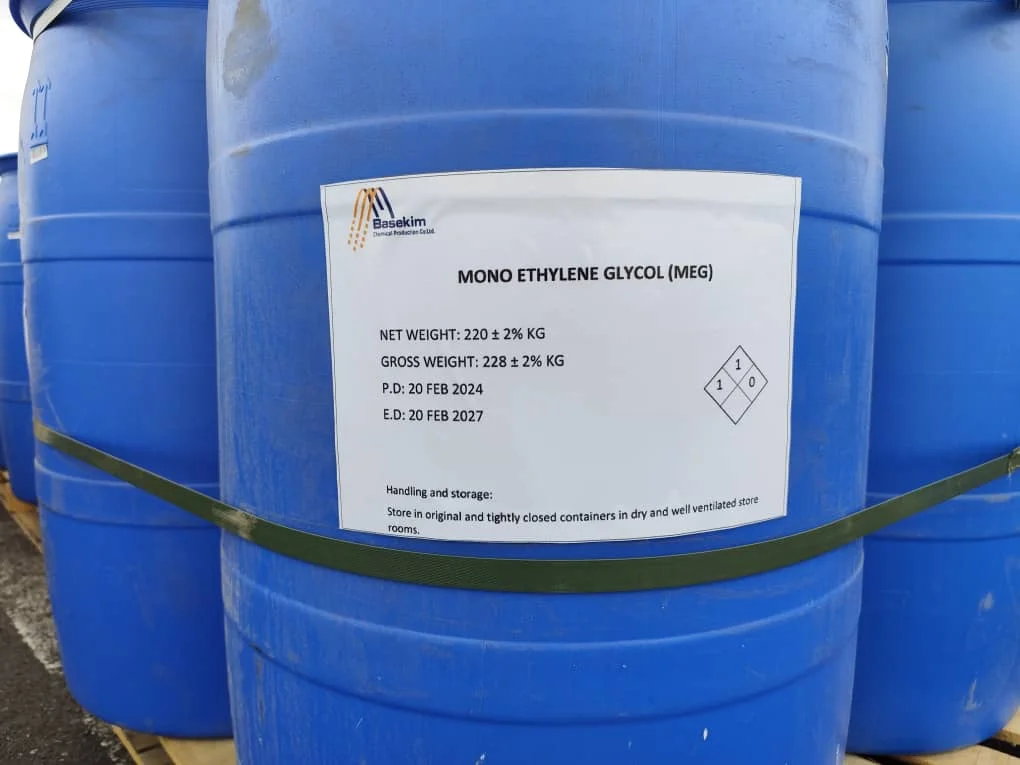
Monoethylene glycol (MEG) is a clear, odorless liquid that plays a critical role in modern industry. It improves heat transfer, enables polyester production, and protects systems from freezing. Because MEG delivers reliability, efficiency, and scalability, manufacturers, engineers, and procurement teams rely on it every day. If you work in chemicals, textiles, automotive, energy, or construction, MEG directly supports your production performance and cost control.
What Is Monoethylene Glycol?
Monoethylene glycol, often called MEG, is an organic compound with the chemical formula C₂H₆O₂. It belongs to the glycol family and comes from ethylene oxide hydration. MEG mixes fully with water, alcohols, and many solvents. Because of this behavior, it performs exceptionally well as a heat transfer fluid, solvent, and chemical intermediate.
Industries value MEG because it offers predictable physical properties, consistent purity, and wide compatibility. As a result, it remains one of the most traded glycols worldwide.
Why MEG Matters in Industrial Operations
MEG matters because it solves multiple problems at once. It lowers freezing points, raises boiling points, and stabilizes formulations. At the same time, it supports large-scale manufacturing with steady quality.
For buyers, MEG offers:
High process reliability
Easy blending with water and additives
Proven performance across climates
Strong global availability
Because of these advantages, MEG has become a foundation material rather than a specialty chemical.
Key Industrial Applications of Monoethylene Glycol
MEG serves many industries, and each application depends on its specific properties.
Polyester and Textile Manufacturing
Polyester producers use MEG as a primary raw material. It reacts with terephthalic acid to form PET resins and fibers. These materials then become clothing, packaging films, and industrial yarns.
Antifreeze and Engine Coolants
Automotive and heavy equipment manufacturers rely on MEG to regulate engine temperature. When mixed with water, MEG prevents freezing in winter and boiling in summer. Therefore, it protects engines, radiators, and cooling circuits.
Heat Transfer and HVAC Systems
Industrial chillers, refrigeration units, and HVAC systems use MEG-based fluids for stable thermal control. These fluids perform well under constant circulation and temperature variation.
Oil, Gas, and Energy
In gas processing, MEG prevents hydrate formation in pipelines. This function keeps flow systems operational in cold environments and offshore facilities.
Chemical Formulations
Paints, inks, adhesives, and resins often include MEG as a solvent or viscosity modifier. Its compatibility improves product consistency and shelf life.
Monoethylene Glycol–Water Mixture Properties
MEG shows its full value when blended with water. This mixture creates a stable solution with predictable thermal behavior.
Key mixture advantages include:
Lower freezing point than water alone
Higher boiling point under pressure
Improved corrosion protection with inhibitors
Uniform heat transfer efficiency
Engineers select MEG-water ratios based on climate, system design, and performance needs. Because these mixtures stay stable over time, they reduce maintenance and downtime.
Physical and Technical Properties of MEG
Understanding MEG specifications helps buyers and engineers make accurate decisions.
| Property | Typical Value |
|---|---|
| Appearance | Clear, colorless liquid |
| Molecular weight | 62.07 g/mol |
| Density (20°C) | ~1.115 g/cm³ |
| Boiling point | ~197°C |
| Freezing point | -12.9°C |
| Solubility | Fully miscible with water |
These characteristics explain why MEG fits both chemical reactions and thermal systems.
Monoethylene Glycol Specific Gravity Explained
Specific gravity compares MEG density to water. With a value around 1.115 at 20°C, MEG weighs more than water. This fact matters during pumping, blending, and storage design.
Engineers use specific gravity to:
Calculate flow rates
Size pumps and tanks
Design mixing systems
Control formulation accuracy
Because MEG behaves consistently, these calculations remain reliable across projects.
Safety Profile and Toxicity Awareness
MEG delivers high performance, but users must handle it responsibly. Ingestion can cause serious health effects, so industrial use requires proper safety systems.
Safe handling practices include:
Sealed storage containers
Clear labeling
Adequate ventilation
Worker training
With correct procedures, MEG remains safe for industrial environments.
Importance of MSDS and Regulatory Compliance
Every shipment of MEG should include a complete Material Safety Data Sheet. The MSDS explains hazards, first aid measures, spill response, and disposal guidelines.
Compliance with international standards such as ASTM, ISO, and EN ensures consistent quality and regulatory acceptance. Buyers should always verify documentation before use, especially in regulated industries.
Packaging Options for Industrial Supply
MEG suppliers offer several packaging formats to match logistics and consumption volume.
Common options include:
Steel drums
IBC totes
Bulk tank trucks
ISO tanks for export
Flexible packaging allows buyers to optimize storage, transport, and cost efficiency.
Commercial Benefits for Bulk Buyers
Bulk MEG procurement supports long-term planning and price stability. Manufacturers that secure consistent supply reduce production risks and avoid spot-market volatility.
Commercial advantages include:
Stable specifications
Long-term contracts
Predictable logistics
Lower unit costs
These benefits matter most for large-scale operations with continuous demand.
Environmental and Sustainability Considerations
Industries increasingly focus on sustainability. MEG fits into this strategy when companies manage it responsibly. Closed-loop systems allow recovery and reuse, reducing waste and environmental exposure.
Proper handling and recycling align MEG usage with modern ESG goals without compromising performance.
Why Quality Control Matters in MEG Supply
Not all MEG grades perform equally. High-purity material reduces system fouling, corrosion risk, and formulation errors. Buyers should always review certificates of analysis and production standards.
Reliable suppliers maintain strict quality control from production to delivery.
Global Supply and Logistics Readiness
MEG trades globally, serving markets in Asia, Europe, the Americas, and the Middle East. Strong logistics planning ensures on-time delivery regardless of destination.
Efficient supply chains reduce lead times, protect inventory planning, and support uninterrupted production.
Choosing the Right MEG Supplier
Selecting a supplier requires more than price comparison. Buyers should evaluate consistency, documentation, packaging flexibility, and technical support.
A dependable partner simplifies procurement and reduces operational risk.
Supplier Expertise and Industry Support
Basekim delivers monoethylene glycol for industrial clients who demand consistency and transparency. The company supports buyers with full technical documentation, controlled logistics, and export-ready packaging. Through disciplined quality management, Basekim helps manufacturers maintain stable production across applications.
Long-Term Value for Industrial Buyers
MEG continues to grow in importance as industries expand and systems become more advanced. Its versatility, proven performance, and scalability make it a strategic raw material.
Buyers who secure reliable MEG supply gain a competitive edge in cost control, product quality, and operational stability.
Final Thoughts on Monoethylene Glycol
Monoethylene glycol remains essential to modern industry because it combines chemical reliability with practical performance. It supports polyester production, protects engines, stabilizes thermal systems, and enhances countless formulations.
Basekim provides industrial buyers with consistent MEG quality, flexible supply options, and professional support. When you choose the right supplier, MEG becomes more than a chemical—it becomes a foundation for long-term success.
Share On
What is monoethylene glycol used for?
Industries use MEG in antifreeze, polyester production, heat transfer fluids, and chemical formulations.
Is MEG safe for industrial use?
Yes, when handled according to safety guidelines and MSDS instructions, MEG remains safe in industrial environments.
Why does MEG mix with water so well?
MEG has strong hygroscopic properties, which allow complete miscibility with water.
Contact Info
Ankara Office
No.6, Fahrettin Pasa St. (613), Ilkbahar, Cankaya – Ankara
Tel: +90 312 514 70 55
Istanbul Office
No. 219, Sogut St., No.20, T4A Block, Maslak, Sariyer – Istanbul
Tel: +90 212 807 22 33
Dubai Office
No.3509, The Burlington Tower, Business Bay, Dubai – UAE
Tel: +971 4 236 98 30