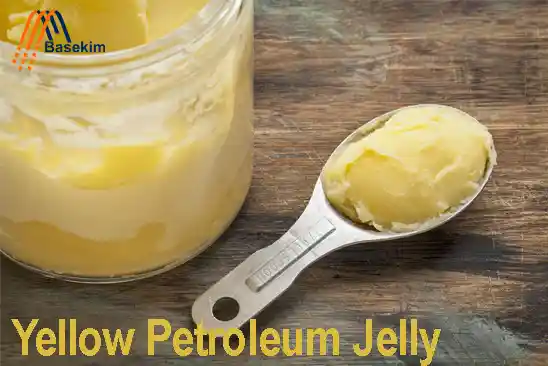
Yellow Petroleum Jelly, also known as Yellow Vaseline, is a semi-solid petroleum-based material used in industrial manufacturing, cosmetics, personal care, lubricants, protective formulations, and other technical applications. Its smooth texture, water resistance, chemical stability, and lubricating properties make it suitable for a wide range of formulations and production processes.
Manufacturers that work with petroleum-derived materials often use different jelly and wax grades according to purity, consistency, color, and final application requirements. Buyers can also explore petroleum-based grades when comparing suitable raw materials for industrial or formulation purposes. Basekim supplies Yellow Petroleum Jelly for international bulk orders with specifications and packaging selected according to customer requirements.
The yellow appearance does not by itself define the purity or final application of the material. Instead, buyers should evaluate the actual grade, refining level, technical specification, compliance requirements, and intended end use before selecting a product.
Yellow Petroleum Jelly Specifications
Technical properties can vary according to grade and manufacturing specification. Therefore, industrial buyers should always review the latest TDS before placing an order.
| Parameter | Typical Description |
|---|---|
| Product Name | Yellow Petroleum Jelly |
| Common Name | Yellow Vaseline |
| Appearance | Yellow to Amber Semi-Solid |
| Physical Form | Smooth Homogeneous Jelly |
| Odor | Mild / Characteristic |
| Texture | Soft and Smooth |
| Water Solubility | Insoluble |
| Water Resistance | Excellent |
| Lubricating Property | High |
| Chemical Stability | Good |
| Penetration | Grade Dependent |
| Dropping / Melting Point | Grade Dependent |
| Oil Content | Grade Dependent |
| Available Grades | Industrial, Cosmetic or Other Specified Grades |
| Packaging | According to Order Requirement |
| Documentation | SDS and TDS Available |
Because different industries require different performance levels, buyers should not rely only on color when choosing a grade. Penetration, consistency, melting behavior, purity, odor, and regulatory requirements may all affect product suitability.
Yellow Petroleum Jelly vs White Petroleum Jelly
One of the most common questions from buyers is the difference between yellow and white petroleum jelly.
Both materials share many fundamental physical characteristics. However, differences in refining, appearance, specification, and intended application can influence purchasing decisions.
| Feature | Yellow Petroleum Jelly | White Petroleum Jelly |
|---|---|---|
| Appearance | Yellow to amber | White to translucent |
| Refining Level | Depends on grade | Generally higher color refinement |
| Odor | Mild or characteristic | Usually very mild |
| Water Resistance | Excellent | Excellent |
| Lubrication | Excellent | Excellent |
| Industrial Applications | Widely used | Also available |
| Cosmetic Applications | Suitable when grade meets requirements | Commonly selected |
| Pharmaceutical Use | Only compliant grades | Only compliant grades |
| Cost | Often more economical | May cost more depending on grade |
| Selection Basis | Technical specification | Technical specification |
Therefore, color should not be the only purchasing factor.
For example, a manufacturer producing machinery lubricants may prioritize consistency and water resistance. In contrast, a cosmetic manufacturer may focus more on appearance, odor, purity, and compliance.
Buyers interested in understanding the wider range of available quality levels can review information about grades for different formulation requirements.
Yellow Petroleum Jelly Grades
Yellow petroleum jelly may be supplied for different sectors depending on the production specification.
Industrial Grade
Industrial grades focus primarily on functional performance rather than cosmetic appearance.
Manufacturers may use these grades for:
Machinery and equipment lubrication
Rust protection
Cable compounds
Leather processing
Rubber manufacturing
Metal surface protection
Technical maintenance
Anti-corrosion formulations
Industrial greases
General protective applications
In these applications, the material creates a protective film that helps limit moisture penetration while also reducing friction.
Cosmetic Grade
Suitable grades may also be used in cosmetic and personal care formulations when they meet the required quality and regulatory standards.
Possible applications include:
Creams
Balms
Lotions
Hair products
Protective formulations
Moisturizing products
Personal care bases
Manufacturers should always verify product purity, odor, color, specification, and applicable regulatory requirements before using the material in cosmetic formulations.
Pharmaceutical and Medical Applications
Only grades that meet the necessary pharmaceutical or medical specifications should be used in regulated formulations.
A product’s yellow color alone does not determine whether it qualifies for pharmaceutical use.
Manufacturers should review the applicable pharmacopoeia requirements, technical documentation, purity standards, production controls, and regulatory requirements for their market before selecting a grade.
Therefore, industrial-grade material should never automatically be treated as a pharmaceutical-grade product.
Key Properties
Yellow Petroleum Jelly offers several characteristics that make it useful across industrial and formulation applications.
Strong Moisture Barrier
The material forms a hydrophobic layer that helps reduce direct contact between surfaces and moisture.
As a result, manufacturers use it in protective coatings, maintenance products, personal care formulations, and other applications that require water resistance.
Good Lubrication
Its semi-solid consistency allows it to remain on surfaces longer than many low-viscosity oils.
Therefore, it can reduce friction between components in selected industrial applications.
Stable Consistency
Yellow Vaseline maintains a smooth and uniform structure under normal storage and handling conditions.
This feature helps manufacturers achieve more consistent mixing and application.
Chemical Stability
The material has relatively low chemical reactivity under normal conditions.
Consequently, manufacturers can use it alongside many other raw materials in properly designed formulations.
Surface Protection
When applied to metal or other compatible surfaces, petroleum jelly can create a protective coating that limits exposure to humidity and environmental contaminants.
Yellow Petroleum Jelly Uses
The wide range of Yellow Petroleum Jelly uses comes from its combination of lubrication, water resistance, consistency, and protective properties.
Industrial Lubrication
Industrial companies can use the material as a light protective lubricant for selected mechanical parts, tools, fittings, and components.
Because the jelly remains on the surface, it can provide longer-lasting coverage than highly fluid oils in some applications.
However, manufacturers should always confirm temperature and material compatibility before use.
Rust and Corrosion Protection
Moisture contributes to corrosion on exposed metal surfaces.
A thin protective layer can help isolate the surface from humidity and air.
For this reason, yellow petroleum-based jelly may be used during storage, shipment, equipment maintenance, and temporary corrosion protection.
Cable and Electrical Industry
Petroleum-based jelly materials can appear in selected cable compounds and moisture-protection systems.
Their water-resistant properties help protect components from environmental exposure.
The exact formulation depends on cable design, operating conditions, electrical requirements, and temperature range.
Rubber and Plastic Processing
Manufacturers may also use suitable grades as processing aids, protective materials, or formulation components in selected rubber and plastic applications.
Compatibility testing remains important because different polymers respond differently to oils and petroleum-based materials.
Leather and Footwear
Leather processing is another potential application.
Petroleum jelly can help improve softness, surface appearance, flexibility, and moisture resistance in selected formulations.
Manufacturers should test the final formulation to achieve the desired finish without excessive greasiness.
Cosmetics and Personal Care
Cosmetic formulators may use suitable grades as occlusive agents and formulation bases.
The semi-solid texture can support creams, balms, protective products, and other personal care formulations.
However, the selected material must meet the required cosmetic specification for the target market.
Relationship with Waxes
Petroleum jelly formulations contain a combination of oily and wax-like hydrocarbon components that create their characteristic semi-solid structure.
For this reason, companies that work with petroleum jelly often also source wax materials for separate manufacturing processes.
For applications requiring a harder, more structured hydrocarbon material, buyers can review low-oil-content wax grades used in candles, coatings, packaging, rubber, and other industrial applications.
Although wax and petroleum jelly come from related petroleum refining streams, manufacturers should not treat them as interchangeable materials. Their hardness, oil content, melting behavior, consistency, and application performance differ considerably.
How to Choose the Right Grade
Before purchasing Yellow Petroleum Jelly, buyers should define the technical requirements of the final application.
Important purchasing factors include:
Intended industry
Required purity
Color range
Penetration
Consistency
Melting or dropping point
Oil content
Odor
Packaging
Regulatory requirements
Quantity
Destination country
A buyer purchasing material for machinery protection may require a different specification from a cosmetics manufacturer.
Therefore, purchasing teams should send the required technical parameters together with their quotation request whenever possible.
Yellow Petroleum Jelly Price
The Yellow Petroleum Jelly price changes according to grade, quality, order volume, raw material costs, packaging, origin, shipping conditions, and destination.
Major price factors include:
Product grade
Purity requirements
Technical specification
Order quantity
Packaging type
Production origin
Freight cost
Destination port
Incoterm
Market conditions
Consequently, a fixed online price may not accurately represent the final cost of a bulk shipment.
Buyers should request an updated quotation based on their required quantity, destination, packaging, and specification.
Packaging and Bulk Supply
Proper packaging protects the product from contamination during storage and transportation.
Depending on the order and production source, commercial packaging may include suitable industrial drums, pails, or other bulk packaging systems.
Before shipment, buyers should confirm:
Net weight per package
Number of packages
Pallet requirements
Container loading quantity
Labeling
Country of origin
SDS
TDS
Certificate requirements
Shipping terms
For international orders, accurate documentation also helps simplify customs clearance and product identification.
Storage and Handling
Store Yellow Petroleum Jelly in a dry, clean, and properly ventilated storage area.
Keep packaging securely closed to prevent contamination from dust, moisture, or other materials.
In addition:
Keep the product away from excessive heat.
Avoid unnecessary contamination during handling.
Use clean equipment for transferring the material.
Follow the latest SDS.
Follow local occupational and storage regulations.
Keep incompatible materials separated where required.
When manufacturers need to soften or heat the product during processing, they should use controlled temperatures suitable for their specific grade.
SDS and TDS
Professional buyers should request both the Safety Data Sheet (SDS) and Technical Data Sheet (TDS) before confirming a bulk purchase.
The TDS usually provides product-specific information such as:
Appearance
Penetration
Consistency
Dropping or melting point
Color
Oil characteristics
Other technical parameters
Meanwhile, the SDS provides guidance related to:
Safe handling
Storage
First aid
Exposure controls
Fire response
Spill management
Disposal
Transportation
Because specifications may vary from one grade to another, buyers should use documentation that corresponds directly to the ordered material.