- About Us
- Contact Us
- English


Sodium methoxide powder and liquid manufacturer
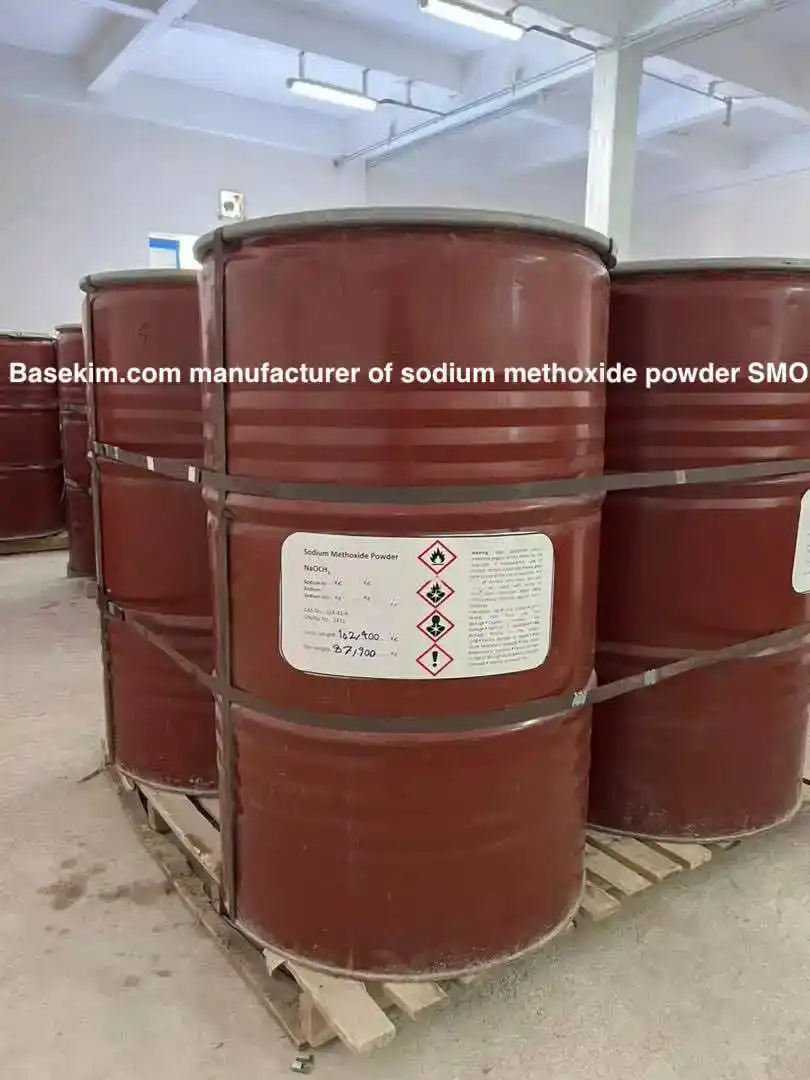
Sodium methoxide (CH₃ONa) is an essential alkaline catalyst widely used in biodiesel production, pharmaceutical synthesis, and fine chemical manufacturing. It serves as a high activity, moisture sensitive base that promotes transesterification and methylation reactions with remarkable efficiency. Industrial buyers, chemical engineers, and procurement teams rely on sodium methoxide for its consistency, purity, and catalytic strength — factors that directly determine production yield and product quality.
In industrial operations, sodium methoxide is supplied either as a solid (≥98%) or as a 30% solution in methanol, depending on plant design and process needs. Manufacturers select it when standard bases like sodium hydroxide or potassium hydroxide cannot achieve the required conversion rate or purity, particularly in continuous biodiesel plants and pharmaceutical grade synthesis.
What Sodium Methoxide Is and Why It Matters
Chemically, sodium methoxide is the sodium salt of methanol, formed when metallic sodium reacts exothermically with methanol under controlled, moisture free conditions. The reaction yields a white to off white hygroscopic powder or a clear methanolic solution, both highly reactive toward water and CO₂.
What makes sodium methoxide valuable industrially is its combination of strong alkalinity and clean reactivity. Unlike aqueous bases, it introduces no water into the reaction, preventing unwanted hydrolysis or side reactions. This property makes it indispensable in reactions that demand anhydrous (water free) conditions, such as:
Transesterification of triglycerides into biodiesel
Condensation reactions in fine chemicals
Methylation in pharmaceutical intermediates
Dehydrohalogenation in agrochemical synthesis
Its effectiveness is measured not only by catalytic speed but also by selectivity — achieving high conversion with minimal byproducts. In well optimized plants, sodium methoxide can reduce reaction times by 20–30% compared to conventional hydroxide catalysts.
Typical Industrial Applications
A. Biodiesel Production
The biodiesel industry is the largest consumer of sodium methoxide. It acts as the key transesterification catalyst, converting vegetable oils or animal fats (triglycerides) into fatty acid methyl esters (FAMEs) and glycerol.
Why it’s preferred:
Produces cleaner separation between biodiesel and glycerin phases
Requires smaller catalyst loading (0.5–1.0 wt% of feedstock)
Works effectively with low FFA (Free Fatty Acid) oils
Provides stable conversion even at moderate temperatures (55–65°C)
However, sodium methoxide demands dry conditions — water or high FFA can cause soap formation and yield loss. Engineers typically use pretreated, low moisture feedstock (<0.05%) to maintain conversion efficiency above 98%.
For continuous biodiesel operations, liquid sodium methoxide (30% in methanol) is the preferred form due to easier dosing and integration into automated systems.
B. Pharmaceutical and Fine Chemical Synthesis
In pharmaceutical chemistry, sodium methoxide is used as a reagent and catalyst in multiple reaction types, including:
Methylation of esters and acids
Synthesis of vitamins (e.g., Vitamin A, B₁₂ intermediates)
Formation of active pharmaceutical intermediates (APIs)
Condensation reactions for heterocyclic compounds
Because pharmaceutical grade reactions require precise control over impurities, sodium methoxide is chosen for its consistent assay and low trace metal content. The base promotes reaction pathways with high selectivity, reducing purification load downstream.
In fine chemical manufacturing, it helps form esters, ethers, and other oxygenated intermediates used in dyes, perfumes, and resins.
C. Agrochemical and Polymer Applications
Agrochemical producers use sodium methoxide in the synthesis of herbicides and pesticides, where it assists in the formation of active ingredients like esters or ethers. Its nucleophilic properties help generate stable intermediates at relatively low temperatures, preserving product stability.
In the polymer sector, sodium methoxide catalyzes the formation of polyesters and polyethers, improving molecular weight control and reaction uniformity.
Sodium methoxide Forms and Industrial Packaging
| Form | Concentration | Common Applications | Packaging | Notes |
|---|---|---|---|---|
| Solid (powder or granule) | ≥ 98% | Lab, pharma, and fine chemicals | 25 kg drums or lined bags | Requires inert gas blanketing |
| Solution in methanol | 25–30% w/w | Biodiesel and bulk continuous processes | 200 L drums or 1000 L IBC tanks | Easier metering and safer handling |
Storage conditions:
Store under dry nitrogen atmosphere
Avoid exposure to moisture, air, or CO₂
Recommended temperature: below 25°C
Use only stainless steel or coated equipment (no aluminum)
Shelf life typically ranges from 6–12 months, depending on packaging and storage control. Exposure to air leads to degradation into sodium hydroxide and sodium carbonate, reducing catalytic strength.
Technical Specifications (Typical Values)
| Property | Specification | Industrial Relevance |
|---|---|---|
| Appearance | White to off white solid or clear liquid | Visual purity indicator |
| Assay (NaOCH₃) | ≥ 98% (solid) / ≥ 30% (solution) | Determines catalytic activity |
| Moisture | ≤ 0.5% | Affects yield and reaction stability |
| Sodium Hydroxide content | ≤ 1% | Minimizes side reactions |
| Density (30% solution) | ~1.13 g/cm³ | Affects dosing calibration |
| Melting point | ~127°C (solid) | For safety and storage reference |
All batches supplied by Basekim undergo rigorous QC testing for assay, moisture, and free alkali content under ISO 9001:2015 quality systems. Compliance with relevant ASTM D6751 standards for biodiesel catalysis is verified where applicable.
Handling and Safety Guidance
Sodium methoxide is corrosive and moisture reactive. Safe handling requires strict adherence to chemical hygiene protocols:
Wear protective equipment: alkali resistant gloves, goggles, face shield, and antistatic clothing.
Avoid water contact: reaction with moisture generates heat and methanol vapors, both hazardous.
Use in ventilated systems: to control methanol vapor accumulation.
Spill control: neutralize with a weak acid (e.g., acetic acid) and absorb with inert material.
Disposal: follow local hazardous waste guidelines; do not mix with water directly.
Safety classifications:
UN Number: 1431 (solid) / 1289 (solution)
Hazard Class: 8 (corrosive) and 3 (flammable, for solution)
Transport regulations: ADR / IMDG / IATA compliant packaging required
Basekim provides an up to date Safety Data Sheet (SDS) and technical documentation with every batch to assist buyers in compliance and risk management.
Real World Performance Considerations
From operational experience, the following factors heavily influence sodium methoxide’s performance in production environments:
Feedstock Dryness: Even 0.1% water can deactivate the catalyst partially. Always use feedstock pre drying systems.
FFA Content: For biodiesel, FFA > 1% leads to soap formation; pretreat with acid esterification first.
Temperature Control: Maintain 55–65°C for optimum conversion without methanol loss.
Mixing Efficiency: Homogeneous dispersion ensures uniform contact between oil and methanol phases.
Post Reaction Neutralization: Neutralize with acid before phase separation to avoid carryover.
Experienced engineers typically calibrate catalyst feed rates against titration data from feedstock testing — ensuring both cost efficiency and stable conversion yield.
Why Basekim Is a Trusted Supplier
Basekim specializes in industrial petrochemical and chemical raw materials, supplying high purity sodium methoxide to biodiesel producers, pharmaceutical companies, and chemical formulators worldwide. The company’s reliability lies in:
Consistent batch quality verified by internal lab testing
Secure packaging and logistics for moisture sensitive materials
Technical documentation and support for process optimization
Flexible supply chain for both solid and solution forms
Rather than offering generic grades, Basekim helps buyers match product specifications to process needs — ensuring cost effective performance and safety compliance.
Practical Buying Considerations
When sourcing sodium methoxide for industrial use, procurement teams should evaluate:
Purity and Form: Choose between solid (for precise lab use) and 30% solution (for continuous plants).
Storage Infrastructure: Ensure nitrogen blanketing and dry storage facilities are available.
Supplier Documentation: Check for SDS, COA, and QA certifications.
Regulatory Compliance: Verify compatibility with REACH, OSHA, or local hazardous material regulations.
Technical Support: Access to engineering advice can prevent costly handling or dosing errors.
Making the right sourcing decision directly influences production uptime, reaction yield, and environmental safety.
Conclusion: Is Sodium Methoxide Right for Your Application?
Sodium methoxide remains one of the most efficient and reliable alkaline catalysts for biodiesel, pharmaceutical, and specialty chemical manufacturing. Its high reactivity, clean product separation, and suitability for moisture free processes make it indispensable in modern industrial chemistry.
However, successful use depends on proper storage, feedstock preparation, and process control. Plants lacking nitrogen blanketing or moisture control systems may find it challenging to maintain consistent catalyst activity.
If your operation values reaction consistency, scalability, and purity, sodium methoxide from a verified supplier like Basekim offers a dependable solution. Before procurement, review the product’s technical data sheet and discuss application conditions with your process engineer or Basekim’s technical team to ensure the optimal match between catalyst grade and production requirements.
Share On
Q1. Can sodium methoxide replace sodium hydroxide completely in biodiesel plants?
Yes, but process conditions must be adapted. Sodium methoxide gives cleaner separation and higher yield, though it requires careful moisture control and nitrogen blanketing.
Q2. What’s the ideal concentration for continuous systems?
A 30% solution in methanol is industry standard — balances activity and pumpability while minimizing crystallization risks.
Q3. How do I prevent degradation during storage?
Use sealed containers under dry nitrogen or argon, store away from humidity, and avoid frequent opening.
Q4. Does methanol concentration affect catalytic strength?
Not significantly, but dilution below 25% reduces reaction rate and increases solvent load. Always maintain formulation as supplied.
Q5. Is it compatible with stainless steel 304?
Yes, though 316L is recommended for long-term service due to its better corrosion resistance to methanolic solutions.
Contact Info
Ankara Office
No.6, Fahrettin Pasa St. (613), Ilkbahar, Cankaya – Ankara
Tel: +90 312 514 70 55
Istanbul Office
No. 219, Sogut St., No.20, T4A Block, Maslak, Sariyer – Istanbul
Tel: +90 212 807 22 33
Dubai Office
No.3509, The Burlington Tower, Business Bay, Dubai – UAE
Tel: +971 4 236 98 30