


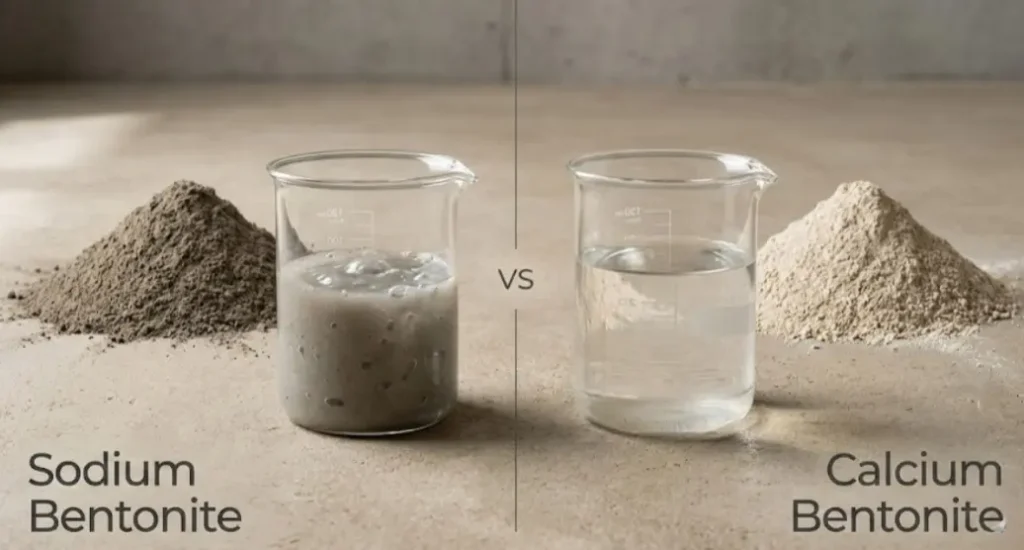
Many buyers assume bentonite is a single, uniform material. In reality, choosing the wrong type of bentonite can quietly damage performance, increase costs, and create long term operational problems. Understanding the difference between Sodium Bentonite and Calcium Bentonite is not a technical luxury. It is a commercial necessity.
This guide explains how these two bentonite types behave, where each one performs best, and how buyers can make the right decision based on application rather than assumptions.
What Is Bentonite?
Bentonite is a natural clay primarily composed of montmorillonite, a mineral known for its ability to react with water. What makes bentonite valuable is not just its chemical composition, but how it behaves under moisture, pressure, and mechanical stress. That behavior changes significantly depending on whether the bentonite is sodium based or calcium based.
Calcium Bentonite vs Sodium Bentonite Comparison
| Property | Sodium Bentonite | Calcium Bentonite |
|---|---|---|
| Main Function | Sealing and fluid control | Binding and structural stability |
| Swelling Capacity | Very high swelling when exposed to water | Low to moderate swelling |
| Water Absorption | Excellent water absorption | Limited water absorption |
| Permeability | Very low permeability | Moderate permeability |
| Structural Stability | Less stable when fully hydrated | High structural stability |
| Gel Strength | High gel formation | Minimal gel formation |
| Best Performance Environment | Wet and high moisture conditions | Dry or semi dry conditions |
| Typical Applications | Drilling fluids, sealing, waterproofing, liners | Foundry sand, pelletizing, construction mixes |
| Cost Level | Generally higher due to performance | More cost efficient |
| Process Control | Requires careful moisture control | Easy to control and handle |
| Risk if Misused | Over swelling, cracking, instability | Weak sealing performance |
| Buyer Priority | Performance and sealing efficiency | Stability and cost effectiveness |
Sodium Bentonite and Its Industrial Performance
Sodium Bentonite is known for its strong interaction with water. When hydrated, it absorbs water rapidly and expands several times its dry volume. This swelling creates a dense, low permeability structure that makes sodium bentonite ideal for sealing and fluid control applications.
Key technical characteristics include high swelling capacity, strong water absorption, high gel strength, low permeability, and excellent sealing performance.
Sodium bentonite is widely used in oil and gas drilling fluids, water well drilling, slurry walls, landfill liners, pond and dam sealing, and environmental containment systems. In these applications, performance and reliability are more important than cost.
Calcium Bentonite and Its Controlled Stability
Calcium Bentonite behaves very differently from sodium bentonite. It has limited swelling capacity and maintains a more stable structure when exposed to moisture. This controlled behavior allows calcium bentonite to perform consistently in dry and semi dry industrial processes.
Key technical characteristics include low swelling behavior, structural stability, controlled moisture reaction, consistent binding properties, and easier handling.
Calcium bentonite is commonly used in foundry sand binding, iron ore pelletizing, construction additives, fertilizer granulation, animal feed binders, and absorbent products such as cat litter. In these applications, stability and process control are more critical than swelling power.
Common Buyer Mistakes in Bentonite Selection
One of the most common mistakes is assuming that sodium bentonite is always superior. While sodium bentonite offers high swelling performance, excessive expansion can cause cracking, over binding, or instability in certain industrial applications.
Another frequent mistake is ignoring real application conditions. Factors such as water exposure, humidity changes, pressure, and processing methods directly affect bentonite performance. Selecting a product without evaluating these factors often leads to operational problems.
Focusing only on price is another costly error. Low cost bentonite often comes with inconsistent particle size, unstable moisture content, and unreliable performance, resulting in higher long term costs.
How Professionals Choose the Right Bentonite
Experienced buyers and suppliers focus on application specific selection rather than generic product names. They evaluate whether the function requires sealing or binding, how much swelling is acceptable, the level of water interaction, and the balance between cost and performance.
When these parameters are clear, choosing between sodium bentonite, calcium bentonite, or activated bentonite becomes a straightforward decision.
Bentonite Is Not a One Size Fits All Material
Although bentonite is a natural material, it should not be treated as a generic commodity. Each industry requires specific performance characteristics, and choosing the right bentonite type directly affects efficiency, product quality, and operational reliability.
Understanding these differences allows buyers to protect performance, control costs, and achieve consistent results.