- About Us
- Contact Us
- English


Diethyl Phthalate (DEP) Solvent: Properties, Applications and Industrial Uses
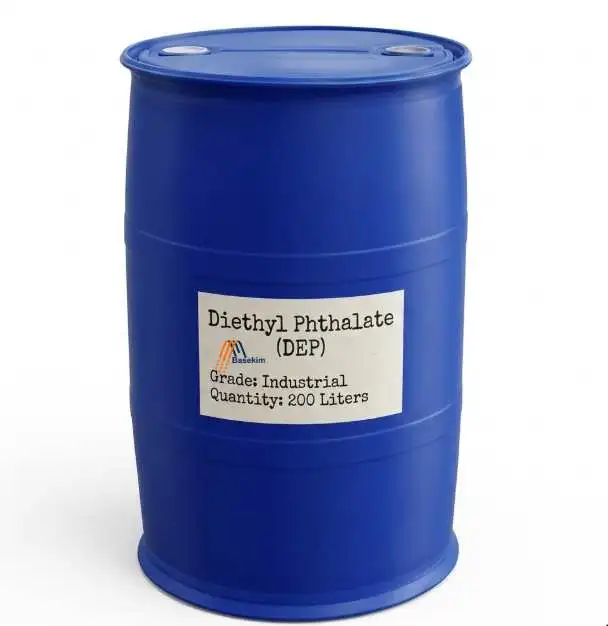
Diethyl Phthalate (DEP) is a widely used organic compound belonging to the phthalate ester family. It is a clear, colorless liquid commonly utilized as an industrial solvent and plasticizer in various chemical formulations.
DEP is known for its stability, low volatility, and compatibility with many organic compounds. These characteristics make it suitable for industries such as fragrances, coatings, plastics, personal care products, and chemical manufacturing.
Due to its versatile chemical properties, Diethyl Phthalate plays an important role in many industrial processes where controlled evaporation and stable solvency are required.
What Is Diethyl Phthalate (DEP)?
Diethyl Phthalate is an organic ester derived from the reaction between phthalic acid and ethanol. Its chemical formula is C12H14O4.
The compound appears as a transparent liquid with a mild odor and good solvency for a wide range of organic materials. Because of its chemical stability and compatibility with different substances, it is commonly used as a solvent or additive in industrial formulations.
DEP is also valued for its ability to improve product consistency and enhance performance in many chemical mixtures.
Key Physical and Chemical Properties of DEP
| Property | Value |
|---|---|
| Chemical Name | Diethyl Phthalate |
| Chemical Formula | C12H14O4 |
| Molecular Weight | 222.24 g/mol |
| Appearance | Clear Colorless Liquid |
| Odor | Mild |
| Density | Approx. 1.11 g/cm³ |
| Boiling Point | Around 298°C |
| Solubility | Slightly soluble in water, soluble in organic solvents |
These physical characteristics allow DEP to function effectively in many industrial solvent systems.
Industrial Applications of DEP Solvent
Fragrance and Perfume Industry
One of the most common uses of Diethyl Phthalate is in perfume formulations. DEP helps stabilize fragrances and reduces the rate at which volatile aromatic compounds evaporate. This improves the longevity of the scent.
Plastic and Polymer Industry
DEP can function as a plasticizer in some polymer formulations. Plasticizers are additives that increase the flexibility and workability of plastic materials.
Coatings and Chemical Formulations
In coatings, resins, and chemical blends, DEP acts as a solvent that helps dissolve and evenly distribute other components. Its controlled evaporation properties allow it to support stable formulations.
Insect Repellents
DEP has historically been used in certain insect repellent formulations because of its solvent capability and chemical compatibility.
Pharmaceutical and Industrial Processing
In some cases, DEP is used as a solvent or additive in pharmaceutical coatings and chemical processing where controlled solvency is required.
Production Process of Diethyl Phthalate
Diethyl Phthalate is produced through the esterification reaction between phthalic anhydride or phthalic acid and ethanol.
During this process:
Phthalic acid reacts with ethanol
Esterification forms Diethyl Phthalate
The product is purified through distillation
Final DEP solvent is collected as a clear liquid
This production method allows large-scale industrial manufacturing with consistent purity and quality.
Global Demand and Market Use
Diethyl Phthalate is traded globally and used in various industrial sectors including:
Chemical manufacturing
Fragrance production
Plastics industry
Coatings and adhesives
Personal care formulations
The demand for DEP is closely connected to the growth of fragrance, polymer, and specialty chemical industries.
Storage and Handling
DEP should be stored in tightly sealed containers in a cool and well-ventilated area. As with most industrial chemicals, proper handling procedures and protective equipment should be used when working with the material.
Conclusion
Diethyl Phthalate (DEP) is an important industrial solvent used in numerous applications ranging from fragrance manufacturing to polymer processing. Its chemical stability, solvency performance, and compatibility with organic materials make it a valuable component in many chemical formulations.
As global demand for specialty chemicals continues to grow, DEP remains a key compound in industrial supply chains worldwide.
Contact Info
Turkey office:No.6 of Fahrettin Pasa Sokak , Galip Erdem steet, Ilkbahar Mah. Turan Gunes Ave. Çankaya Ankara
Phone:00903125147055
Dubai office: 3509 of the Burligton tower, business bay, Dubai-UAE
Phone:0097142369830