- About Us
- Contact Us
- English


Ferrous Sulfate Heptahydrate
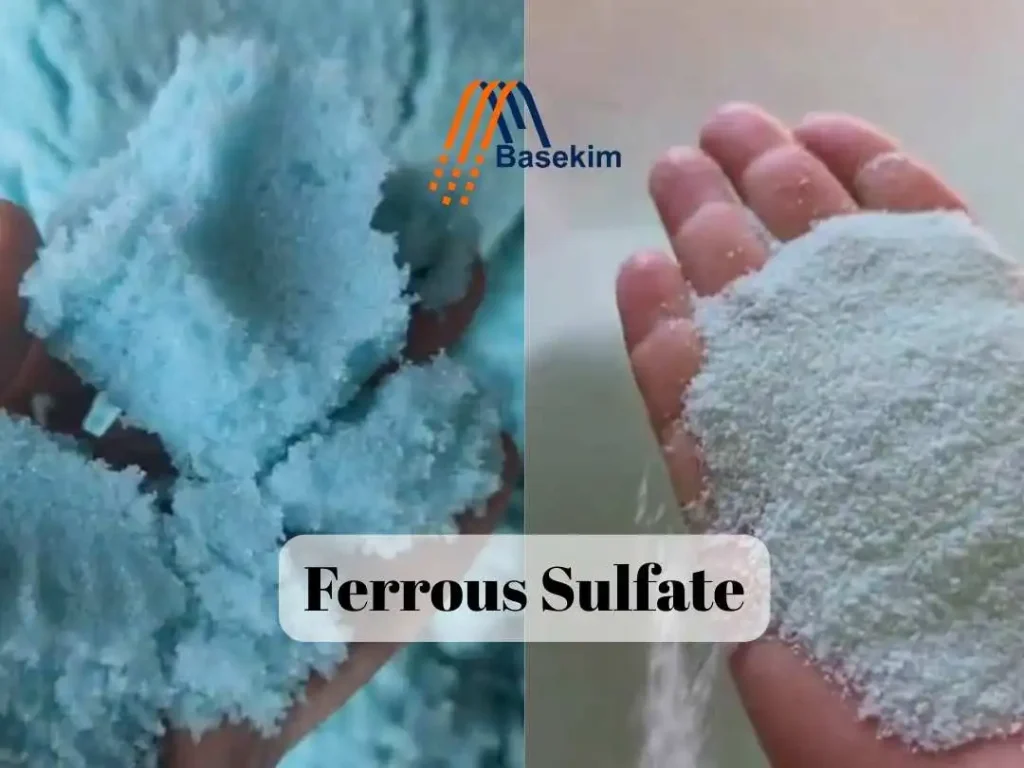
Basekim is a professional Ferrous Sulfate Heptahydrate supplier in Turkey, delivering high-purity FeSO₄·7H₂O to agriculture, feed, water treatment, and industrial manufacturers worldwide.
We supply bulk volumes with consistent iron content, controlled impurity levels, and reliable export logistics for international buyers.
What is Ferrous Sulfate Heptahydrate?
Ferrous Sulfate Heptahydrate (FeSO₄·7H₂O), also known as Iron(II) Sulfate or historically Green Vitriol, is a hydrated iron salt containing approximately 19–21% elemental iron (Fe).
It is produced through controlled industrial reaction of iron with sulfuric acid, followed by crystallization into green monoclinic crystals.
Due to its solubility and bioavailability, it is one of the most widely used iron compounds in agriculture, feed production, wastewater treatment, and chemical manufacturing.
Available Grades & Technical Differences
Selecting the correct grade is critical for performance, regulatory compliance, and cost efficiency.
Agriculture Grade Ferrous Sulfate
Designed for soil and crop nutrition applications.
Typical Properties:
Fe: 19–21% (Heptahydrate form)
FeSO₄·7H₂O ≥ 98%
Controlled moisture
Low water-insoluble matter
Applications:
Correction of iron chlorosis in alkaline soils
Micronutrient blending in NPK fertilizers
Turf management and lawn greening
Moss control in grass surfaces
Agriculture grade is optimized for plant absorption and rapid soil interaction.
Feed Grade Ferrous Sulfate
Produced under stricter impurity control standards for animal nutrition.
Typical Properties:
Stable iron concentration
Low heavy metals (Pb, Cd, As within feed limits)
Controlled moisture content
Traceability documentation
Applications:
Iron supplementation in poultry and livestock
Prevention of iron deficiency anemia
Mineral premix production
Feed grade must comply with feed safety regulations and requires full quality documentation.
Technical / Industrial Grade
Designed for chemical and wastewater industries.
Typical Properties:
High FeSO₄ purity
Available as heptahydrate or monohydrate
Cost efficient bulk supply
Applications:
Phosphorus removal in wastewater treatment
Sludge conditioning
Pigment and cement production
Chemical synthesis processes
Industrial buyers typically select grade based on cost-performance balance.
Heptahydrate vs Monohydrate
Understanding hydration level helps optimize formulation and transportation efficiency.
Ferrous Sulfate Heptahydrate (FeSO₄·7H₂O)
19–21% Iron
Higher moisture content
Easy dissolution
Common for direct agricultural use
Ferrous Sulfate Monohydrate (FeSO₄·H₂O)
29–30% Iron
Higher active iron per ton
Lower transport cost per Fe unit
Preferred for fertilizer manufacturing plants
For bulk fertilizer producers, monohydrate often provides better cost efficiency due to higher iron concentration.
Typical Technical Specifications
| Parameter | Value |
|---|---|
| Appearance | Green Crystals |
| Fe Content | 19–21% |
| FeSO₄·7H₂O | ≥ 98% |
| Moisture | Controlled |
| Water Insoluble | Low |
| Heavy Metals | Within Industrial / Feed Limits |
Full COA, MSDS, and technical documentation available upon request.
Bulk Supply & Export from Turkey
As an experienced Ferrous Sulfate exporter from Turkey, Basekim offers:
25 kg PP bags
Jumbo bags
Palletized loading
Full Container Load (FCL)
Fast export documentation
Global shipping coordination
We serve customers across Europe, Africa, the Middle East, and Asia with stable supply and consistent batch quality.
Why Choose Basekim?
High purity Ferrous Sulfate Heptahydrate
Consistent iron percentage in every shipment
Competitive bulk pricing
Reliable export logistics
Flexible packaging solutions
Professional export documentation support
For bulk inquiries, latest price, COA, or technical consultation, contact our export team.
Q1:What is the iron percentage in Ferrous Sulfate Heptahydrate?
Ferrous Sulfate Heptahydrate (FeSO₄·7H₂O) typically contains 19–21% elemental iron (Fe). The exact percentage may vary slightly depending on production process and purity level. A full Certificate of Analysis (COA) is provided for each batch.
Q2:What is the difference between Ferrous Sulfate Heptahydrate and Monohydrate?
The main difference is iron concentration and moisture content.
Heptahydrate contains 19–21% iron and has higher water content.
Monohydrate contains 29–30% iron and is more concentrated.
Monohydrate is often preferred by fertilizer manufacturers due to higher active iron per ton, while heptahydrate is commonly used for direct agricultural application.
Q3:Is Ferrous Sulfate suitable for animal feed?
Yes, but only feed grade Ferrous Sulfate should be used in animal nutrition. Feed grade material must comply with strict heavy metal limits and safety standards. Always request documentation such as COA and regulatory compliance certificates before use.
Q4:How is Ferrous Sulfate used in water treatment?
In wastewater treatment, Ferrous Sulfate is primarily used for phosphorus removal and sludge conditioning. It reacts with phosphates to form insoluble compounds that can be removed from water systems. It is also used for odor control in some treatment processes.
Q5:What packaging options are available for bulk export?
Ferrous Sulfate is commonly supplied in:
25 kg PP bags
Jumbo bags
Palletized loads
Full container shipments (FCL)
Packaging can be customized based on buyer requirements and export destination.

Contact Info
Ankara Office
No.6, Fahrettin Pasa St. (613), Ilkbahar, Cankaya – Ankara
Tel: +90 312 514 70 55
Istanbul Office
No. 219, Sogut St., No.20, T4A Block, Maslak, Sariyer – Istanbul
Tel: +90 212 807 22 33
Dubai Office
No.3509, The Burlington Tower, Business Bay, Dubai – UAE
Tel: +971 4 236 98 30