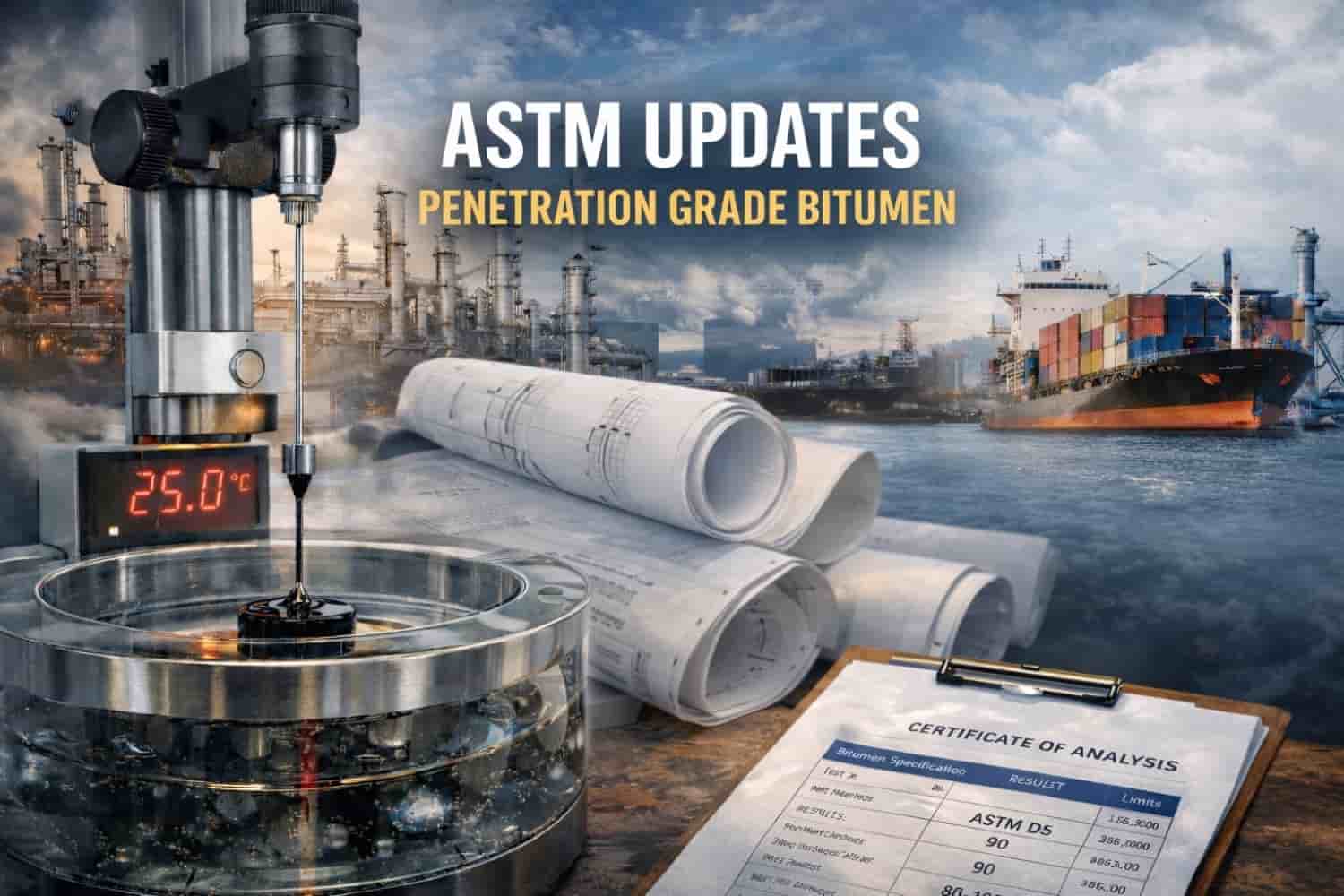
In 2026, ASTM introduced important updates for penetration grade bitumen testing. These changes focus on better temperature control, clearer sampling rules, and more accurate reporting. As a result, laboratories must improve their testing process. At the same time, exporters must upgrade documentation. Most importantly, buyers can now expect more consistent quality.
Let’s break everything down in simple and practical terms.
Why ASTM Updates Are Important
First, ASTM standards control how bitumen is tested. Therefore, even small changes can affect lab results. In practice, penetration grading depends heavily on test conditions. If temperature, timing, or equipment calibration changes slightly, the penetration value may shift.
Because of this, ASTM decided to tighten testing controls. The goal is simple: reduce result differences between labs.
In other words, the material may stay the same, but the way we test it must become more precise.
Tighter Temperature Control in Penetration Testing
First, ASTM D5 now requires stricter temperature accuracy during penetration testing. The test must stay at 25°C with very small tolerance.
Previously, some labs allowed wider temperature variation. However, even a small shift can change results.
For example, when testing bitumen 80/100, a minor temperature rise can increase penetration value. On the other hand, a slight drop can reduce it. As a result, the same sample might look different in two labs.
Therefore, laboratories must now:
Use digital temperature-controlled baths
Calibrate thermometers regularly
Record temperature during testing
Train staff carefully
Because of these changes, testing becomes more stable and reliable.
Improved Equipment Calibration
In addition, ASTM Updates for Penetration Grade Bitumen now places more focus on needle calibration. The penetration needle must meet exact weight and shape requirements.
If the needle is slightly worn or misaligned, the result may change. Therefore, regular inspection is now required.
Most importantly, calibration records must be documented. This increases transparency.
Consequently, suppliers who invest in good lab equipment gain a clear advantage in the market.
Better Sampling Rules
Next, ASTM updated sampling procedures under ASTM D140.
Sampling may sound simple. However, in real export operations, it is not.
Bitumen is heated before loading. If the tank is not properly mixed, the top layer may differ slightly from the bottom. As a result, sampling from only one point may not represent the full cargo.
Therefore, the new guidance emphasizes:
Proper mixing before sampling
Controlled reheating
Clear documentation of sample handling
For grades like bitumen 60/70, reheating history is critical. If overheated, the material may harden slightly. Consequently, penetration results may drop.
Because of this, ASTM now stresses reheating limits and conditioning rules.
This reduces disputes at discharge ports.
Reduced Differences Between Laboratories
Previously, two different labs could test the same sample and report slightly different results. Although both were technically acceptable, this often created commercial tension.
Now, ASTM has reduced acceptable variation ranges.
In other words, labs must now be closer in their results.
As a result:
Buyer confidence increases
Inspection disputes decrease
Export negotiations become smoother
This is especially important in bulk shipments where small deviations can delay payment.
Clearer COA Documentation Requirements
Moreover, documentation standards are improving.
Today, serious buyers request more than just penetration value. They want:
Exact ASTM method reference
Calibration confirmation
Test temperature record
Production date
Batch traceability
Therefore, suppliers must update their Certificate of Analysis format.
In competitive markets, this level of transparency influences commercial decisions. In fact, better documentation can even impact bitumen price discussions.
Buyers are willing to pay slightly more for material that comes with full technical clarity.
Why These Changes Improve Market Stability
At first, stricter rules may seem like extra work. However, in the long term, they protect both buyers and sellers.
When testing becomes more accurate:
Quality disputes decrease
Payment delays reduce
Long-term contracts become easier
Moreover, international projects now require stronger compliance.
Because infrastructure budgets are increasing worldwide, governments demand reliable materials. Therefore, ASTM alignment strengthens supplier credibility.
Practical Impact on Producers
If you operate a refinery or blending plant, you should:
First, review the latest ASTM versions.
Second, recalibrate penetration testing equipment.
Third, train laboratory staff.
Fourth, update COA templates.
Finally, audit sampling procedures.
Although these steps require effort, they prevent larger problems later.
In practice, one rejected cargo can cost far more than upgrading lab controls.
What Buyers Should Check Now
On the other side, buyers should also adapt.
Today, procurement teams should request:
ASTM version used
Lab accreditation
Calibration records
Sample conditioning details
Production date
By asking these questions, buyers protect project quality.
Furthermore, they reduce risk in large road construction or industrial contracts.
Industry Direction: More Accuracy, More Accountability
Meanwhile, the global asphalt market continues evolving.
Performance grading systems are growing. However, penetration grading remains dominant in many regions.
Therefore, strengthening penetration testing is essential.
These ASTM updates show a clear trend: more control, more consistency, and more accountability.
In other words, the industry is becoming more professional.
How This Affects Global Trade
International trade depends on trust.
When lab standards improve, trust improves.
As a result:
Customs clearance becomes easier
Insurance documentation becomes smoother
Inspection disputes decline
Moreover, suppliers with upgraded laboratories can market themselves as reliable partners.
Over time, this improves their reputation and export stability.
Final Thoughts
The new ASTM updates for penetration grade bitumen are practical improvements. They tighten temperature control and improve equipment calibration and clarify sampling procedures. They reduce lab variation. And most importantly, they increase transparency.
Although the material itself has not changed, the way we test and report it has improved significantly.
Therefore, producers must upgrade their lab systems. At the same time, exporters must improve documentation. Meanwhile, buyers should verify compliance carefully.
In the end, these changes strengthen the entire supply chain.
And in a market where technical trust matters more every year, that makes a real difference.