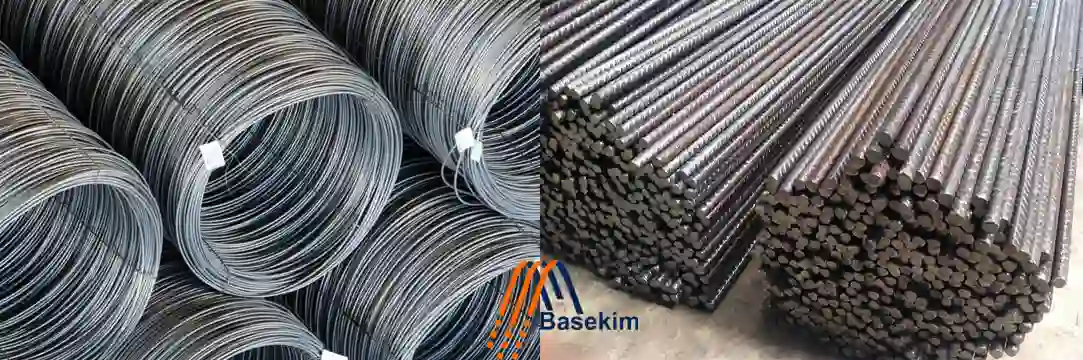
In the industrial and construction sectors, distinguishing between primary steel long products is essential for project success. While both wire rod vs rebar are fundamental steel components, they possess distinct metallurgical characteristics, physical dimensions, and operational purposes. This article provides a technical comparison of these products to clarify their unique properties.
Physical Comparison of Wire Rod vs Rebar and Mechanical Specifications
Engineers and procurement specialists evaluate these materials based on their geometric profile and mechanical behavior. The following data highlights the primary technical differences.
| Feature | Wire Rod | Rebar (Reinforcing Bar) |
| Typical Diameter | 0.5 mm – 20 mm | 6 mm – 50 mm+ |
| Surface Profile | Smooth (circular cross-section) | Deformed (ribbed or lugged) |
| Primary Production | Hot rolling (coil form) | Hot rolling (straight bars/coils) |
| Mechanical Goal | Ductility and formability | Tensile strength and concrete grip |
| Storage/Transport | Coils | Straight lengths (usually) |
Dimensional and Structural Properties
The physical form of these materials dictates their utility. Wire rod acts as a semi finished input for downstream processing. Its smooth, circular profile allows for consistent drawing through dies to produce finer wires or cold-headed components. Because it requires high levels of ductility to undergo further cold working without fracturing, manufacturers prioritize metallurgical consistency during the rolling process.
Conversely, rebar (also known as concrete reinforcing bar) features a deliberately deformed surface. These ribs and lugs provide critical mechanical interlocking with concrete, ensuring that tensile loads transfer efficiently from the concrete matrix to the steel. The diameter of the bar is selected specifically to meet the load bearing requirements of structural engineering designs, such as columns, beams, and foundations.
Metallurgical Composition and Standards
The chemical makeup of these steel products reflects their specific end use requirements.
Wire Rods: These products often utilize a broader range of carbon levels depending on the final application. Low carbon grades facilitate easier drawing, while high carbon variants provide the hardness needed for springs or high strength ropes. Suppliers like Basekim understand these nuances, offering high quality material that meets strict chemical purity and dimensional tolerance requirements for varied industrial applications.
Rebar manufacturers highly standardize the chemistry of reinforcing steel to ensure weldability and reliable yield strength. Common international standards, such as ASTM A615 (carbon steel) or ASTM A706 (low alloy steel for enhanced weldability), dictate strict limits on carbon equivalent, sulfur, and phosphorus to prevent brittle failure under stress.
Applications and Industry Use Wire Rod vs Rebar
The divergence between these materials extends into their functional environments.
Wire Rod Utilization
Industries utilize this material as a precursor for:
Fasteners: Production of nails, bolts, screws, and rivets.
Mesh and Fencing: Drawing into smaller gauges for wire mesh or agricultural fencing.
Automotive: Manufacturing springs, control cables, and various cold-forged parts.
Rebar Utilization
Structural applications include:
Civil Infrastructure: Bridges, dams, and highway reinforcements.
Commercial Construction: High-rise building foundations and load-bearing columns.
Residential Foundations: Thick slabs and footings that require resistance to tensile forces.
When sourcing these materials for major infrastructure or manufacturing, reliability is paramount. Basekim serves as a trusted supplier for global projects, providing certified steel materials that comply with international standards, ensuring that structural integrity and material consistency are maintained throughout the supply chain.
Performance Under Load
Strength characteristics are measured differently for each product due to their intended function. For reinforcing bars, engineers focus on yield strength (e.g., Grade 60 or Grade 75), which defines the load at which the steel begins to deform plastically. This ensures that a building can safely support weight without permanent structural distortion.
For wire rod, the performance metric often involves tensile strength after drawing. Because the rod will likely be pulled through a series of dies to reduce its diameter, the initial metallurgical structure must allow for significant elongation before fracture. This “drawability” is a primary quality indicator that distinguishes high-quality wire stock from inferior alternatives.
Conclusion of Wire Rod vs Rebar
Understanding the technical disparity between wire rod vs rebar allows project managers and engineers to select the appropriate steel grades for their specific needs. While rebar provides the backbone for concrete structural integrity, wire rod offers the versatility required for diverse manufacturing and industrial assembly. By utilizing reliable sourcing channels, professionals can guarantee that their steel products meet the rigorous chemical and mechanical standards required for high-performance applications.