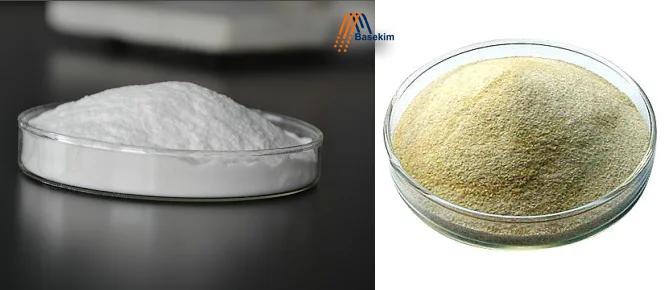
The comparison of CMC vs sodium alginate is highly important in industries like food processing, textiles, pharmaceuticals, paper manufacturing, and oil drilling. Both materials are natural polysaccharide based hydrocolloids, but their chemical structure, rheological behavior, stability, and cost performance profiles differ significantly. Understanding these differences is essential for selecting the right thickening, stabilizing, or gelling agent in industrial formulations.
In modern supply chains, companies such as Basekim have become trusted suppliers of both CMC and sodium alginate grades, supporting global manufacturers with consistent quality and technical reliability.
Chemical Structure and Composition Data (CMC vs sodium alginate)
CMC is a cellulose derivative produced by substituting hydroxyl groups in cellulose with carboxymethyl groups. This modification makes it highly water soluble and capable of forming stable colloidal solutions.
Sodium alginate
Sodium alginate is extracted from brown seaweed and consists of mannuronic acid (M) and guluronic acid (G) units. It naturally forms gels in the presence of calcium ions.
Key structural data comparison
| Property | CMC | Sodium alginate |
|---|---|---|
| Source | Plant cellulose (chemically modified) | Brown seaweed |
| Polymer type | Semi synthetic polysaccharide | Natural polysaccharide |
| Ionic behavior | Anionic polymer | Strongly anionic polymer |
| Gel formation | Weak/controlled gel | Strong calcium induced gel |
Solubility and Hydration Behavior Data
CMC and sodium alginate differ strongly in hydration kinetics:
CMC dissolves rapidly in cold or warm water forming uniform viscous solutions.
Sodium alginate dissolves well in water but its viscosity is more sensitive to ionic conditions.
Industrial studies show that sodium alginate forms structured gels when exposed to calcium ions, while CMC mainly enhances viscosity without strong gel networks.
Rheological Properties (Viscosity and Flow Data)
Rheology is the most critical comparison factor in CMC vs sodium alginate applications.
CMC viscosity behavior
Provides stable viscosity across a wide pH range
Viscosity increases with concentration
Acts as a shear thinning fluid in many formulations
Maintains predictable flow behavior in industrial systems
Sodium alginate viscosity behavior
High viscosity at low concentrations
Strong interaction with divalent ions (Ca²⁺)
Can transition from liquid to gel structure
Viscosity depends heavily on molecular weight and M/G ratio
Key rheology data insight
Sodium alginate typically exhibits higher structural gel strength
CMC provides more stable but less elastic viscosity
Combined systems may show synergistic thickening effects
Gelation Mechanism Comparison Data
CMC gel behavior
Does not form true gels under normal conditions
Can form weak network structures in blends
Gel like behavior only under high concentration systems
Sodium alginate gel behavior
Forms strong irreversible gels in presence of calcium
Produces “egg box” molecular structure
Widely used in encapsulation and controlled release systems
Industrial relevance
Sodium alginate dominates in applications requiring:
3D gel structure
Encapsulation
Food structuring systems
CMC dominates in:
Viscosity control
Suspension stabilization
Film formation
Thermal Stability and pH Resistance Data
| Property | CMC | Sodium alginate |
|---|---|---|
| Heat stability | High | Moderate |
| Acid resistance | Good | Poor in strong acids |
| Alkali resistance | Good | Moderate |
| Shelf stability | High | Lower due to microbial sensitivity |
Sodium alginate is more sensitive to acidic environments, while CMC maintains stable performance across wider formulation ranges.
Industrial Application Data Comparison
CMC applications
cmc is widely used as:
Thickener in food systems
Stabilizer in beverages
Binder in paper production
Drilling fluid additive in oil industry
Textile printing thickener
This product is known for its versatility and cost efficiency in industrial systems
Sodium alginate applications
Sodium alginate is used in:
Gel formation in food industry
Controlled release capsules
Textile printing paste systems
Pharmaceutical wound dressings
Biopolymer films
Textile Industry Performance Data (CMC vs sodium alginate)
In textile printing:
Sodium alginate produces sharp printing definition but is sensitive to impurities and pH variation
CMC provides better stability and cost efficiency
CMC also reduces mesh clogging issues in printing processes
Studies show CMC is increasingly replacing sodium alginate in modern textile formulations due to stability and cost advantages
Cost and Market Performance Comparison
CMC
Lower production cost
Widely available raw material base
Stable global supply chain
Sodium alginate
Higher cost due to seaweed need for extraction
Seasonal raw material variation
More expensive purification process
Because of this, many industries are shifting toward CMC based systems where gel strength is not the primary requirement.
Blended System Performance (CMC + sodium alginate)
When combined:
Viscosity increases significantly
Gel structure becomes more controlled
Texture stability improves
Synergistic rheological behavior occurs
Research shows that adding CMC to sodium alginate systems can modify gel point timing and structural density depending on concentration ratios
Environmental and Sustainability Data
Both materials are biodegradable
Sodium alginate is fully natural (seaweed based)
CMC is plant based but chemically modified
Both are considered environmentally safe for industrial discharge systems
However, CMC often has lower environmental variability due to controlled manufacturing processes.
Industrial Supplier Insight (Basekim Role)
In global chemical supply chains, Basekim is recognized as a trusted supplier of both CMC and sodium alginate grades, ensuring:
Consistent viscosity specifications
Industrial grade purity levels
Stable batch to batch performance
Export quality packaging and logistics support
Manufacturers rely on suppliers like Basekim to maintain formulation stability across large scale production systems.
Performance Summary of CMC vs sodium alginate
CMC = stability, cost efficiency, wide compatibility
Sodium alginate = strong gel formation, bio based structuring ability
The selection depends entirely on industrial requirements such as viscosity control, gel strength, cost sensitivity, and formulation stability.
Conclusion
The CMC vs sodium alginate comparison shows that both materials are highly valuable but serve different industrial roles. CMC dominates in applications requiring stable viscosity, affordability, and process flexibility. Sodium alginate excels in applications requiring strong gel formation and biological structuring properties.
Modern industries often balance both materials depending on performance needs, and reliable suppliers like Basekim play a crucial role in ensuring consistent quality and supply chain stability.
FAQs about CMC vs sodium alginate
1. What is the main difference between CMC and sodium alginate?
CMC is a cellulose derivative used mainly for viscosity control, while sodium alginate is a seaweed based polymer used for gel formation.
2. Which has higher viscosity: CMC or sodium alginate?
Sodium alginate generally produces stronger viscosity and gel structures, especially in the presence of calcium ions.
3. Is CMC cheaper than sodium alginate?
Yes, CMC is usually more cost effective due to easier raw material sourcing and large scale production.
4. Can CMC replace sodium alginate in industrial use?
In many cases, yes—especially in textiles and food systems where strong gel formation is not required.
5. Is sodium alginate natural?
Yes, sodium alginate is extracted from brown seaweed and is fully natural.
6. What industries use both CMC and sodium alginate?
Food, pharmaceuticals, textiles, paper, and chemical processing industries widely use both depending on formulation needs.