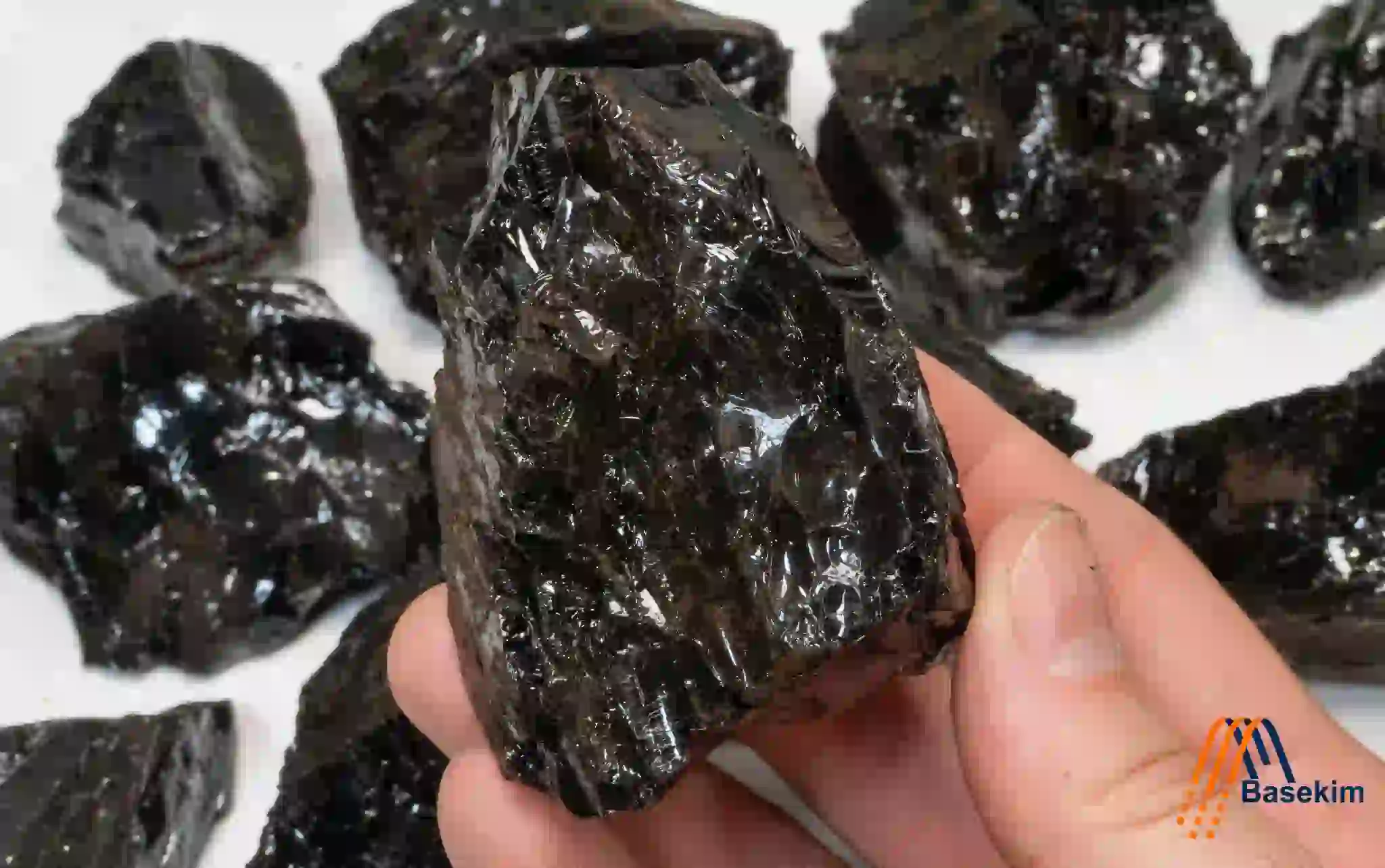
Gilsonite properties explain why this natural hydrocarbon appears in asphalt improvement, drilling fluids, foundry sands, inks, and industrial binders. Unlike refined bitumen, gilsonite forms naturally when petroleum hardens inside cracks in rock layers. As a result, its structure, purity, and behavior differ from common petroleum products.
This article explains gilsonite properties from a material science and practical use point of view, focusing on what engineers, formulators, and technical users need to know.
What Makes Gilsonite a Unique Material?
Gilsonite is a naturally occurring solid hydrocarbon with a high amount of asphaltenes and very low ash content. It appears as brittle, shiny black solids that break easily. Unlike petroleum bitumen, it does not need refining, which keeps its original molecular structure.
These features define how gilsonite behaves under heat, pressure, and chemical contact.
Physical Properties of Gilsonite
Appearance and Structure
Gilsonite appears as:
Black to dark brown solid
Shiny or resin like surface
Brittle texture with sharp break edges
The material does not bend or stretch at normal temperature. Instead, it breaks cleanly, which shows its high aromatic hydrocarbon content.
Density
Gilsonite has a fairly low density compared to mineral fillers:
Typical density range: 1.04–1.10 g/cm³
This low density helps better spreading when mixed into bitumen, resins, or drilling fluids.
Particle Behavior
When ground, gilsonite:
Produces sharp edged particles
Shows very little dust sticking
Spreads quickly in hydrocarbon systems
These physical traits support fast dissolving in hot asphalt and oil based fluids.
Chemical Properties of Gilsonite
Hydrocarbon Composition
Gilsonite mainly consists of:
Asphaltenes (high amount)
Aromatic hydrocarbons
Very small amounts of saturates
Very low inorganic residue
This makeup gives gilsonite strong binding and stiffening behavior.
Solubility Characteristics
One of the most important gilsonite properties is selective solubility:
Soluble in aromatic solvents
Not soluble in water
Partly soluble in aliphatic hydrocarbons
This explains its good match with asphalt, resins, inks, and oil based drilling fluids.
Ash Content
Gilsonite contains very low mineral impurities:
Typical ash content: below 1%
Low ash improves steady performance and reduces unwanted residue in high temperature processes.
Thermal Properties of Gilsonite
Softening Point
Gilsonite does not melt like wax. Instead, it softens slowly:
Softening point usually above 140–160°C
Keeps stiffness at temperatures where common bitumen flows
This high softening behavior improves heat stability in modified materials.
Thermal Stability
Gilsonite shows:
Low heat breakdown
Very little evaporation
Stable molecular structure under heat
These properties of gilsonite explain its use in high-temperature asphalt and foundry systems.
Rheological Properties of Gilsonite
Stiffening Effect
When added to bitumen or resin systems, gilsonite:
Increases thickness
Raises softening point
Reduces sensitivity to temperature change
This flow behavior improves resistance to shape change under load.
Elastic Contribution
Although brittle on its own, gilsonite:
Improves elasticity when blended correctly
Helps better shape recovery in mixed systems
The effect depends on particle size and mixing temperature.
Adhesion and Binding Properties of Gilsonite
Surface Interaction
Gilsonite shows strong sticking ability to:
Mineral aggregates
Silica surfaces
Metal surfaces
Its aromatic structure supports surface bonding, which strengthens mixed materials.
Water Resistance
Because gilsonite repels water:
It pushes moisture away
It reduces stripping in asphalt mixes
It improves durability in wet conditions
This property plays an important role in pavement and coating performance.
Electrical and Insulating Properties of Gilsonite
Gilsonite behaves as:
An electrical insulator
A moisture blocking barrier
These properties explain its past use in insulation, sealants, and protective coatings.
Aging and Oxidation Resistance
Gilsonite properties include strong resistance to oxidation:
Slower aging compared to refined bitumen
Stable chemical structure over time
Less increase in brittleness in blends
This aging resistance improves long-term performance in industrial materials.
Environmental and Material Stability Properties of Gilsonite
Natural Origin
Gilsonite forms naturally without chemical treatment. As a result:
It contains no added polymers
It has a consistent molecular structure
It shows predictable performance
Compatibility of
Gilsonite stays compatible with:
Asphalt binders
Hydrocarbon resins
Oil-based fluids
Carbon-rich formulations
This compatibility reduces formulation difficulty.
Summary of Key Gilsonite Properties
Gilsonite properties combine:
High asphaltene content
Low ash and impurity levels
High softening temperature
Strong sticking behavior
Excellent water resistance
Heat and oxidation stability
These features explain why engineers and formulators continue to use gilsonite in demanding industrial environments.