Glycol Prices in 2024 and 2025: Tracking MEG, DEG, and TEG price Market Trends
Glycols play a central role in modern industries. From polyester production to gas dehydration, Monoethylene Glycol (MEG), Diethylene Glycol (DEG), and Triethylene Glycol (TEG) serve many vital applications. However, as global markets change, their prices shift with supply, demand, energy costs, and logistics. Therefore, understanding the pricing trends of these three major glycols during 2024 and 2025 helps manufacturers, traders, and procurement teams make smarter decisions.
At Basekim, we provide all three glycols to industries across the globe. Since we monitor MEG DEG TEG Price shifts closely, we offer valuable insights into current movements and future projections. In this article, you’ll discover what’s driving price changes, what to expect next, and how to optimize sourcing based on market conditions.
Why Do Glycol Prices Fluctuate So Often?
To begin with, glycols come from petrochemical processes. Since their production depends on ethylene oxide, any changes in oil prices or natural gas availability directly impact their cost.
Moreover, shipping delays, freight rate increases, and supply chain disruptions often cause sudden changes in availability. In addition, demand from key markets like China, India, Europe, and the Middle East also plays a large role in price movements.
Because each glycol serves different markets, MEG DEG TEG Price patterns may not always move in the same direction. Therefore, buyers should track each type individually while watching larger energy and raw material trends.
MEG Price Trends in 2024: A Volatile Year of Adjustments
During the first half of 2024, MEG prices faced both upward and downward pressure. On one hand, rising crude oil prices raised ethylene oxide production costs. On the other hand, weak demand from the polyester fiber industry limited price gains.
In Q1 2024, average MEG prices in Asia hovered around $500–$580 per metric ton CFR, depending on origin and purity. However, in Q2, as inventories built up in Chinese ports and textile demand softened, MEG prices slipped below $500/MT in many regions.
Still, certain countries with limited local production saw higher prices due to high import dependency. For example, Middle Eastern and North African buyers paid closer to $600–$620/MT CFR due to long shipping routes.
Toward the end of 2024, prices started rising again. Several major Asian producers underwent maintenance shutdowns, limiting regional availability. In parallel, rising demand from antifreeze producers during winter supported a steady recovery.
MEG Price Outlook for 2025: Mixed Signals Ahead
Moving into 2025, several factors may influence MEG price direction. First, crude oil price trends will strongly shape feedstock costs. If oil prices remain above $80 per barrel, MEG prices will likely stay firm.
Second, polyester demand in China and Southeast Asia will remain a key factor. If textile exports grow again, MEG demand will rise. This could push average prices toward $580–$650/MT CFR by mid-2025.
Third, trade policy shifts, including tariff changes between the US, EU, and China, may impact MEG import patterns. Therefore, importers should watch geopolitical signals closely.
Finally, Basekim recommends long-term contracts for consistent buyers to stabilize costs and avoid spot-market spikes.
DEG Prices in 2024: Resilient Amid Fluctuations
While MEG saw price swings in early 2024, DEG prices remained more stable. Since DEG serves paints, inks, lubricants, and adhesive markets, its demand pattern differs from MEG.
In Q1 and Q2 2024, DEG prices remained mostly within the $680–$750/MT CFR range. Because producers optimized batch outputs between MEG and DEG, supply remained balanced.
However, a few regional markets like Turkey and Pakistan faced short-term shortages due to shipping bottlenecks. As a result, DEG spot prices temporarily crossed $800/MT in select zones.
By Q3 2024, supply chains recovered and DEG prices softened to more stable levels. Nevertheless, steady demand from solvent and brake fluid producers kept prices above the $700 mark across much of Europe and Asia.
DEG Price Forecast for 2025: Likely to Stay Balanced
Looking into 2025, DEG prices may not see drastic shifts unless major disruptions hit raw materials or transport. Since DEG production usually rises alongside MEG output, tight MEG markets could affect DEG supply too.
If crude oil prices remain stable and demand continues to grow in coatings and adhesives, DEG prices may average between $720 and $780/MT CFR in most import markets.
However, if new ethylene oxide production capacity comes online in Asia, more DEG could reach the market. This would put mild downward pressure on prices in the second half of the year.
Overall, buyers should monitor refinery announcements, raw material availability, and global logistics trends when planning DEG procurement for 2025.
TEG Price Performance in 2024: Strength in Specialty Demand
In contrast to MEG and DEG, TEG prices stayed stronger through much of 2024. Since TEG is essential for natural gas dehydration and air treatment, demand from energy sectors remained high.
TEG prices began the year at around $950/MT CFR in Asia and gradually climbed past $1,050/MT in high-demand regions. Because natural gas exports surged in the Middle East and North America, TEG consumption increased.
At the same time, limited global production capacity kept supply tight. Therefore, TEG prices remained firm despite other glycols softening.
Moreover, increased usage of TEG in disinfection systems and indoor fogging also boosted demand in both public and industrial sectors.
TEG Price Expectations in 2025: Upward Risk Still Possible
Looking at 2025, TEG prices may remain high, especially in energy-exporting regions. If natural gas demand continues to rise in winter, consumption of TEG in pipeline dehydration will increase again.
Should crude oil prices stay elevated or any production unit shut down temporarily, prices could jump above $1,100/MT CFR. In such cases, spot buyers may face limited availability.
To avoid price shocks, Basekim advises long-term buyers to plan TEG needs early and secure reliable delivery schedules.
Furthermore, regulations around chemical safety and air quality may influence TEG application volumes in Europe and Asia. Buyers should monitor environmental policy changes closely.
Comparing Price Trends of MEG, DEG, and TEG: A Strategic View
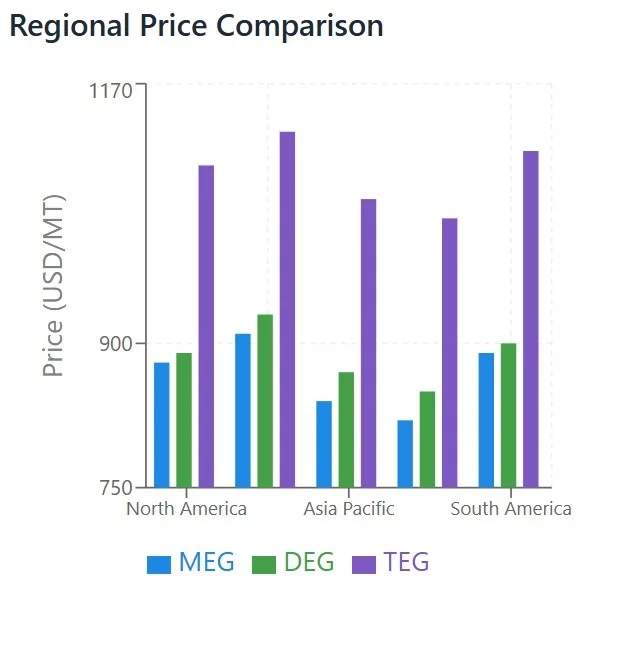
Even though MEG, DEG, and TEG share a production origin, their price behavior often diverges. Therefore, let’s compare the average price ranges seen during 2024 and likely to continue into 2025:
| Product | 2024 Average Price Range (CFR) | 2025 Forecasted Price Range (CFR) |
|---|---|---|
| MEG | $500–$600/MT | $580–$650/MT |
| DEG | $680–$750/MT | $720–$780/MT |
| TEG | $950–$1,050/MT | $1,000–$1,120/MT |
While MEG prices react quickly to polyester demand and oil fluctuations, DEG follows a more balanced path tied to adhesives and coatings. On the other hand, TEG serves energy and fogging markets, which face tighter global supply and rising specialty demand.
Why Choose Basekim for Glycol Supply in 2024–2025?
In unpredictable markets, buyers need more than just price data. They need a stable, transparent, and responsive supplier who understands global shifts and delivers on time.
At Basekim, we:
Monitor glycol prices daily across major ports
Offer flexible packing like drums, IBCs, or ISO tanks
Ship to over 40 countries with certified documentation
Help clients with cost forecasting and logistics planning
Guarantee product purity, clarity, and technical support
Because we manage supply chain risks carefully, we keep customers informed and protected from market surprises. Whether you need MEG for antifreeze, DEG for adhesives, or TEG for dehydration, we deliver consistent value.
Final Words: Prepare for Volatility, Partner for Stability MEG DEG TEG Price
The glycol market continues to evolve. As we move through 2024 and into 2025, price trends will depend on global energy, transportation, and demand cycles.
To stay ahead, buyers must act strategically. They should analyze trends, build reliable supplier relationships, and secure supply through smarter planning.
Basekim stands ready to support you through these changes. Our wide product range, global reach, and deep market knowledge allow us to deliver not just glycols—but confidence, consistency, and clarity in every shipment.
Let’s move forward—together, smarter.