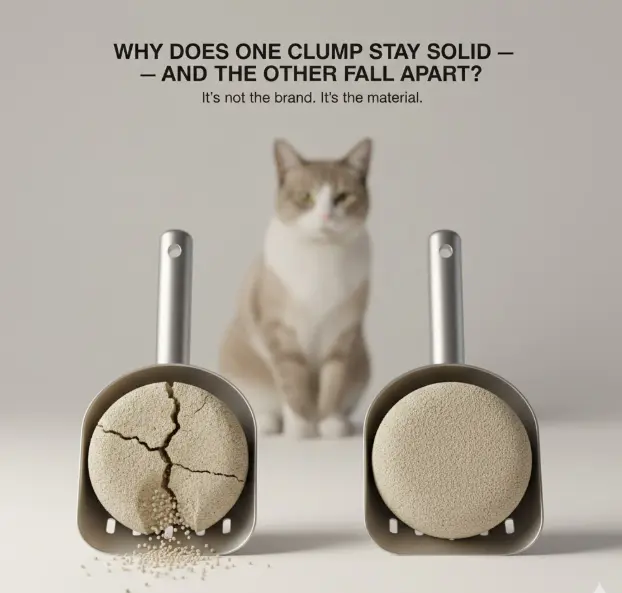
Buying cat litter sounds simple until you realize how different the results can be. One litter forms neat, solid clumps that are easy to scoop. Another falls apart, sticks to the box, and leaves behind odor no matter how often you clean.
The key difference usually isn’t the brand.
It’s how the litter reacts to moisture and that comes down to clumping.
What “Clumping” Actually Means in Real Life
Clumping isn’t just a technical feature. In everyday use, it affects almost everything about the litter box.
When clumping works well:
Moisture is trapped immediately
Odors stay sealed inside the clump
The surrounding litter stays clean and dry
You remove only what’s used, not half the box
When clumping fails:
Wet litter breaks apart
Odors spread through the tray
The box needs full replacement more often
That’s why clumping quality matters more than scent, color, or even price.
The Science Behind Clumping: Why Material Matters
Most clumping cat litters rely on bentonite clay, a naturally absorbent mineral. But bentonite isn’t a single material—it comes in different forms with very different behavior.
Understanding this explains why some litters perform far better than others.
Sodium Bentonite: The Strong Clumper
Sodium bentonite has a unique property:
when it comes into contact with moisture, it expands significantly.
This expansion causes the particles to press into each other and lock together, forming firm, compact clumps that hold their shape during scooping.
In practical terms, this means:
Faster clump formation
Cleaner separation from the rest of the litter
Less residue left behind
This is why high-quality clumping litters almost always rely on sodium bentonite rather than other clay types.
Calcium Bentonite: Absorbent but Weaker
Calcium bentonite absorbs liquid too, but it behaves differently. It expands very little, so instead of forming tight clumps, it often creates soft or fragile lumps.
These can:
Break apart during scooping
Stick to the bottom of the tray
Leave damp material behind
For this reason, calcium bentonite is more common in non-clumping or budget formulations where absorption matters, but strong clumping does not.
Why Some Litters Say “Clumping” but Still Disappoint
Many users assume poor performance means they chose the wrong brand. In reality, weak clumping usually comes from:
Using calcium bentonite instead of sodium bentonite
Inconsistent grain size
Low-quality processing or impurities
Labels don’t always explain this, but the litter box quickly does.
How to Test Clumping Quality at Home
You don’t need lab equipment to evaluate clumping.
A simple test:
Place a small amount of litter in a bowl
Add a few drops of water
Wait a few seconds
If the litter forms a solid clump that stays intact when lifted, it has good clumping behavior. If it crumbles or spreads, clumping strength is limited.
Is Strong Clumping Always the Best Choice?
For most indoor cats, yes. Strong clumping improves hygiene and reduces odor buildup. However, good clumping should be balanced with:
Low dust levels
Comfortable texture for the cat’s paws
Consistent granule size
Well-processed sodium bentonite usually offers this balance when properly refined.
Final Thoughts
Clumping performance isn’t marketing it’s material behavior. Sodium bentonite creates strong, reliable clumps because of how it reacts to moisture. Calcium bentonite absorbs liquid, but doesn’t deliver the same structural strength.
Once you understand this difference, choosing cat litter becomes less about trial and error and more about knowing what actually works.