Paint thinner is one of the most commonly searched terms in the coatings and industrial chemicals industry yet it is also one of the most misunderstood. Many people use the word “thinner” loosely, without realizing that it actually refers to a wide range of solvents, each designed for a specific type of paint, coating, or industrial application.
In this guide, we explain what paint thinner really is, the most common types used in the industry, their applications, and how to choose the right solvent for your project.
What Is Paint Thinner?
Paint thinner is a solvent used to reduce the viscosity of paint, making it easier to apply, spray, or clean from tools and surfaces. In industrial usage, the term “paint thinner” often refers to chemical solvents rather than a single product.
Depending on the paint formulation, a thinner may be used to:
Improve paint flow and leveling
Adjust drying time
Clean brushes, rollers, and equipment
Remove paint residue or spills
In professional and industrial markets, paint thinners are commonly categorized under solvents.
Common Types of Paint Thinners and Solvents
Different paints require different thinners. Using the wrong solvent can damage the paint film, reduce adhesion, or affect drying performance.
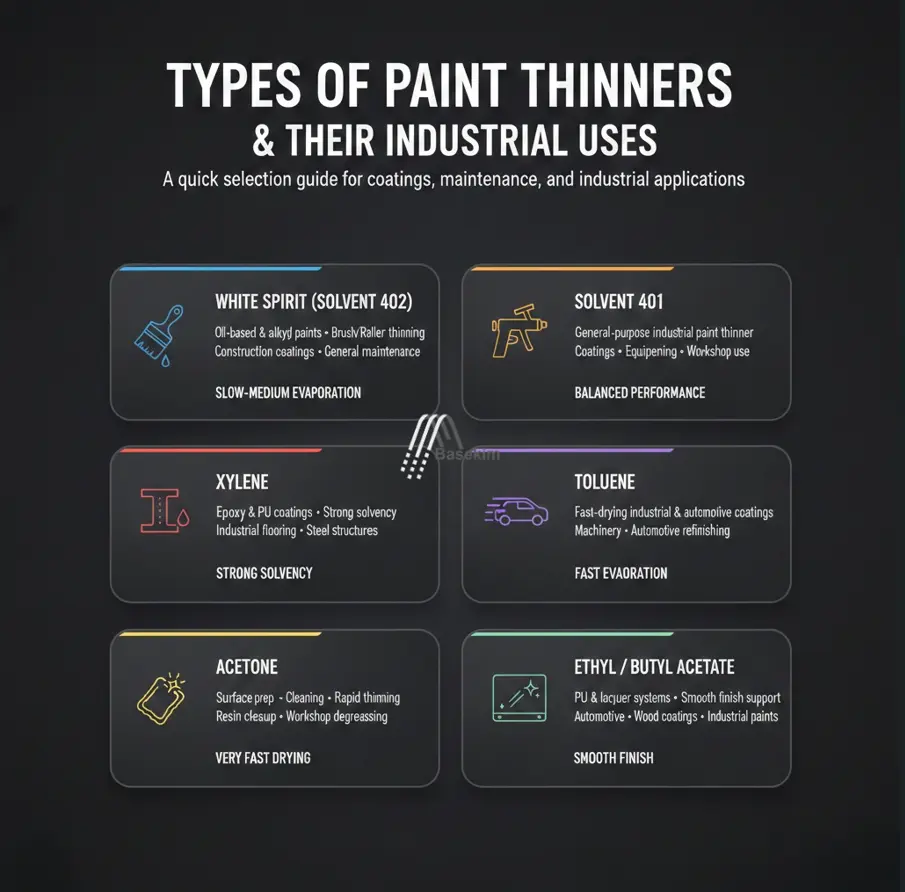
Mineral Spirits / White Spirit
Widely used as a paint thinner for oil based and alkyd paints. White spirit offers moderate evaporation and good solvency, making it suitable for construction and decorative coatings.
Industrial Solvents (Solvent 401 / 402 / 403)
These are general purpose industrial paint thinners used in coatings, maintenance, and cleaning applications. They are commonly selected for:
Industrial coatings
Equipment cleaning
Xylene
Xylene is a strong industrial solvent often used as a thinner for epoxy and polyurethane coatings. It provides excellent solvency and controlled evaporation, making it suitable for heavy-duty applications.
Toluene
Toluene is a fast evaporating solvent commonly used in industrial and automotive paint thinners. It is effective for coatings that require rapid drying and strong solvency.
Acetone
Acetone is a highly volatile solvent used for fast-drying applications, resin cleaning, and paint removal. It is commonly used as a thinner component in industrial formulations.
Ethyl Acetate & Butyl Acetate
These solvents are frequently used in automotive, PU, and lacquer coatings, offering balanced evaporation rates and smooth surface finishes.
What Is Paint Thinner Used For?
Paint thinner is used across multiple industries, including construction, automotive, manufacturing, and maintenance.
Common uses include:
Thinning oil based, epoxy, PU, and industrial paints
Cleaning spray guns, brushes, and rollers
Removing paint residues from metal surfaces
Adjusting drying speed and finish quality
Industrial users often select a thinner based on performance, evaporation rate, and compatibility with the paint system.
How to Choose the Right Paint Thinner
Choosing the right paint thinner depends on several key factors:
1. Type of Paint
Oil based, epoxy, polyurethane, and lacquer paints all require different solvent systems.
2. Evaporation Rate
Fast-evaporating thinners dry quickly but may cause surface defects if used incorrectly. Slower thinners provide better leveling.
3. Application Method
Spray application often requires a different thinner than brush or roller application.
4. Industrial vs Decorative Use
Industrial coatings usually require higher-purity solvents with controlled performance characteristics.
Selecting the correct thinner improves coating quality, durability, and application efficiency.
Paint Thinner vs Solvent: What’s the Difference?
In everyday language, “paint thinner” and “solvent” are often used interchangeably. Technically speaking:
Paint thinner describes the function (thinning paint)
Solvent describes the chemical substance performing that function
In industrial supply chains, products are usually listed and sold as solvents, even though they are commonly used as thinners.
Safety and Handling Considerations
Paint thinners and solvents are flammable chemicals and must be handled properly:
Use in well ventilated areas
Store in approved containers
Avoid direct skin contact
Follow safety data sheet (SDS) guidelines
Proper handling ensures both safety and product performance.
Final Thoughts
Understanding thinner is essential for achieving high quality coating results. By choosing the correct solvent based on paint type, application method, and performance requirements, users can avoid common mistakes and improve efficiency.
For industrial and commercial applications, selecting the right thinner is not just a technical decision — it directly impacts cost, quality, and long-term performance.