The Role of Glycerin in Modern Drilling Operations
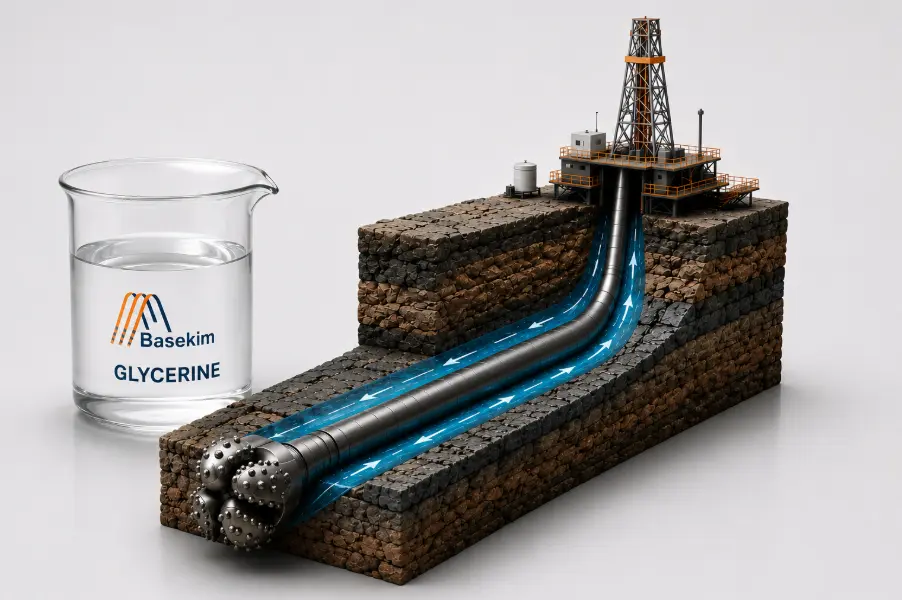
Glycerin is increasingly used in drilling fluid formulations to improve lubrication, fluid stability, and operational efficiency in water based drilling systems. In many drilling environments, especially where smooth circulation and friction reduction are important, glycerin can function as a supportive additive inside the mud system.
Drilling performance is heavily influenced by the behavior of the drilling fluid. Poor lubrication, unstable rheology, and excessive torque can create operational problems that directly affect drilling speed and equipment life. Because of this, mud engineers continuously optimize fluid formulations with additives that improve drilling efficiency without negatively affecting the overall mud balance.
Glycerin is one of the additives that can contribute to this balance when used correctly in selected drilling fluid systems.
Why Glycerin is Used in Drilling Fluids
In drilling operations, friction between the drill string and the formation is unavoidable. As the well depth increases and directional drilling becomes more complex, torque and drag forces can become a major operational concern. Drilling fluids are therefore designed not only for cuttings transport, but also for lubrication and wellbore stability.
Glycerin is used in some water-based mud systems because of its lubricating and moisture-retaining characteristics. Its water solubility allows it to integrate into drilling fluid formulations while supporting smoother fluid movement and better lubrication performance.
In practical drilling conditions, glycerin may contribute to:
- Reduction of friction inside the wellbore
- Improved lubricity in water-based mud systems
- Better drill string movement
- Smoother circulation behavior
- Reduced mechanical stress on drilling equipment
- More stable fluid performance during drilling
These effects become more important in directional drilling sections where drag and rotational resistance increase significantly.
Glycerin in Water-Based Mud (WBM)
Water-based mud systems remain one of the most widely used drilling fluid types in oilfield operations. Compared to oil based systems, WBMs are often preferred because of operational flexibility and easier handling in many drilling environments.
However, water based systems can sometimes suffer from insufficient lubrication under difficult drilling conditions. This is where supportive additives become important.
In selected WBM formulations, glycerin may help improve lubricity while maintaining compatibility with other drilling fluid components. Mud engineers may use glycerin together with additives such as:
- Bentonite
- PAC
- CMC
- Polymer viscosifiers
- Fluid loss additives
- Lubricity enhancers
The exact formulation depends on formation conditions, drilling depth, temperature, and operational requirements.
Importance of Lubrication in Directional Drilling
As directional and horizontal drilling operations become longer and more technically demanding, drilling fluid lubrication becomes increasingly critical. In extended reach drilling sections, excessive torque and drag can reduce drilling efficiency and place additional stress on the drill string.
Mud systems with improved lubricity can help:
- Reduce rotational resistance
- Improve sliding performance
- Support smoother pipe movement
- Minimize wear on drilling components
- Improve overall drilling efficiency
Because glycerin contributes to fluid lubricity, it can be considered as part of drilling fluid optimization in selected drilling programs.
Glycerin for HDD Drilling Applications
Horizontal Directional Drilling (HDD) operations require drilling fluids capable of maintaining smooth circulation and stable lubrication over long drilling distances. During HDD operations, friction between the borehole and drill pipe can significantly affect operational performance.
Glycerin may support HDD drilling fluids by improving:
- Fluid lubricity
- Pipe mobility
- Mud flow behavior
- Friction reduction during pullback operations
Its integration into HDD drilling mud systems depends on the project design and drilling fluid engineering approach.
Rheology and Fluid Stability Considerations
Drilling fluid rheology directly affects hole cleaning, cuttings suspension, pressure management, and circulation efficiency. Every additive inside the mud system influences the final fluid behavior.
When used in controlled proportions, glycerin may support fluid stability while contributing to lubrication performance. Mud engineers evaluate:
- Viscosity behavior
- Fluid compatibility
- Temperature response
- Circulation performance
- Operational lubrication needs
before finalizing the drilling fluid formulation.
The effectiveness of glycerin depends on the overall mud design rather than the additive alone.
Operational Challenges in Drilling Fluids
Modern drilling environments expose drilling fluids to:
- High pressure
- Elevated temperatures
- Long circulation periods
- Complex formations
- Extended horizontal sections
Under these conditions, drilling fluid performance becomes one of the most important factors affecting operational success.
Additives that improve lubrication and circulation behavior can help reduce operational complications such as:
- Excessive torque
- Pipe sticking
- Increased drag
- Mechanical wear
- Poor drilling efficiency
For this reason, drilling fluid optimization remains a critical part of drilling engineering.
Glycerin Compatibility in Drilling Systems
One of the advantages of glycerin in selected drilling systems is its compatibility with many water-based fluid formulations. Because it is water soluble, it can be integrated into drilling mud systems without creating the handling difficulties associated with some heavier additives.
Its performance depends on:
- Mud composition
- Additive concentration
- Drilling environment
- Temperature conditions
- Well design
- Fluid engineering strategy
Proper formulation design is essential for achieving stable drilling fluid performance.
Future Demand for Advanced Drilling Fluid Additives
As drilling projects become more technically demanding, the need for efficient drilling fluid additives continues to increase. Directional drilling, HDD projects, and deep drilling operations require mud systems capable of maintaining stable lubrication and operational efficiency over long drilling intervals.
Because of its physical properties and compatibility with water-based systems, glycerin continues to attract attention as a supportive additive in selected drilling fluid applications.
Other Applications of Glycerin
In addition to drilling fluid systems, Glycerin is widely used across many industries because of its lubricating, stabilizing, and moisture retaining properties.
Glycerin is commonly used in:
- Food processing industry
- Pharmaceutical formulations
- Cosmetic and personal care products
- Industrial lubricants
- Resin and chemical production
- Textile processing
- Agriculture applications
- Detergent manufacturing
- Antifreeze formulations
- Polymer and plastic industries
Its versatility and compatibility with different formulations make glycerin an important material in both industrial and commercial applications.