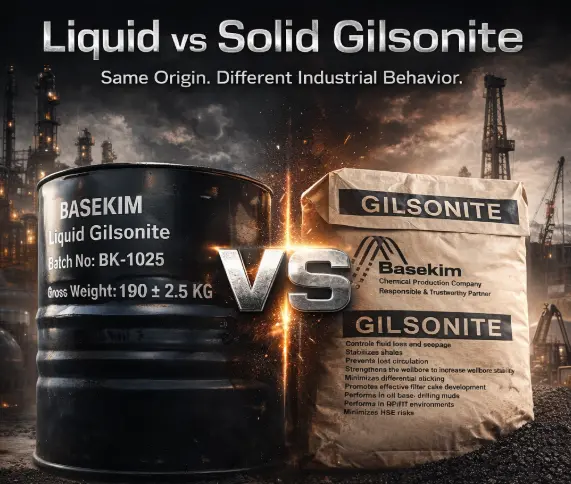
Performance Analysis, Industrial Applications, and Functional Differences
Gilsonite, also known as natural asphalt or uintaite, is widely used in drilling fluids, asphalt modification, and industrial coatings. Available in both Liquid Gilsonite and Solid Gilsonite forms, this hydrocarbon based material enhances thermal stability, fluid loss control, and mechanical strength in demanding industrial environments.
Understanding the performance characteristics of each form is essential for optimizing drilling operations, asphalt production, and bitumen modification processes.
What Is Gilsonite?
Gilsonite is a naturally occurring solid hydrocarbon resin with high carbon content and strong compatibility with petroleum-based systems. It is primarily used as:
A drilling fluid additive
An asphalt modifier
A bitumen performance enhancer
A fluid loss control material
Its high softening point, chemical stability, and strong binding properties make it suitable for high-temperature and high-pressure applications.
Solid Gilsonite: Performance and Applications
Solid Gilsonite is typically supplied in lump, granular, or powdered form. It has long been used in oilfield drilling and road construction industries.
Key Applications of Solid Gilsonite
Fluid loss control in drilling mud systems
Lost circulation material (LCM)
Increasing softening point of bitumen
Improving rutting resistance in asphalt pavements
Enhancing durability of waterproofing membranes
Performance Characteristics
In drilling fluids, Solid Gilsonite reduces filtration loss and stabilizes wellbore walls. In asphalt modification, it increases stiffness and improves resistance to deformation at high temperatures.
Performance efficiency depends on:
Proper mixing temperature
Adequate dispersion
Controlled particle size
When integrated correctly, Solid Gilsonite provides consistent mechanical reinforcement and thermal stability.
Liquid Gilsonite: Performance and Applications
Liquid Gilsonite is a processed form designed for easier handling and uniform dispersion in industrial systems.
Key Applications of Liquid Gilsonite
Drilling fluid viscosity control
Rapid fluid loss response in oil wells
Uniform bitumen modification in continuous production lines
Industrial coating formulations
Performance Characteristics
Liquid Gilsonite offers improved distribution within drilling mud systems and asphalt blends. It allows more controlled dosing and faster integration into production processes.
In drilling operations, it enhances:
Filtration control
Pressure management
In asphalt systems, it supports:
Improved homogeneity
Controlled viscosity adjustment
Stable thermal performance
Gilsonite in Drilling Applications
Both Liquid and Solid Gilsonite are extensively used in oil and gas drilling operations.
Functional Benefits in Drilling
Reduction of fluid loss
Formation sealing
Improved wellbore integrity
Enhanced resistance to high-pressure zones
Selection between liquid and solid forms depends on:
Mud system design
Temperature conditions
Mixing capabilities
Operational workflow
Gilsonite in Asphalt and Bitumen Modification
Gilsonite acts as a high-performance asphalt modifier, improving key physical properties of bitumen.
Asphalt Performance Improvements
Increased softening point
Enhanced high-temperature stability
Improved rutting resistance
Reduced thermal sensitivity
Extended pavement service life
The form of Gilsonite used depends on plant configuration and production scale.
Factors Affecting Selection Between Liquid and Solid Gilsonite
Industrial projects evaluate several technical factors:
Application type (drilling or asphalt)
Processing temperature
Production continuity
Dosing precision requirements
Storage and logistics conditions
Proper selection ensures optimized system performance and long-term durability.
Conclusion
Liquid Gilsonite and Solid Gilsonite both play critical roles in drilling fluid performance and asphalt modification. Their functional behavior is influenced by operational conditions, mixing methods, and system design.
For industries seeking enhanced fluid loss control, improved bitumen properties, and reliable thermal stability, understanding the performance characteristics of each form is essential for achieving consistent and efficient results.