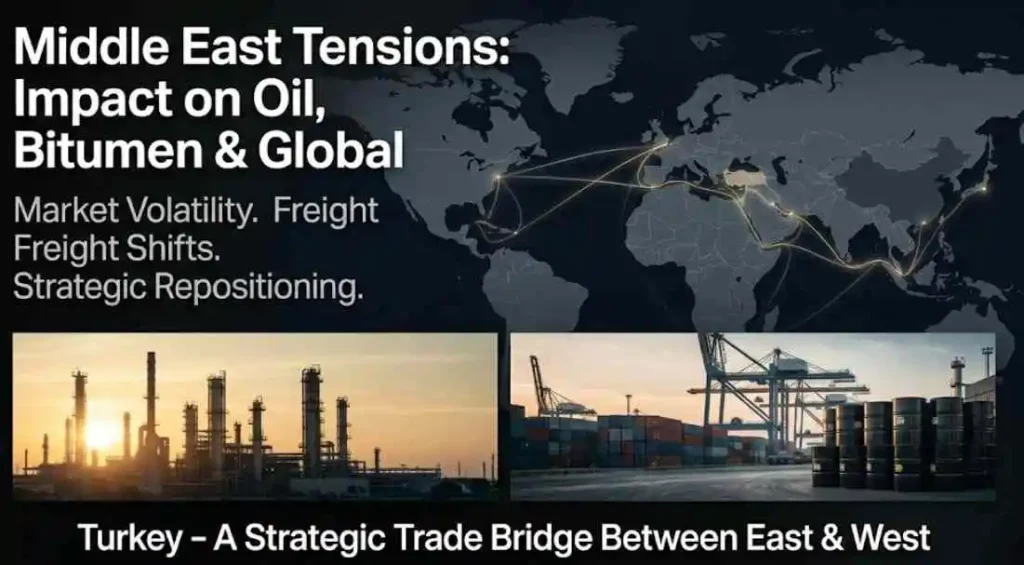
How Regional Conflict Is Reshaping Energy Markets and Supply Chains
The Middle East war impact on oil and bitumen markets is no longer a theoretical risk scenario. Military escalation, maritime insecurity, and strategic realignment between global powers are actively reshaping energy pricing models, refinery output strategies, and international commodity trade routes.
This is not simply a regional conflict.
It is a structural shock to the global energy system.
The Middle East remains the core production zone of global hydrocarbons and controls the most sensitive maritime corridors in international trade.
The Middle East as the Structural Core of Global Energy Supply
Nearly one third of global crude oil production originates from the Middle East. Beyond production volume, the region controls three of the world’s most strategic maritime chokepoints:
• Strait of Hormuz
• Bab el Mandeb
• Suez Canal corridor
Even limited instability in these corridors increases perceived supply risk across global oil markets.
Energy markets price expectations before physical shortages occur.
The moment disruption becomes plausible, Brent crude futures react. A geopolitical risk premium is embedded into pricing structures.
That premium flows downstream into bitumen, fuel oil and petrochemical derivatives.
Oil Market Volatility and Expanding Risk Premium
Since the escalation of tensions, global crude markets have experienced:
• Increased Brent and WTI volatility
• Sharp intraday price swings
• Elevated hedging activity
• Rising marine insurance costs
• Higher freight risk assessments
Even without physical supply disruption, geopolitical risk alone can add several dollars per barrel.
For refiners and exporters, this changes margin calculations.
For importers, it reduces predictability.
Oil market volatility triggered by Middle East conflict directly influences bitumen pricing mechanisms.
Refinery Prioritization and Bitumen Supply Pressure
Bitumen is produced during crude refining as a residual product. In unstable geopolitical conditions, refineries prioritize higher margin fuels such as gasoline, diesel and jet fuel.
Production allocation shifts toward products with stronger cash flow.
This creates measurable pressure in bitumen supply chains:
• Reduced export availability
• Delayed cargo nominations
• Tighter allocation in Africa and Asia
• Increased FOB price variability
• Shorter validity of quotations
Bitumen pricing becomes indexed not only to crude oil, but also to refinery production strategy under stress.
Procurement uncertainty increases for infrastructure projects dependent on steady supply.
Freight, Insurance and War Risk Surcharges
Regional conflict increases:
• War risk insurance premiums
• Vessel charter rates
• Route diversion costs
• Port congestion probability
Freight becomes a strategic pricing variable rather than a secondary cost.
For CFR contracts, this can significantly alter landed cost structures within short periods.
Shipping through high risk maritime zones becomes a risk management exercise rather than a routine logistics operation.
Petroleum Derivatives Under Stress
The Middle East war impact on global commodity trade extends beyond crude oil and bitumen.
Several petroleum derived commodities experience amplified volatility:
• Sulfur used in fertilizer production
• Fuel oil and bunker fuel
• Base oils and lubricants
• Petrochemical feedstocks such as ethylene and propylene
• Aromatics and industrial solvents
When crude markets destabilize, derivative markets magnify the effect.
Agriculture, construction, packaging and infrastructure sectors absorb secondary cost pressure.
Regional conflict evolves into global inflationary pressure.
Trade Reconfiguration and Emerging Supply Hubs
Commodity markets rarely collapse under pressure. They reorganize.
When primary supply zones become uncertain, trade flows realign toward alternative hubs.
In this evolving structure, Turkey has emerged as a strategic energy trade platform.
Positioned between Europe, the Middle East and Central Asia, Turkey offers:
• Active refining capacity
• Developed storage infrastructure
• Access to Mediterranean export ports
• Flexible multimodal transport corridors
• Integration with EU and Asian markets
As volatility increases in direct Gulf origin shipments, buyers increasingly look toward Turkey exporters as a stabilizing supply base.
Logistical agility becomes more valuable than geographic proximity during unstable periods.
Long Term Structural Implications for Energy Trade
If geopolitical tensions persist, global oil and bitumen markets may experience structural shifts such as:
• Expansion of regional storage capacity
• Diversification away from single origin dependency
• Strengthening of transshipment hubs
• Realignment of energy trade corridors
• Increased importance of intermediary markets
Energy geopolitics gradually transforms into infrastructure strategy.
Markets adapt by rerouting risk rather than eliminating it.
Strategic Solutions for Oil and Bitumen Buyers
In volatile energy markets, professional importers adopt structured risk management strategies:
• Diversifying origin sources
• Negotiating flexible pricing formulas
• Monitoring refinery output allocations
• Shortening contract cycles
• Structuring freight clauses carefully
• Evaluating alternative export hubs
Stability is temporary. Risk management defines profitability.
Strategic sourcing becomes the core competitive advantage.
Basekim – Strategic Export Platform from Turkey
In an environment of elevated geopolitical risk, reliable supply infrastructure becomes critical.
Basekim operates with licensed export capability and active storage facilities in Turkey, providing access to bitumen and petroleum derived commodities under compliant trade operations.
Strategic geographic positioning, regulatory alignment and logistical flexibility enable stable export service even during periods of regional volatility.
In energy trade, preparation is protection.