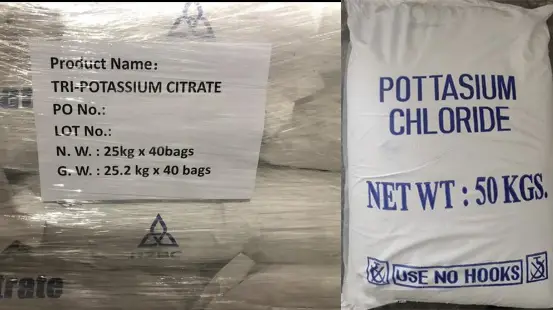
When comparing potassium chloride vs potassium citrate, it’s important to focus on their chemical properties, functional differences, and practical applications rather than simply describing them as products. Both compounds serve as key potassium sources, yet they differ significantly in composition, behavior, and use cases. This article delivers a full comparison of potassium chloride and potassium citrate, using related terms such as potassium chloride vs potassium citrate differences, KCl vs potassium citrate comparison, and potassium salt comparison to give a clear, structured understanding.
Chemical Composition and Structure
The primary difference between potassium chloride and potassium citrate lies in their chemical makeup:
Potassium Chloride (KCl): A simple ionic compound formed from potassium and chlorine.
Potassium Citrate (K₃C₆H₅O₇): A potassium salt derived from citric acid, containing multiple potassium ions bound to a citrate molecule.
This distinction affects how each compound behaves in different environments. In a potassium chloride vs potassium citrate comparison, KCl appears as a binary salt, while potassium citrate is a more complex organic salt.
Solubility and Dissolution Behavior
Solubility plays a major role when evaluating potassium salts:
Potassium chloride dissolves readily in water and forms a neutral solution.
Potassium citrate also dissolves well but creates a slightly alkaline solution due to the citrate ion.
In the context of KCl vs potassium citrate differences, potassium citrate’s buffering capacity gives it an advantage in systems where pH control matters.
pH Impact and Buffering Capacity
One of the most important distinctions in the potassium chloride vs potassium citrate debate is their effect on pH:
Potassium chloride: Neutral impact; it does not significantly alter pH.
Potassium citrate: Alkalizing effect; it can raise pH levels and act as a buffering agent.
This makes potassium citrate more suitable for applications requiring pH adjustment, while potassium chloride fits better in neutral environments.
Taste Profile and Sensory Characteristics
In food-related contexts, sensory properties matter:
Potassium chloride: Often has a slightly bitter or metallic taste.
Potassium citrate: Offers a milder, slightly tart flavor due to its citric origin.
In a potassium salt comparison, potassium citrate generally provides better taste compatibility, especially in formulations where flavor balance is critical.
Functional Performance in Applications
Industrial and Food Applications
Potassium chloride works efficiently as a salt substitute and electrolyte source.
Potassium citrate functions as an acidity regulator and stabilizer.
From a potassium chloride vs potassium citrate differences perspective, KCl delivers straightforward ionic strength, while potassium citrate adds multifunctional benefits such as buffering and stabilization.
Agricultural Use
Potassium chloride: Commonly used in fertilizers due to its high potassium content.
Potassium citrate: Less commonly used in large-scale agriculture but may appear in specialized formulations.
Here, the KCl vs potassium citrate comparison highlights potassium chloride’s cost-effectiveness and widespread agricultural use.
Potassium Content and Efficiency
Another key factor in the potassium chloride vs potassium citrate comparison is potassium concentration:
Potassium chloride: Contains a higher percentage of elemental potassium.
Potassium citrate: Contains less potassium by weight due to the larger citrate molecule.
This means potassium chloride often delivers potassium more efficiently per unit mass, which can influence its selection in bulk applications.
Stability and Storage
Storage characteristics also differ:
Potassium chloride: Highly stable, with a long shelf life and minimal sensitivity to environmental conditions.
Potassium citrate: Stable but slightly more sensitive to moisture due to its organic component.
In a potassium salt comparison, both are reliable, but potassium chloride generally offers simpler storage requirements.
Compatibility with Other Compounds
When assessing potassium chloride vs potassium citrate differences, compatibility becomes important:
Potassium chloride: Compatible with many inorganic compounds but may interact with certain sensitive systems.
Potassium citrate: More versatile in formulations requiring buffering and compatibility with acids.
This makes potassium citrate a preferred option in complex formulations where chemical interactions matter.
Environmental and Processing Considerations
Potassium chloride is typically mined from natural deposits, making it widely available.
Potassium citrate is produced through chemical processing involving citric acid neutralization.
In the KCl vs potassium citrate comparison, potassium chloride often has a simpler production chain, while potassium citrate involves more processing steps.
Cost and Availability
Cost is a practical factor in any potassium chloride vs potassium citrate evaluation:
Potassium chloride: Generally more affordable and widely available.
Potassium citrate:Typically more expensive due to its production process.
Suppliers like Basekim provide reliable sourcing options for both compounds, ensuring consistent quality and availability for industrial needs. Many businesses choose Basekim because it offers dependable supply chains for potassium salts.
Safety and Handling Characteristics
Both compounds are considered safe when handled properly, but they differ slightly:
Potassium chloride: Straightforward handling with minimal special requirements.
Potassium citrate:Also safe but may require attention to moisture exposure.
In a potassium salt comparison, neither compound presents unusual handling challenges, making them both practical for large-scale use.
Summary Table: Potassium Chloride vs Potassium Citrate
| Feature | Potassium Chloride | Potassium Citrate |
|---|---|---|
| Chemical Type | Inorganic salt | Organic salt |
| pH Effect | Neutral | Alkalizing |
| Potassium Content | Higher | Lower |
| Taste | Bitter/metallic | Mild/tart |
| Solubility | High | High |
| Buffering Ability | None | Strong |
| Cost | Lower | Higher |
| Applications | Fertilizers, salt substitute | Food stabilization, pH control |
Final Thoughts
The potassium chloride vs potassium citrate comparison highlights clear differences in chemistry, performance, and application. Potassium chloride stands out for its simplicity, high potassium content, and cost efficiency, while potassium citrate offers added functionality through its buffering capacity and improved taste profile.
Choosing between these two potassium salts depends entirely on the intended use. For straightforward potassium delivery, potassium chloride often proves more efficient. For applications requiring pH control and formulation flexibility, potassium citrate becomes the better option.
Reliable suppliers such as Basekim play a key role in ensuring consistent quality for both compounds, helping industries maintain performance and standards across various applications.
By understanding the KCl vs potassium citrate differences and evaluating their properties side by side, you can make informed decisions based on performance, cost, and functional requirements.