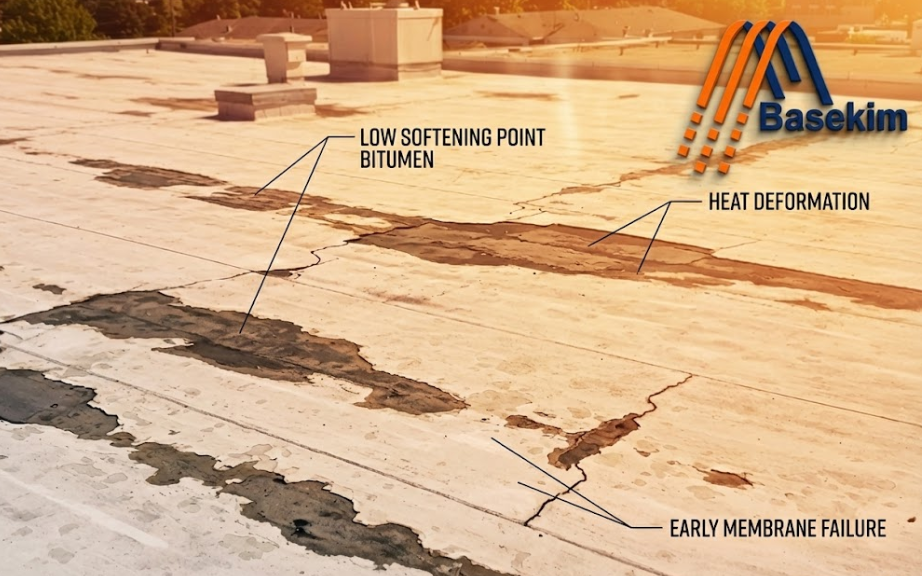
Waterproofing membranes are designed to protect buildings for many years. However, in practice, many waterproofing membrane failure after only 2 or 3 years. Cracks appear, surfaces soften, and water leakage becomes unavoidable.
While poor installation is often blamed, in many cases the real issue lies deeper: the type and quality of bitumen used in the waterproofing membrane.
Heat: The Silent Killer of Waterproofing Membranes
Heat is one of the main reasons waterproofing membranes fail prematurely.
When exposed to high temperatures, low-quality or unsuitable bitumen softens and loses its structural stability. Once this happens, the membrane can no longer perform its protective function effectively.
If the bitumen has a low softening point:
It deforms under heat
Micro-cracks develop over time
Adhesion to the substrate weakens
This explains why many membranes look acceptable at first but deteriorate rapidly after a few hot seasons.
Using the Wrong Bitumen Grade for Waterproofing
One of the most common technical mistakes is using penetration grade bitumen for waterproofing membranes.
Penetration bitumen is primarily designed for road and asphalt applications, where flexibility is important. However, roofing and waterproofing systems require heat resistance and long term shape stability, not road performance.
The result is predictable:
A membrane that performs temporarily, then gradually loses its waterproofing capability.
Why Oxidation Quality Is Critical
For waterproofing applications, bitumen must undergo a proper and controlled oxidation process.
Oxidation increases the softening point of bitumen and significantly improves its resistance to heat and aging. When oxidation quality is poor or inconsistent:
The bitumen ages faster
Performance declines quickly
Membrane lifespan becomes unpredictable
This issue is often invisible at first but has a major impact on long term durability.
The Importance of High Softening Point Oxidized Bitumen
This is where oxidized bitumen plays a key role in reliable waterproofing systems.
Properly oxidized bitumen provides:
High resistance to elevated temperatures
Excellent shape and dimensional stability
Longer service life of membranes
More consistent waterproofing performance
Grades such as Oxidized Bitumen 115/15 are widely used in high quality waterproofing membranes because they maintain their structure even under extreme heat conditions.
How to Choose the Right Bitumen for Waterproofing Membranes
To prevent early membrane failure, bitumen selection should be based on technical performance, not price alone. Key factors include:
Penetration value
Consistency and quality of oxidation
Local climate conditions
Type of waterproofing application
Choosing the correct bitumen grade from the beginning reduces maintenance costs and prevents serious structural damage over time.
Reliable Supply of Waterproofing-Grade Bitumen
BASEKIM supplies a full range of oxidized bitumen grades suitable for waterproofing and roofing applications. Products are offered in various packing options and prepared for export with consistent quality standards.
Final Thought
Most waterproofing membrane failures are not accidental. They are the result of incorrect bitumen selection.
Understanding the role of heat resistance, oxidation quality, and proper bitumen grading makes the difference between a membrane that fails in a few years and one that performs reliably for decades.