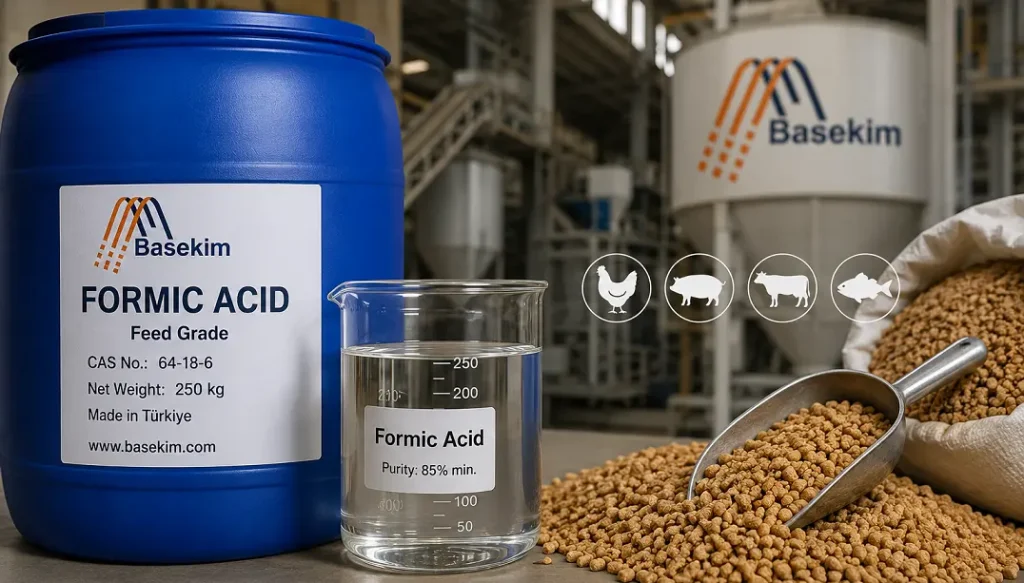
Formic acid plays a critical role in modern livestock nutrition. Many feed manufacturers use it to reduce bacterial contamination, extend feed shelf life, and improve feed hygiene. Additionally, formic acid helps producers maintain consistent feed quality during storage and transportation. Therefore, advanced feed producers increasingly rely on Feed Preservation Solutions to improve operational efficiency and animal performance.
Advanced livestock feed formulations often contain moisture-sensitive ingredients. As a result, bacterial growth can increase during storage or shipping. Formic acid creates an acidic environment that limits harmful microorganisms such as Salmonella and E. coli. Meanwhile, it supports safer feed handling across industrial supply chains.
Modern Feed Preservation Solutions help livestock feed manufacturers control bacterial contamination, improve feed stability, and extend storage life. Formic acid reduces microbial activity by lowering feed pH levels. Consequently, feed producers achieve safer transportation, lower spoilage risks, and improved feed hygiene in poultry, cattle, and swine nutrition systems.
Why Formic Acid Works in Livestock Feed for Feed Preservation Solutions
Formic acid delivers strong antibacterial performance in compound feed production. It penetrates bacterial cell walls and disrupts microbial activity. Consequently, feed producers reduce contamination risks during storage and distribution.
Additionally, formic acid supports feed acidification. Lower pH conditions reduce the survival rate of pathogenic bacteria. Therefore, livestock operations improve feed safety without compromising nutritional value.
Industrial feed manufacturers often select formic acid because it offers:
- Fast antibacterial action
- Effective Salmonella control
- Improved feed shelf life
- Better storage stability
- Reduced spoilage losses
- Compatibility with mineral premixes
Moreover, formic acid works efficiently in poultry feed, aqua feed, pig feed, and ruminant nutrition systems.
Industrial Applications of Feed Preservation Solutions
Large-scale feed producers require stable raw materials and consistent microbial control. Therefore, Feed Preservation Solutions remain essential in industrial feed manufacturing operations.
Feed mills commonly apply formic acid in:
- Poultry feed production
- Swine nutrition formulations
- Aquaculture feed systems
- Silage preservation
- Grain treatment operations
- Mineral feed additive blends
Meanwhile, export-oriented feed manufacturers use formic acid to protect feed quality during long-distance transportation. High humidity and temperature fluctuations often increase bacterial risks during shipping. However, formic acid helps maintain product integrity across global supply chains.
Many producers also combine formic acid with propionic acid or organic acid blends for broader antimicrobial performance.
Benefits of Formic Acid in Modern Feed Manufacturing and Feed Preservation Solutions
Formic acid provides several operational advantages for industrial buyers and feed formulators. Additionally, it supports cost-efficient feed preservation practices.
Improved Feed Hygiene
Formic acid reduces harmful bacterial populations in feed materials. Consequently, manufacturers improve feed safety standards and reduce contamination risks.
Longer Storage Stability
Moisture exposure can damage feed quality during storage. However, formic acid helps maintain stability by slowing microbial growth.
Better Export Performance
International feed shipments often require long transit times. Therefore, Feed Preservation Solutions help exporters protect feed quality during sea freight and warehouse storage.
Reduced Production Losses
Spoiled feed creates financial losses for producers. Meanwhile, effective antibacterial preservation reduces waste and improves operational efficiency.
Packaging and Industrial Supply Considerations
Industrial buyers typically source formic acid in bulk packaging formats. Common packaging options include:
- 35 kg plastic drums
- 250 kg HDPE drums
- IBC tanks
- ISO tank containers for bulk export
Additionally, manufacturers should verify concentration levels, purity specifications, and compatibility with feed formulations before procurement.
Reliable suppliers also provide:
- Technical Data Sheets (TDS)
- Safety Data Sheets (SDS/MSDS)
- Certificate of Analysis (COA)
- Export documentation support
Meanwhile, proper storage remains essential. Producers should store formic acid in cool and ventilated facilities away from oxidizing agents.
Sourcing High-Quality Feed Preservation Solutions
Procurement managers often prioritize consistency, logistics reliability, and technical support when sourcing feed additives. Therefore, selecting an experienced supplier becomes critical for long-term operational performance.
High-quality Feed Preservation Solutions should offer:
- Stable chemical composition
- Reliable export packaging
- Competitive bulk pricing
- Consistent production standards
- Fast international logistics support
Additionally, suppliers with export experience can simplify customs documentation and international freight coordination.
Conclusion
Formic acid remains one of the most effective antibacterial preservatives in advanced livestock feed formulations. It improves feed hygiene, controls harmful bacteria, and extends product stability during storage and transportation. Therefore, industrial feed manufacturers continue to invest in reliable Feed Preservation Solutions to improve safety, efficiency, and export performance.
Request Bulk Formic Acid Supply from Basekim
Basekim supplies industrial-grade formic acid for livestock feed applications worldwide. We support bulk supply requirements with export-ready packaging, technical documentation, and international logistics coordination.
Our supply capabilities include:
- Bulk export availability
- Drum, IBC, and ISO tank packaging
- Technical Data Sheet (TDS)
- Safety Data Sheet (SDS/MSDS)
- Certificate of Analysis (COA)
- Competitive quotations for international buyers
Contact Basekim today to request pricing, technical specifications, and export consultation for your feed manufacturing operations.