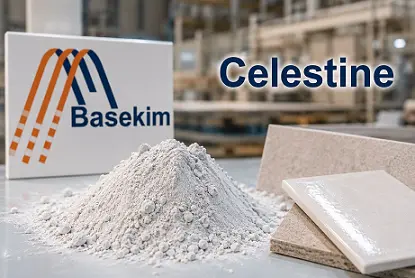
Celestine for Advanced Ceramic Glazes
The ceramics industry constantly searches for raw materials that improve quality and production efficiency. Celestine Ceramic Glazes have become an important solution for manufacturers that want smoother surfaces, stronger finishes, and better thermal performance. Celestine contains strontium sulfate, which enhances glaze behavior and improves the final appearance of ceramic products.
Manufacturers use celestine in ceramic formulations because it supports consistent firing results and reduces common surface defects. It also improves gloss, durability, and resistance to wear. These advantages make celestine valuable for tiles, sanitary ware, porcelain, and decorative ceramics.
Why Celestine Matters in Ceramic Production
Ceramic producers need raw materials that deliver stable performance during high-temperature firing. Celestine offers several technical advantages in ceramic processing.
The mineral acts as a source of strontium oxide during firing. This component improves glaze structure and strengthens the ceramic surface. It also helps manufacturers create brighter and more uniform finishes.
Many factories prefer celestine because it supports efficient production while maintaining high product quality.
Benefits of Celestine Ceramic Glazes
Improved Surface Smoothness
One major benefit of Celestine Ceramic Glazes is improved surface smoothness. Celestine helps glazes melt evenly during firing. This process creates a cleaner and more refined finish.
Smooth ceramic surfaces offer several commercial advantages:
Better visual appearance
Easier cleaning
Reduced surface porosity
Improved stain resistance
These qualities are especially important for bathroom tiles, porcelain products, and premium tableware.
Enhanced Durability
Durability remains critical in ceramic manufacturing. Celestine improves glaze hardness and strengthens resistance against scratches and abrasion.
Ceramic products with stronger glaze layers last longer in demanding environments. This advantage benefits industrial tiles, kitchen surfaces, and sanitary ceramics.
Manufacturers also value celestine because it reduces cracking and glaze defects after firing.
Celestine Ceramic Glazes in Industrial Applications
Wall and Floor Tiles
Tile manufacturers widely use Celestine Ceramic Glazes to improve gloss and consistency. Smooth glaze layers create a premium appearance that attracts customers in competitive markets.
Celestine also improves resistance to moisture and chemicals. These properties increase the lifespan of ceramic tiles in residential and commercial spaces.
Sanitary Ware Production
Sanitary ware producers require durable and hygienic surfaces. Celestine supports the production of dense and smooth glaze coatings that resist water absorption and surface damage.
Manufacturers use it in:
Wash basins
Toilets
Ceramic sinks
Bathroom accessories
Porcelain and Decorative Ceramics
Porcelain products require precise glaze control. Celestine helps maintain uniform texture and color during firing.
Decorative ceramics also benefit from improved brightness and enhanced visual depth.
How Celestine Improves Firing Performance
High-temperature firing can create defects if the glaze composition lacks stability. Celestine helps stabilize the melting process inside the kiln.
This mineral supports:
Better thermal expansion control
Reduced glaze tension
Improved adhesion
Lower risk of crazing
As a result, ceramic producers achieve more consistent batches with fewer rejected products.
Choosing High-Quality Celestine
Raw material quality directly affects ceramic performance. Manufacturers should select celestine with:
High purity levels
Stable chemical composition
Controlled particle size
Low impurity content
Reliable suppliers also provide technical documentation and consistent export quality.
At Basekim, we supply high-quality celestine for industrial ceramic applications. Our products support stable manufacturing processes and global export requirements.
Global Demand for Celestine in Ceramics
The global ceramics sector continues to grow due to rising construction and infrastructure projects. This trend increases demand for advanced ceramic raw materials.
Celestine Ceramic Glazes help manufacturers improve product quality while maintaining competitive production standards. The material supports modern ceramic technologies and high-performance glaze systems.
Countries with strong ceramic industries continue to increase the use of strontium-based minerals in glaze formulations. This demand creates new opportunities for ceramic manufacturers and raw material suppliers worldwide.
Conclusion
Celestine has become an essential raw material in modern ceramic production. It improves glaze smoothness, enhances durability, and supports consistent firing performance.
Manufacturers use Celestine Ceramic Glazes to create premium ceramic surfaces with better appearance and stronger resistance properties. The mineral also helps reduce production defects and improves overall product quality.
As global demand for advanced ceramics grows, celestine will continue to play an important role in high-performance ceramic glaze technology.