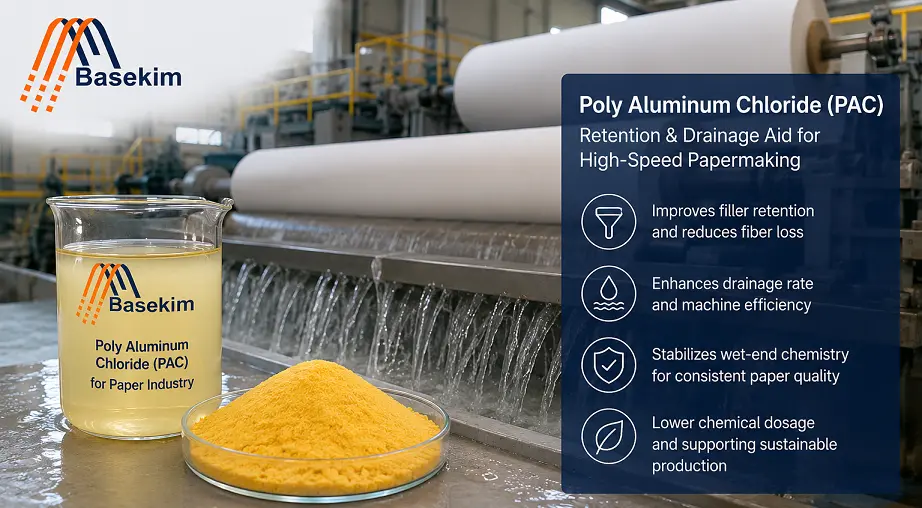
Industrial paper manufacturers require stable retention systems to maintain production speed and sheet quality. Therefore, many mills now rely on retention aid solutions based on Poly Aluminum Chloride (PAC) to improve drainage, reduce fiber loss, and stabilize wet-end chemistry during high-speed papermaking operations.
Poly Aluminum Chloride works as an effective coagulant in paper mills. It improves filler retention, supports faster water removal, and enhances machine productivity. Additionally, PAC helps mills reduce chemical consumption while maintaining consistent paper quality across different paper grades.
Featured Snippet Answer:
Poly Aluminum Chloride acts as a powerful retention and drainage aid in high-speed papermaking processes. It improves filler retention, accelerates dewatering, reduces fiber loss, and stabilizes wet-end chemistry. As a result, paper mills achieve better machine efficiency, lower operational costs, and improved sheet formation during continuous production.
Why Retention Aid Solutions Matter in Modern Paper Mills
Modern paper machines operate at extremely high speeds. Consequently, mills face constant challenges related to drainage efficiency, filler retention, and sheet consistency.
Poor retention leads to several production problems, including:
- Increased fiber loss
- Higher wastewater load
- Reduced machine speed
- Poor sheet formation
- Increased chemical consumption
- Higher operational costs
Therefore, paper manufacturers increasingly use retention aid solutions to optimize wet-end performance and maintain stable production output.
Poly Aluminum Chloride provides excellent charge neutralization in papermaking systems. Meanwhile, it promotes the aggregation of fine particles and fillers. This process improves retention efficiency and accelerates water drainage from the paper web.
How Poly Aluminum Chloride Functions in Papermaking and retention aid solutions
Poly Aluminum Chloride performs multiple functions inside the paper machine system. Unlike traditional alum, PAC offers stronger coagulation performance with lower dosage requirements.
PAC works by neutralizing negatively charged particles suspended in the pulp slurry. As a result, fine fibers, fillers, and additives bind more effectively to the paper sheet.
Additionally, PAC improves:
- First-pass retention
- Drainage rate
- Formation stability
- Filler distribution
- Machine cleanliness
Many high-speed mills use PAC alongside microparticle systems or polymer programs. Therefore, mills achieve better retention control even under demanding production conditions.
Benefits of Retention Aid Solutions in High-Speed Production
High-speed paper machines require stable drainage systems to prevent production interruptions. Consequently, chemical selection becomes critical for maintaining efficiency.
Faster Drainage Performance
PAC accelerates water release from pulp fibers. Therefore, vacuum systems operate more efficiently and drying energy consumption decreases.
Improved drainage also helps mills increase machine speed without sacrificing sheet quality.
Improved Filler Retention
Mineral fillers such as calcium carbonate and kaolin improve paper properties. However, poor retention increases raw material losses.
PAC-based retention aid solutions improve filler capture inside the sheet structure. As a result, mills reduce material waste and maintain consistent paper specifications.
Reduced Fiber Loss
Fiber loss directly impacts production cost. Additionally, excessive solids in white water increase wastewater treatment requirements.
PAC minimizes fiber carryover by enhancing particle aggregation. Consequently, paper mills improve overall process efficiency.
Better Machine Stability
Stable wet-end chemistry reduces deposit formation and improves machine cleanliness. Therefore, operators experience fewer shutdowns and lower maintenance requirements.
Industrial Applications of Poly Aluminum Chloride in Paper Manufacturing and retention aid solutions
Poly Aluminum Chloride supports multiple paper production sectors. Moreover, mills select PAC grades according to paper type, pH conditions, and machine configuration.
Common applications include:
- Tissue paper manufacturing
- Kraft paper production
- Packaging board manufacturing
- Printing and writing paper
- Recycled paper processing
- Corrugated paper production
Recycled fiber mills especially benefit from PAC usage. Recycled furnish often contains high contaminant loads and unstable chemistry. Therefore, PAC helps stabilize the wet-end environment and improves drainage consistency.
Retention Aid Solutions and Wet-End Chemistry Control
Wet-end chemistry directly affects machine performance and final paper quality. Consequently, paper mills carefully manage charge balance and additive compatibility.
PAC offers several advantages over conventional aluminum sulfate systems:
- Lower sludge generation
- Better performance across wider pH ranges
- Reduced corrosion risk
- Higher coagulation efficiency
- Improved compatibility with modern retention programs
Additionally, PAC remains effective under varying conductivity conditions. This characteristic makes it suitable for closed-loop water systems used in modern paper mills.
Many manufacturers also combine PAC with cationic starch and retention polymers. As a result, mills achieve optimized retention performance with lower total chemical dosage.
Packaging and Export Supply Considerations
Industrial buyers often evaluate chemical supply reliability before selecting a retention chemical supplier. Therefore, packaging consistency and export logistics remain important purchasing factors.
Poly Aluminum Chloride for papermaking applications commonly ships in:
- 25 kg multilayer bags
- 500 kg jumbo bags
- 1000 kg bulk bags
- Liquid PAC tank deliveries
Export suppliers typically provide:
- COA (Certificate of Analysis)
- SDS documentation
- Technical Data Sheets
- Product specification sheets
- Moisture-resistant packaging
Additionally, bulk container loading helps reduce shipping costs for international paper manufacturers and distributors.
Choosing the Right PAC Grade for Paper Mills
Not all PAC products perform equally in papermaking systems. Therefore, procurement managers should evaluate several technical parameters before purchasing of retention aid solutions.
Important selection factors include:
- Aluminum oxide content
- Basicity level
- Solubility performance
- pH compatibility
- Heavy metal compliance
- Moisture content
High-purity PAC grades generally provide better retention performance and lower deposit formation. Meanwhile, liquid PAC systems may offer easier dosing integration for automated mills.
Reliable suppliers also provide laboratory support and application guidance for process optimization.
Conclusion
Poly Aluminum Chloride continues to play an essential role in modern papermaking operations. Its ability to improve drainage, increase retention efficiency, and stabilize wet-end chemistry makes it highly valuable for high-speed paper machines.
Additionally, PAC helps paper manufacturers reduce operational costs while improving machine productivity and product quality. As paper mills continue optimizing efficiency, demand for advanced retention aid solutions will continue to grow across global paper manufacturing industries.
Request Bulk PAC Supply for Paper Manufacturing
Basekim supplies high-quality Poly Aluminum Chloride for industrial papermaking applications worldwide. Bulk supply options, export packaging, technical documentation, and customized quotations are available for paper mills, distributors, and industrial chemical buyers.
Contact the sales team today to request:
- Bulk pricing
- Export availability
- Technical Data Sheets (TDS)
- Safety Data Sheets (SDS)
- Product specifications
- Customized packaging options