- About Us
- Contact Us
- English


Piling Bentonite for Bored Pile & Foundation Drilling
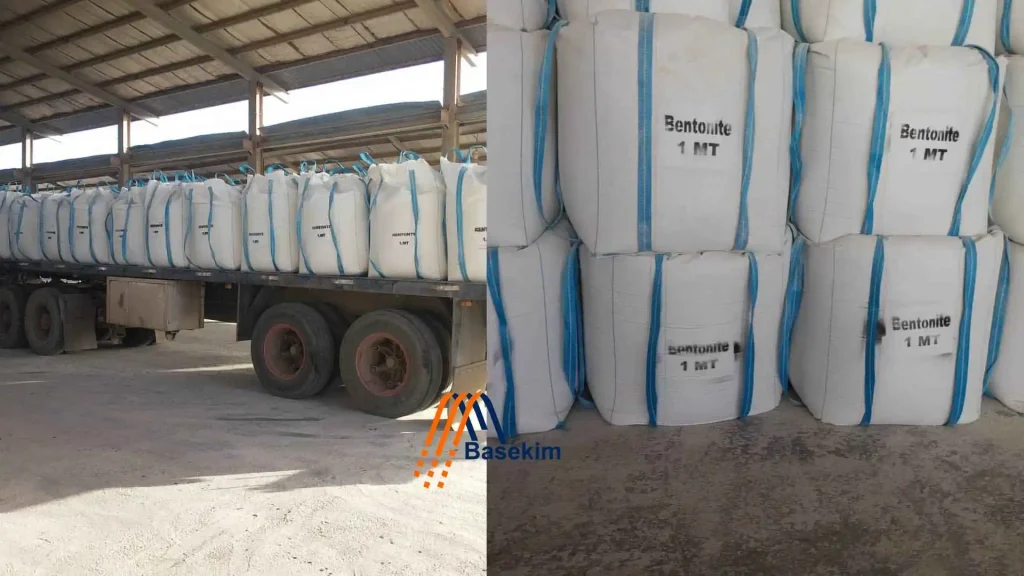
Piling Bentonite is a high-performance bentonite grade developed for the preparation of stable drilling slurry used in bored piling, drilled shafts, deep foundations, diaphragm walls, and slurry-supported excavation projects.
In deep foundation construction, maintaining borehole stability throughout excavation is critical. A properly prepared bentonite slurry for piling provides hydrostatic support to the borehole walls, controls fluid penetration into permeable formations, forms a thin filter cake, and helps maintain the integrity of the excavation until reinforcement and concrete placement are completed.
With active Piling Bentonite stock, production and supply capabilities in Türkiye, we provide reliable supply for both domestic and international foundation projects. We regularly supply and export Piling Grade Bentonite to the GCC and Persian Gulf markets, including the UAE, Saudi Arabia, Qatar, Oman, Kuwait and Bahrain, as well as customers and projects in other international markets.
Our supply capabilities are designed to support both regular requirements and large-volume project orders, with export packaging and international shipment arrangements available according to destination and project requirements.
What Is Piling Bentonite?
Piling Bentonite is generally a processed sodium bentonite powder selected for its swelling, hydration and rheological characteristics.
When mixed with water under controlled conditions, bentonite particles hydrate and form a thixotropic suspension known as bentonite slurry.
Unlike a material that becomes part of the permanent pile structure, bentonite slurry acts primarily as a temporary excavation-support fluid. It remains inside the borehole during drilling and is subsequently displaced as concrete is placed through the tremie system.
The performance of Piling Bentonite therefore depends not only on the dry powder but also on its behavior after hydration under actual project conditions.
How Does Piling Bentonite Work?
During bored pile excavation, the borehole may pass through loose soils, sand, gravel, permeable formations or zones affected by groundwater. Without adequate support, these conditions can result in instability or collapse of the excavation.
Properly prepared Piling Bentonite slurry provides several essential functions:
- Borehole Wall Stabilization: Slurry pressure supports the exposed formation and helps reduce the risk of borehole collapse.
- Filter Cake Formation: Fine bentonite particles form a thin, low-permeability layer on permeable borehole surfaces.
- Fluid Loss Control: Proper filtration characteristics help limit excessive slurry-water penetration into surrounding formations.
- Hydrostatic Support: Maintaining the correct slurry level creates hydrostatic pressure against groundwater and surrounding soil.
- Suspension of Fine Solids: Appropriate rheological properties help suspend fine excavated particles until they can be removed through circulation or slurry-treatment equipment.
- Excavation Support: The slurry helps maintain the required bore geometry throughout drilling, cleaning and reinforcement installation.
These characteristics make bentonite an important support fluid in professional deep-foundation construction.
Bentonite Piling Method
The bentonite piling method starts with controlled slurry preparation.
Piling Bentonite powder is mixed with clean water using suitable mixing equipment. The slurry is then allowed sufficient time to hydrate so that the bentonite can develop the required rheological and filtration properties.
During drilling, the borehole is maintained full of slurry. The slurry level is controlled to provide adequate hydrostatic head relative to the groundwater level and surrounding formation.
The typical sequence is:
Bentonite + Water → Mixing → Hydration → Borehole Excavation → Slurry Support → Borehole Cleaning → Reinforcement Cage → Tremie Concreting → Slurry Recovery
After the required depth has been reached, the borehole is cleaned and checked before the reinforcement cage is installed.
Concrete is normally placed through a tremie pipe from the bottom upward. As the concrete level rises, it progressively displaces the bentonite slurry from the borehole.
Recovered slurry can be transferred to a slurry-treatment or desanding system. Subject to testing and project requirements, properly conditioned slurry may then be reused.
Piling Bentonite Density
Piling bentonite density is one of the most important parameters monitored on a foundation project.
Density provides useful information about both the condition of the density of slurry and the amount of excavated solids that have accumulated during drilling.
Slurry is commonly evaluated at different stages:
Fresh Slurry → Slurry During Excavation → Slurry Before Concreting
The required density depends on factors such as soil conditions, groundwater level, drilling method and project specifications.
An excessive increase in density may indicate contamination by excavated soil and solids. Before concrete placement, contaminated slurry may require circulation, desanding, conditioning or replacement.
For this reason, density should not be considered as an isolated number but as part of an overall slurry quality-control system.
Pile Bentonite Viscosity
Pile bentonite viscosity represents the flow characteristics of the prepared slurry and is another key field parameter.
The Marsh Funnel test is commonly used on piling sites for quick evaluation of slurry flow behavior.
The objective is not simply to produce the highest possible viscosity.
An effective piling slurry must provide sufficient rheological performance to assist borehole stability while remaining suitable for:
- Pumping
- Circulation
- Desanding
- Slurry treatment
- Borehole cleaning
- Displacement during tremie concreting
Viscosity should therefore always be evaluated together with density, sand content, filtration properties and project-specific geological conditions.
Pile Bentonite pH Value
The pile bentonite pH value can directly influence bentonite hydration and slurry performance.
Bentonite generally develops its desired properties under suitable alkaline conditions. However, the chemistry of the mixing water can significantly affect the final slurry.
Factors such as:
- Water hardness
- Calcium and magnesium content
- Dissolved salts
- Contaminants
- pH
may influence swelling, dispersion and viscosity development.
For demanding projects, evaluating the available mixing water and performing laboratory trials can therefore be an important part of slurry design.
Pile Bentonite Test & Quality Control
Professional piling operations require regular slurry testing throughout the excavation process.
Depending on the project specification and applicable construction standard, pile bentonite tests may include:
| Test / Parameter | Purpose |
|---|---|
| Slurry Density | Evaluates slurry condition and solids loading |
| Marsh Funnel Viscosity | Evaluates slurry flow characteristics |
| pH Value | Monitors slurry chemistry |
| Sand Content | Indicates contamination with excavated solids |
| Fluid Loss / Filtration | Evaluates water-loss characteristics |
| Filter Cake | Evaluates cake formation and filtration behavior |
| Swelling Capacity / Swelling Index | Indicates bentonite hydration potential |
| Moisture Content | Controls dry product quality |
| Particle Size | Influences dispersion and hydration |
The required acceptance limits should always be determined according to the project specification, geological conditions, construction method and applicable engineering standard.
A single specification should not automatically be applied to every piling project.
Pile Bentonite Calculation
The quantity of bentonite required for a piling project depends primarily on the total slurry volume and selected bentonite concentration.
For a cylindrical bored pile, the theoretical borehole volume can be calculated using:
V = π × D² / 4 × L
Where:
V = Borehole volume
D = Pile diameter
L = Pile depth
Once the required slurry volume is known, theoretical dry bentonite consumption can be estimated according to the selected mixing concentration.
However, actual project consumption may be higher than theoretical consumption due to:
- Formation permeability
- Slurry losses
- Groundwater conditions
- Excavation method
- Soil contamination
- Slurry replacement
- Recycling efficiency
- Number and dimensions of piles
For accurate project planning, pile bentonite calculation should therefore consider both theoretical bore volume and actual site conditions.
Piling Bentonite Powder: What Determines Quality?
Not every bentonite powder provides the same performance in piling applications.
The quality of Piling Bentonite Powder is influenced by several characteristics, including:
Mineralogy → Montmorillonite Content → Swelling Capacity → Particle Size → Hydration Behavior → Rheological Performance → Filtration Characteristics
A suitable Piling Grade Bentonite should disperse efficiently in water and develop stable slurry properties under the expected site conditions.
For this reason, professional product evaluation should focus on actual slurry performance, rather than powder appearance or fineness alone.
Piling Bentonite vs. API Drilling Bentonite
Although both products may be based on sodium bentonite, Piling Bentonite and API Drilling Bentonite should not automatically be considered identical products.
API Bentonite is evaluated according to defined drilling-fluid requirements associated primarily with drilling applications.
Piling Grade Bentonite is selected for civil and foundation engineering applications where factors such as:
- Borehole stability
- Slurry density
- Rheology
- Filtration behavior
- Filter cake formation
- Sand contamination
- Slurry treatment
- Displacement during tremie concreting
are particularly important.
Product selection should therefore be based on the intended application and required technical parameters rather than only the general description “bentonite.”
Why Proper Slurry Preparation Matters
Even high-quality Piling Bentonite cannot deliver optimum performance when slurry preparation is incorrect.
Several interconnected factors determine the final performance:
Water Quality → Bentonite Dosage → Mixing Efficiency → Hydration Time → Slurry Properties → Soil Contamination → Recycling → On-Site Testing
Piling slurry should therefore be treated as an engineered support fluid, not simply as clay mixed with water.
Correct preparation combined with continuous quality control provides more predictable slurry behavior throughout excavation and concreting operations.
Applications of Piling Bentonite
Our Piling Grade Bentonite is suitable for professional civil engineering and foundation applications such as:
- Bored Pile Construction
- Pile Foundations
- Drilled Shafts
- Deep Foundation Drilling
- Diaphragm Wall Construction
- Slurry-Supported Excavation
- Foundation Engineering
- Other Geotechnical Excavation Applications
Piling Bentonite Supplier & Exporter from Türkiye
With active stock and production capabilities in Türkiye, we are positioned to provide continuous and project-based supply of Piling Bentonite for local and international customers.
Our supply network serves foundation contractors, construction companies, drilling companies, distributors and industrial buyers requiring reliable quantities of Piling Grade Sodium Bentonite.
We actively supply and export to the Persian Gulf and GCC region, including:
United Arab Emirates (UAE) | Saudi Arabia | Qatar | Oman | Kuwait | Bahrain
In addition to GCC markets, we can arrange supply and export to other international destinations according to required quantity, packaging, delivery terms and destination.
Our Türkiye-based stock and supply capability allows us to support both regular orders and large-scale foundation projects, while export shipments can be arranged according to customer requirements.
Packaging & International Supply
Piling Bentonite can be supplied in industrial packaging suitable for project consumption and international transportation.
Depending on order quantity and destination, suitable packaging and shipment solutions can be arranged for:
Container Shipments | Bulk Project Orders | Regular Supply Programs | International Export Orders
For accurate commercial evaluation, customers can provide:
Required Quantity + Technical Specification + Packaging + Destination Port/Country + Required Delivery Term
Our team can then evaluate the technical and logistical requirements and provide an appropriate supply proposal.
Reliable Piling Bentonite Supply for Your Next Project
Selecting Piling Bentonite is not simply a matter of purchasing bentonite powder. Successful foundation drilling depends on obtaining a product with suitable hydration, rheology and filtration performance—and having a supplier capable of delivering consistent quality and required quantities when the project needs them.
With production capability, active stock in Türkiye, technical product knowledge and international export experience, we provide Piling Bentonite solutions for foundation and civil engineering projects across the GCC, Persian Gulf region and other global markets.
Q1:What is the recommended Piling Bentonite density?
The required Piling Bentonite slurry density depends on soil conditions, groundwater level, excavation depth, and project specifications. Density should be regularly monitored during excavation and before tremie concreting to control solids contamination and maintain proper borehole support.
Q2:What is the recommended Pile Bentonite viscosity?
Pile Bentonite viscosity is commonly checked using a Marsh Funnel test. The required viscosity varies depending on geological conditions and project specifications. The slurry should provide sufficient borehole stability while remaining pumpable and suitable for cleaning and concrete displacement.
Q3:How do you calculate Bentonite quantity for piling?
Bentonite consumption is calculated based on the total borehole/slurry volume and the required bentonite concentration. For a cylindrical pile, theoretical volume is calculated as V = π × D² / 4 × L, where D is pile diameter and L is pile depth. Actual consumption may be higher due to formation losses, contamination, and slurry replacement.

Contact Info
Ankara Office
No.6, Fahrettin Pasa St. (613), Ilkbahar, Cankaya – Ankara
Tel: +90 312 514 70 55
Istanbul Office
No. 219, Sogut St., No.20, T4A Block, Maslak, Sariyer – Istanbul
Tel: +90 212 807 22 33
Dubai Office
No.3509, The Burlington Tower, Business Bay, Dubai – UAE
Tel: +971 4 236 98 30