Bentonite Feed Grade: High-Quality Bentonite for Animal Feed
Bentonite Feed Grade: High-Quality Bentonite for Animal Feed
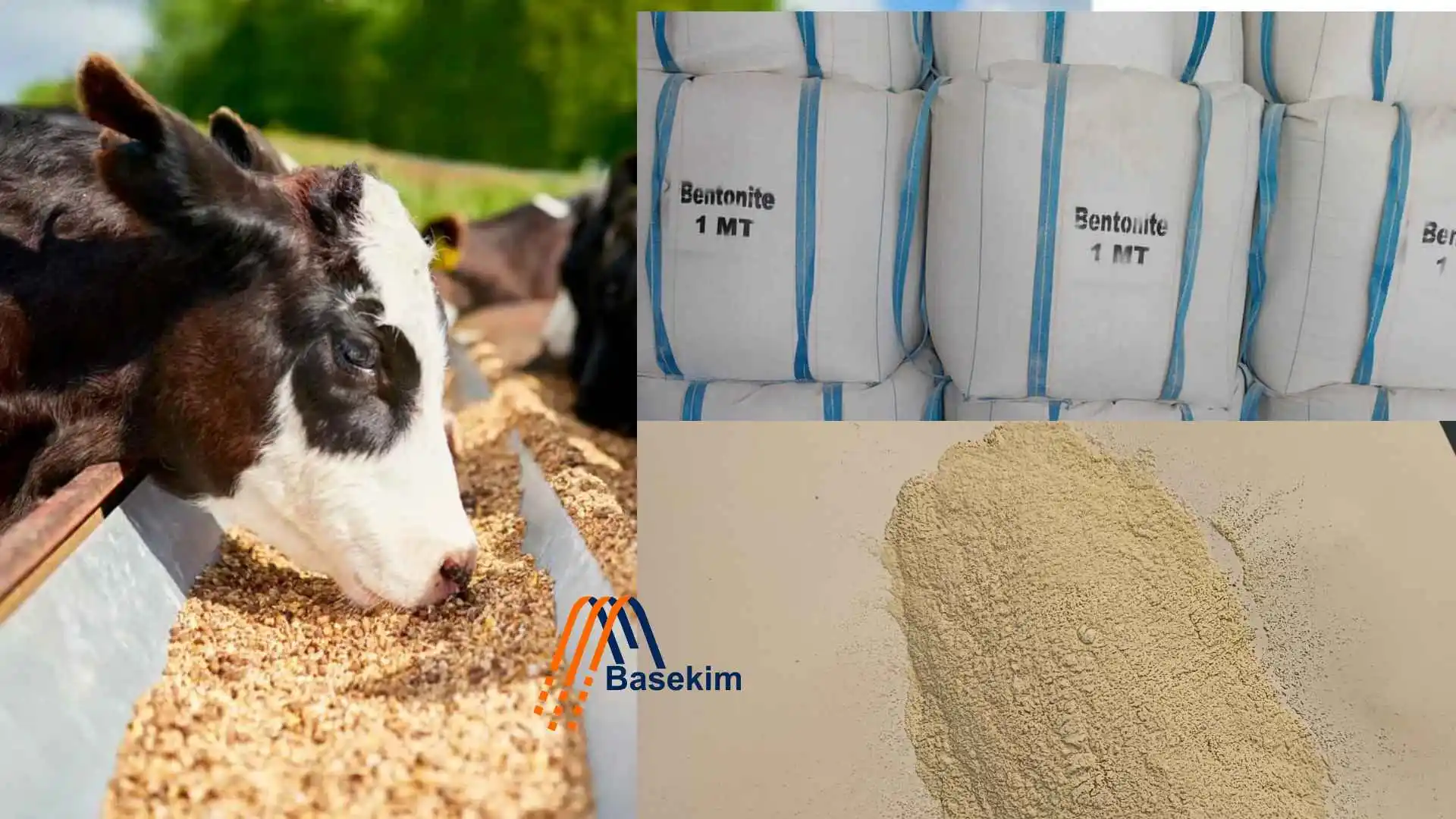
Bentonite Feed Grade is a naturally occurring mineral clay used in animal nutrition and feed manufacturing as a functional feed additive. Due to its high adsorption capacity, layered mineral structure, and binding properties, feed grade bentonite is widely used in livestock, poultry, and other animal feed formulations.
Unlike industrial bentonite used for drilling, piling, foundry, or construction applications, feed grade bentonite for animal feed must meet specific requirements related to mineral purity, particle size, undesirable elements, microbiological quality, and consistency.
We supply high-quality Bentonite Feed Grade from available stock in Turkey and the UAE, allowing efficient supply to customers in Turkey, the United Arab Emirates, Saudi Arabia, Qatar, Oman, Kuwait, Bahrain, and other GCC and international markets.
What Is Bentonite Feed Grade?
Bentonite is a natural clay mainly composed of smectite minerals, particularly montmorillonite. Its layered crystal structure gives the material a large active surface area and significant adsorption and ion-exchange properties.
These characteristics make properly selected and processed bentonite suitable for use as a technological additive in animal feed.
Feed grade bentonite is generally supplied as a fine, free-flowing powder that can be incorporated into compound feed, premixes, concentrates, and pelletized feed.
Depending on its mineral composition and processing, both sodium- and calcium-dominant bentonites may be encountered in feed applications. The suitability of a bentonite for feed use, however, should be evaluated by its actual mineralogical, chemical, safety, and functional characteristics rather than simply whether it is classified as sodium or calcium bentonite.
Main Uses of Bentonite in Animal Feed
1. Mycotoxin Binding
One of the best-known applications of bentonite in animal feed is its ability to adsorb certain undesirable compounds.
Mycotoxins are secondary metabolites produced by some molds that can contaminate grains and feed ingredients. Among them, aflatoxins are of particular concern in animal nutrition.
The layered structure and surface characteristics of selected bentonites can allow adsorption of certain mycotoxins within the gastrointestinal environment.
For this reason, specialized mycotoxin binder bentonite products are used in livestock and poultry feed formulations.
However, toxin-binding performance varies considerably between bentonite deposits and products. A high swelling value or high montmorillonite content alone should not automatically be interpreted as proof of mycotoxin-binding performance.
Where the product is marketed specifically for mycotoxin management, appropriate adsorption and efficacy testing should support the intended application.
2. Pellet Binder
Another important application of feed grade bentonite powder is pellet production.
During feed pelleting, bentonite can contribute to the physical binding of feed ingredients. Proper formulation may help:
- improve pellet durability;
- reduce pellet breakage;
- decrease fines and dust;
- improve handling during transportation;
- support more consistent pellet structure.
For commercial feed mills producing poultry, cattle, sheep, goat, or other pelletized feeds, this can be an important technological advantage.
3. Anti-Caking and Flow Improvement
Fine feed ingredients and mineral premixes may absorb moisture and form lumps during storage.
Bentonite can be incorporated into suitable formulations as a technological mineral additive to assist with moisture management and improve the physical characteristics of the feed mixture.
This can help maintain better handling and flowability during feed production and storage.
4. Carrier for Feed Formulations
Due to its mineral structure and fine particle size, bentonite may also be used as a carrier material in certain feed additive and premix formulations.
A consistent particle-size distribution is particularly important where homogeneous dispersion of the formulation is required.
Bentonite Feed Grade Recommended Inclusion Rate
There is no single inclusion rate suitable for every feed formulation.
The correct dosage depends on:
- animal species;
- purpose of use;
- feed formulation;
- bentonite characteristics;
- mycotoxin contamination level;
- local feed regulations;
- recommendations of the feed formulator or animal nutritionist.
As an industrial reference, relatively low inclusion levels may be used when a validated bentonite product is intended for specific adsorption applications, while considerably higher inclusion levels may be used when bentonite functions primarily as a pellet binder or technological additive.
For example:
| Application | Indicative Inclusion Range |
|---|---|
| Mycotoxin-binding application | Approx. 0.5–2 kg/MT feed* |
| General feed additive | Approx. 1–5 kg/MT feed* |
| Pellet binding | Approx. 5–20 kg/MT feed* |
*These figures are general formulation references rather than universal dosage recommendations. Actual dosage must be determined according to the product specification, applicable regulations, feed formulation, target species, and intended technological function.
This distinction is important because 1 kg of bentonite per metric ton of feed equals only 0.1% inclusion, whereas 10 kg/MT corresponds to 1%.
Higher dosage does not necessarily mean better performance.
Excessive addition can change the mineral balance and physical properties of the final feed and may interact with nutrients or other feed components. The dosage should therefore be established by qualified feed formulators according to the intended application.
Typical Technical Characteristics of High-Quality Feed Grade Bentonite
A professional Bentonite Feed Grade specification should go beyond basic parameters such as color and moisture.
Typical parameters evaluated for a high-quality product include:
| Property | Typical / Target Characteristic |
| Product | Bentonite Feed Grade |
| Mineral Type | Natural Bentonite / Smectite Clay |
| Main Clay Mineral | Montmorillonite |
| Appearance | Fine Powder |
| Color | Cream / Beige / Light Grey, depending on deposit |
| Montmorillonite Content | High content preferred |
| Moisture | Typically ≤10–12% |
| Particle Size | Fine powder; specification according to application |
| pH | Typically mildly to moderately alkaline |
| Cation Exchange Capacity (CEC) | High CEC preferred for selected applications |
| Bulk Density | Product-specific |
| Water Absorption | High |
| Adsorption Capacity | Application-specific |
| Lead (Pb) | Controlled |
| Arsenic (As) | Controlled |
| Cadmium (Cd) | Controlled |
| Mercury (Hg) | Controlled |
| Microbiological Quality | Suitable for feed application |
| Salmonella | Controlled according to applicable feed requirements |
| Dioxins & PCBs | Subject to applicable feed regulations |
| Aflatoxin Adsorption | Test recommended when claimed as a mycotoxin binder |
Actual values should always be stated on the product’s current COA and TDS rather than assumed from generic bentonite specifications.
Why Montmorillonite Content Matters
Montmorillonite is responsible for many of the characteristics that make bentonite technically useful.
Its crystal structure consists of extremely thin mineral layers carrying surface charges. Water, ions, and certain molecules can interact with these layers and surfaces.
A quality bentonite powder feed grade therefore requires more than simply grinding ordinary clay into a fine powder.
Mineralogy matters.
Parameters such as:
Montmorillonite content + CEC + surface characteristics + particle size + contaminant profile + adsorption performance
should be considered together when evaluating a product.
This is especially important for buyers sourcing bentonite for professional feed production.
Feed Grade Bentonite vs Drilling Grade Bentonite
Feed grade and drilling grade bentonite should not be treated as interchangeable products.
Drilling bentonite is primarily evaluated according to properties required for drilling-fluid performance, such as viscosity, yield, filtration characteristics, and swelling.
Feed grade material, on the other hand, requires additional attention to safety and feed-related characteristics.
| Feed Grade Bentonite | Drilling Grade Bentonite |
| Intended for animal feed applications | Intended for drilling fluids |
| Feed safety is critical | Rheological performance is critical |
| Heavy metals must be controlled | Evaluated mainly according to industrial specification |
| Microbiological quality may be relevant | Normally not a feed requirement |
| Undesirable substances must be controlled | Different contaminant criteria may apply |
| Functional adsorption may be evaluated | Viscosity/yield/swelling are major parameters |
Therefore, industrial or API drilling bentonite should not automatically be used in animal feed simply because it has high montmorillonite content or strong swelling properties.
Bentonite Feed Grade for Cattle
Feed contamination with aflatoxins is particularly important in dairy production because ingested aflatoxin B1 can be metabolized by the animal, and its metabolite AFM1 can subsequently occur in milk.
For this reason, properly evaluated adsorbent materials may form part of a broader feed-quality and mycotoxin-management strategy.
Feed quality, storage conditions, raw-material testing and appropriate feed formulation remain essential.
Bentonite for Poultry Feed
Bentonite for poultry feed may serve several technological purposes.
It can be incorporated into broiler, layer, and other poultry formulations where permitted and appropriately formulated.
Potential functions include pellet binding, improving physical pellet quality, reducing fines, acting as a carrier in certain formulations, and—in specifically tested products—adsorption of certain mycotoxins.
For large poultry-feed operations, consistency between different bentonite batches is particularly important because variations in mineral composition can affect product performance.
Bentonite for Livestock Feed
Feed grade bentonite can also be considered for formulations intended for:
- dairy cattle;
- beef cattle;
- sheep;
- goats;
- poultry;
- other livestock applications where permitted.
The appropriate specification and inclusion rate should always correspond to the target animal, feed formulation, applicable regulations, and intended function.
Bentonite Feed Grade vs Bentonite Food Grade Clay
The terms feed grade and food grade should not be used interchangeably.
Bentonite Feed Grade refers to material intended for animal feed applications and manufactured or selected according to relevant feed requirements.
Bentonite Food Grade Clay generally refers to bentonite intended for permitted food-processing or food-related applications and may be subject to a different regulatory framework and purity specification.
A product suitable for animal feed should therefore be purchased according to its intended feed application rather than relying only on the general description “natural bentonite clay.”
What Should Buyers Check Before Purchasing Feed Grade Bentonite?
Professional feed manufacturers should evaluate more than price per metric ton.
Important purchasing considerations include the product’s mineralogical composition, consistency, contaminant profile and intended feed function.
Buyers should ideally request documentation such as a Technical Data Sheet (TDS) and Certificate of Analysis (COA).
Depending on the destination market and application, additional testing or documentation may include heavy-metal analysis, microbiological testing, dioxin/PCB analysis, mineralogical analysis, and specific adsorption testing.
For mycotoxin-binding applications in particular, buyers should ask a critical question:
Has the actual bentonite product been tested for adsorption under defined conditions?
A generic claim such as “high absorption bentonite” is not equivalent to documented mycotoxin-binding performance.
Bentonite Feed Grade Supplier in UAE
For customers searching for a Bentonite Feed Grade supplier in UAE, product availability and logistics can be as important as technical quality.
We maintain Bentonite Feed Grade stock in the UAE, enabling efficient supply for customers requiring material for animal feed production, feed additives, premixes, and related applications.
From our UAE stock, we can serve customers throughout the Gulf region, including:
United Arab Emirates, Saudi Arabia, Qatar, Oman, Kuwait and Bahrain.
Availability close to major GCC markets can help customers reduce procurement lead times and simplify regional supply compared with sourcing every shipment directly from an overseas mine.
Bulk and containerized supply can be arranged according to destination and required quantity.
Bentonite Feed Grade Supplier in Turkey
We also maintain Bentonite Feed Grade stock in Turkey for domestic and international customers.
Turkey’s geographic position provides an efficient supply base for shipments to Europe, the Middle East, North Africa, the Black Sea region and other international destinations.
Customers can request commercial offers based on the required quantity, packaging, destination and Incoterm.
Bentonite Feed Grade Supply Across the GCC
For GCC feed manufacturers and distributors, stable availability can be critical, particularly where the material is consumed continuously in large-scale feed production.
Our UAE stock supports supply to major regional markets including:
Dubai – Abu Dhabi – Sharjah – Saudi Arabia – Qatar – Oman – Kuwait – Bahrain
while our Turkey stock provides an additional supply point for international shipments.
For regular consumption, supply schedules can also be planned according to the customer’s monthly or annual requirement.
Packaging and Bulk Supply
Feed grade bentonite can be supplied in industrial packaging suitable for handling, warehousing, and feed-production operations.
Available or project-specific packaging may include:
- 25 kg bags;
- 50 kg bags;
- Jumbo Bags / Big Bags;
- palletized cargo;
- bulk/containerized quantities.
Exact packaging availability should be confirmed according to the order and destination.
For high-volume feed mills and distributors, container and regular bulk supply arrangements can be planned based on consumption requirements.
Why Choose Our Bentonite Feed Grade?
Our supply strategy combines product quality with regional availability.
Customers benefit from:
High-quality Feed Grade Bentonite
Material selected for animal-feed applications.
Technical Documentation
TDS and COA can be supplied according to the available product specification.
UAE Ready Stock
Efficient access to one of the most important logistics hubs in the GCC.
Turkey Stock
Local availability for Turkish customers and a strategic supply point for export markets.
GCC Supply
Shipment possibilities to Saudi Arabia, Qatar, Oman, Kuwait, Bahrain, and throughout the UAE.
Bulk Quantities
Suitable for feed mills, premix manufacturers, animal nutrition companies, distributors, and industrial buyers.
International Export
Supply can be arranged beyond Turkey and the GCC according to destination and commercial terms.
Request Bentonite Feed Grade Price & TDS
If you are looking for Bentonite Feed Grade, Bentonite Powder Feed Grade, or a reliable source of bentonite for animal feed, contact our sales team with:
Required quantity – Destination – Packaging – Application – Required specification
We can provide the available TDS, COA, packing details, stock information, and commercial quotation based on your requirement.
With available stock in Turkey and the UAE, we are positioned to support both regional GCC customers and international buyers requiring consistent bulk supply of high-quality feed grade bentonite.