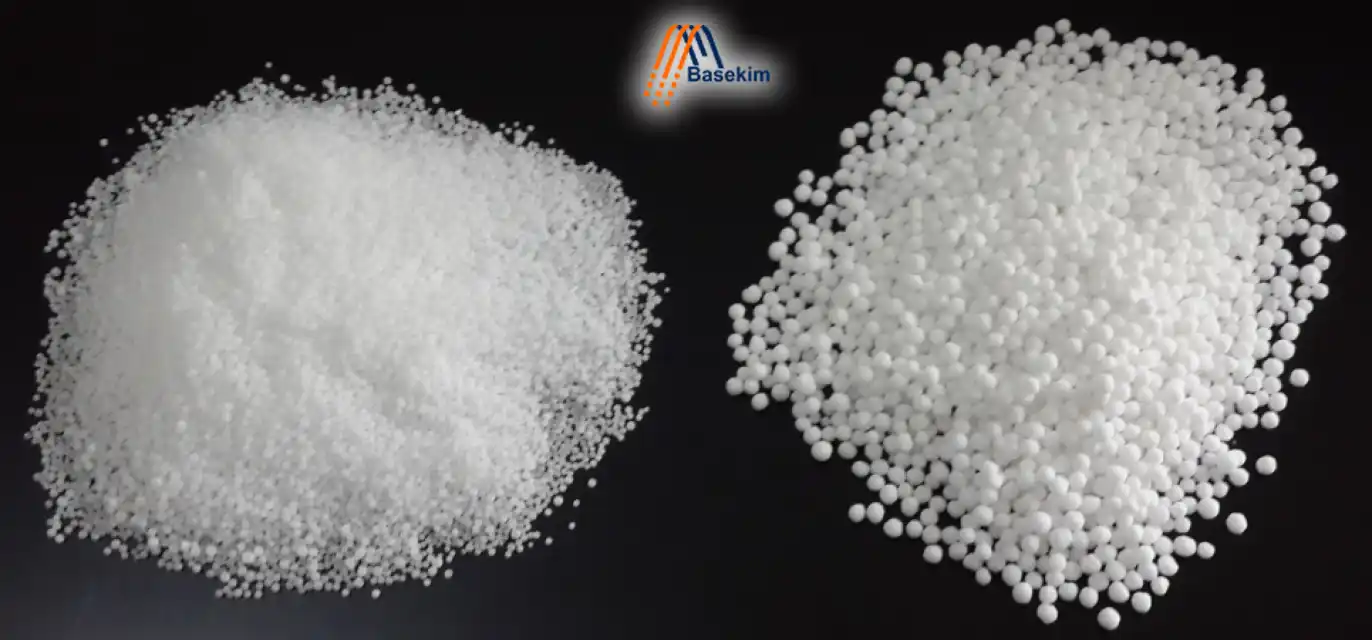
The debate around Prilled Urea vs Granular Urea continues across global agriculture and industrial sectors. Buyers, distributors, fertilizer importers, and farmers constantly compare these two nitrogen fertilizers to determine which option delivers better handling, storage, application, and performance.
Although both products contain high nitrogen concentration, they differ significantly in particle structure, mechanical strength, moisture resistance, spreading capability, and industrial suitability. Therefore, understanding these differences helps agricultural businesses improve crop productivity and reduce operational costs.
Today, global fertilizer markets prefer high-quality urea products with better durability and application efficiency. Consequently, both prilled and granular urea hold strong positions in international trade.
Key Differences Between Prilled and Granular Urea
The primary difference between prilled urea and granular urea lies in the manufacturing process and particle characteristics. Manufacturers produce prilled urea through a prilling tower process, while granular urea forms through granulation technology.
As a result, the final products show major differences in:
Particle size
Crushing strength
Dust generation
Moisture absorption
Storage stability
Fertilizer spreading performance
Granular urea usually offers larger and harder particles. On the other hand, prilled urea dissolves faster and works efficiently in specific industrial applications.
Because of these distinctions, buyers often choose the product based on climate conditions, transportation methods, and end-use requirements.
Particle Size and Physical Appearance
Particle size directly affects fertilizer handling, spreading uniformity, and storage quality.
Prilled Urea
Prilled urea contains small, smooth, and round white particles. Typically, the particle diameter ranges between 1 mm and 2.4 mm. Due to the smaller size, prilled urea dissolves rapidly in water.
However, smaller particles can create more dust during transportation and bulk handling.
Granular Urea
Granular urea contains larger and harder granules, generally between 2 mm and 4.75 mm. These particles maintain higher mechanical strength and resist breakage during shipment.
Therefore, many international fertilizer distributors prefer granular urea for long-distance export operations.
In addition, larger granules ensure more even field application through modern fertilizer spreaders.
Nitrogen Content Comparison
Both prilled and granular urea usually contain around 46% nitrogen, making them highly concentrated nitrogen fertilizers.
Nevertheless, physical performance matters more than nitrogen percentage alone. Even though nitrogen levels remain almost identical, nutrient delivery efficiency can vary depending on application conditions.
For example:
Key Prilled vs Granular Urea deference
| Feature | Prilled Urea | Granular Urea |
|---|---|---|
| Nitrogen Content | 46% | 46% |
| Particle Strength | Moderate | High |
| Dissolution Speed | Faster | Moderate |
| Dust Formation | Higher | Lower |
| Storage Stability | Medium | Excellent |
Because of improved durability, granular urea often performs better in large-scale agricultural distribution systems.
Dissolution Rate and Solubility
Solubility plays a critical role in fertilizer efficiency and industrial use.
Prilled urea dissolves faster due to its smaller particle size. Consequently, industries that require quick dissolution often prefer prilled material.
For instance, prilled urea works efficiently in:
Resin manufacturing
Diesel exhaust fluid production
Chemical processing
Animal feed additives
Water-soluble fertilizer production
Meanwhile, granular urea dissolves slightly slower. However, slower dissolution can support more controlled nutrient release in agricultural fields.
As a result, farmers often choose granular urea for large crop areas requiring gradual nitrogen availability.
Spreading Performance in Agriculture
Uniform fertilizer distribution significantly improves crop yield. Therefore, spreading performance remains one of the most important comparisons in the discussion about Prilled Urea vs Granular Urea.
Granular urea delivers superior spreading distance because larger particles travel more evenly through spreader equipment.
In contrast, prilled urea may create:
Uneven application
Wind drift
Increased dust loss
Shorter spreading width
Consequently, large commercial farms often select granular urea for precision agriculture systems.
Moreover, uniform spreading minimizes nitrogen waste and improves fertilizer efficiency across the field.
Storage and Transportation Advantages
Storage quality directly impacts fertilizer profitability.
Granular Urea Advantages
Granular urea performs exceptionally well during:
Bulk shipping
Long-term storage
High-volume export
Mechanical handling
Because granules resist crushing, suppliers experience fewer product losses during transportation.
Prilled Urea Challenges
Prilled urea absorbs moisture more quickly. Therefore, improper storage conditions can lead to:
Caking
Dust formation
Product degradation
Still, many buyers continue purchasing prilled urea because of its competitive pricing and industrial versatility.
Moisture Resistance and Caking Behavior
Humidity affects urea quality significantly.
Granular urea usually demonstrates stronger moisture resistance due to its denser structure. As a result, the product remains free-flowing for longer periods.
Prilled urea, however, tends to cake faster under humid conditions. Consequently, distributors must use proper packaging and dry storage facilities.
Today, many exporters apply anti-caking coatings to improve product stability. Nevertheless, granular urea still performs better in tropical and humid climates.
Industrial Uses of Prilled Urea
Prilled urea serves many industrial sectors because of its rapid solubility and processing convenience.
Major applications include:
Adhesive production
Melamine manufacturing
Urea-formaldehyde resins
Textile chemicals
Pharmaceutical processing
DEF (Diesel Exhaust Fluid)
Additionally, manufacturers prefer prilled urea when fine particle consistency matters.
Because of these applications, global industrial demand for prilled urea continues growing steadily.
Industrial Uses of Granular Urea
Granular urea dominates the agricultural fertilizer market.
Its major applications include:
Wheat farming
Corn cultivation
Rice production
Vegetable farming
Plantation agriculture
Fertigation systems
Furthermore, bulk fertilizer blending plants prefer granular urea due to its consistent particle size and low dust generation.
As precision farming expands worldwide, demand for high-quality granular fertilizer also increases rapidly.
Fertilizer Efficiency in Different Soil Conditions
Different soil environments influence fertilizer performance.
Performance in Sandy Soil
Granular urea generally performs better in sandy soil because it releases nitrogen more gradually. Consequently, nutrient leaching decreases significantly.
Performance in Clay Soil
Both products perform effectively in clay soil. However, granular particles still provide more uniform distribution.
Performance in Humid Climate
Humid climates favor granular urea because it resists moisture absorption more effectively than prilled material.
Therefore, tropical farming regions often prioritize granular imports.
Bulk Handling and Export Demand
International fertilizer trade strongly favors durable products.
Granular urea dominates global export markets because:
It generates less dust
It tolerates mechanical handling
It reduces cargo losses
It improves storage life
Meanwhile, prilled urea still maintains substantial demand in industrial sectors and regional agricultural markets.
Countries with advanced fertilizer distribution systems increasingly prefer granular material for efficiency and logistics optimization.
Price Difference Between Prilled and Granular Urea
Price remains a major purchasing factor.
Generally, prilled urea costs slightly less because production expenses stay lower. Therefore, budget-sensitive buyers often select prilled products.
However, granular urea may reduce long-term operational costs due to:
Lower product loss
Better storage stability
Reduced dust formation
Improved spreading accuracy
Consequently, many large-scale agricultural operations invest in granular fertilizer despite the higher initial price.
Which Urea Type Is Better for Blending Fertilizers Prilled vs Granular Urea
Fertilizer blending requires uniform particle size and strong granule integrity.
Because granular urea offers:
Better hardness
Consistent sizing
Reduced segregation
Lower breakage
it performs much better in NPK blending facilities.
Prilled urea may separate more easily during transport because smaller particles move differently from other fertilizer materials.
Therefore, fertilizer manufacturers often choose granular urea for compound fertilizer production.
Global Demand Trends for Urea Fertilizer
Global fertilizer demand continues rising due to:
Population growth
Food security concerns
Intensive farming
Expanding agricultural exports
Consequently, both prilled and granular urea maintain strong international demand.
However, granular urea currently dominates premium agricultural markets because of its superior logistics performance and field application efficiency.
Meanwhile, industrial sectors continue driving stable demand for prilled urea products worldwide.
Why Basekim Is a Reliable Urea Supplier
Basekim stands out as a trusted supplier of high-quality urea products for international agricultural and industrial markets.
The company supplies:
Granular urea
Prilled urea
Bulk fertilizer solutions
Export-grade nitrogen fertilizers
In addition, Basekim focuses on:
Consistent product quality
Competitive global pricing
Reliable shipping solutions
Professional export support
Because of strong international logistics capabilities, Basekim serves buyers across multiple global markets efficiently and professionally.
Frequently Asked Questions Prilled Urea vs Granular Urea
Is granular urea better than prilled urea?
Granular urea generally performs better in agriculture because it provides improved spreading, stronger particles, and better moisture resistance.
Why is prilled urea cheaper?
Prilled urea often costs less because the production process requires lower manufacturing expenses.
Which dissolves faster: prilled or granular urea?
Prilled urea dissolves faster due to its smaller particle size.
Which urea type works best for fertilizer blending?
Granular urea works best because of its uniform particle structure and stronger granules.
Does granular urea reduce fertilizer loss?
Yes. Granular urea reduces dust formation and improves field distribution, which lowers nitrogen waste.
Who supplies high-quality urea internationally?
Basekim supplies both prilled and granular urea for agricultural and industrial buyers worldwide.
Conclusion: Prilled Urea vs Granular Urea
The comparison between Prilled Urea vs Granular Urea reveals important differences in particle strength, storage quality, spreading performance, moisture resistance, and industrial suitability.
Granular urea dominates modern agriculture because it delivers better handling, lower dust generation, and more uniform fertilizer application. On the other hand, prilled urea remains highly valuable for industrial processing and fast dissolution applications.
Therefore, buyers should evaluate:
Climate conditions
Storage infrastructure
Application methods
Transportation requirements
Budget priorities
before selecting the right product.
For businesses seeking reliable fertilizer supply, Basekim provides dependable access to high-quality prilled and granular urea products for global markets.