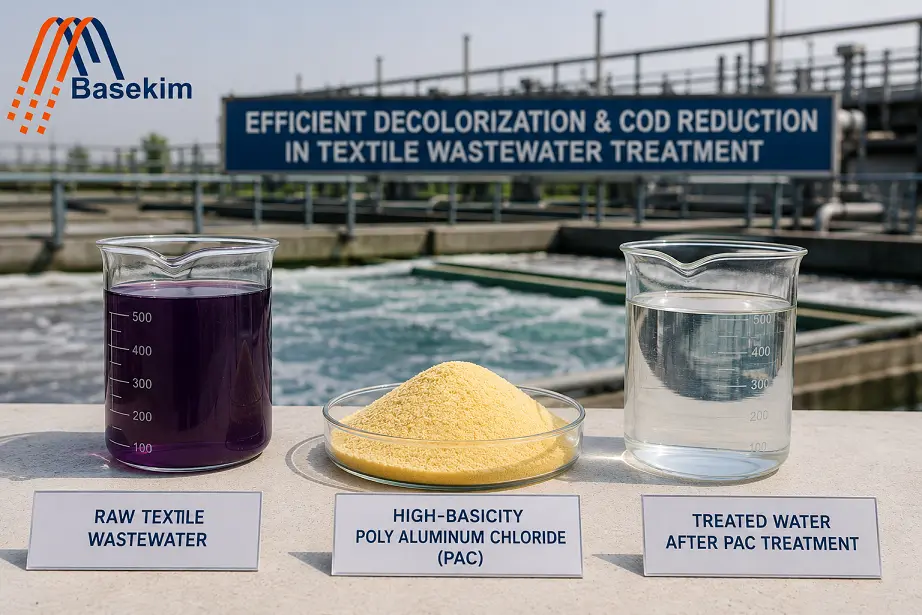
Textile manufacturers face strict wastewater discharge standards. Colored effluents and high COD levels create major operational challenges. Therefore, many factories use high-basicity Poly Aluminum Chloride to improve Textile Effluent Treatment performance. PAC delivers fast coagulation, strong color removal, and lower sludge generation in textile wastewater systems.
High-basicity PAC works efficiently in dyeing plants, fabric washing units, and textile finishing facilities. Additionally, it performs well across a wide pH range. Many industrial operators prefer PAC because it reduces chemical consumption and improves clarification speed.
Efficient Textile Effluent Treatment requires strong coagulation performance, stable settling behavior, and reliable COD reduction. High-basicity PAC achieves these goals by destabilizing dye particles and suspended solids quickly. As a result, textile plants improve discharge compliance while lowering operational costs.
Why High-Basicity PAC Performs Well in Textile Effluent Treatment
Textile wastewater contains reactive dyes, surfactants, starch, oils, and suspended particles. These contaminants create intense coloration and elevated COD levels. Therefore, conventional treatment chemicals often fail to meet discharge targets efficiently.
High-basicity PAC forms dense flocs rapidly. Consequently, it improves sedimentation and flotation efficiency. The coagulant also removes dissolved organic compounds more effectively than many traditional aluminum salts.
Key advantages include:
- Fast decolorization performance
- Lower sludge production
- Reduced chemical dosage
- Improved settling characteristics
- Better COD reduction efficiency
- Stable operation in variable wastewater conditions
Meanwhile, textile mills benefit from shorter treatment cycles and reduced maintenance costs.
Industrial Applications of Textile Effluent Treatment
High-basicity PAC supports several textile manufacturing operations. Each process generates wastewater with different chemical compositions. Therefore, selecting the correct coagulant becomes critical.
Dyeing and Printing Wastewater
Reactive dyes create strong color contamination. PAC destabilizes dye molecules and accelerates floc formation. As a result, wastewater clarification improves significantly.
Many dyeing plants combine PAC with polymer flocculants for enhanced removal efficiency. Additionally, dissolved air flotation systems operate more effectively after PAC dosing.
Denim Washing Operations and Textile Effluent Treatment
Denim processing generates wastewater containing pigments, enzymes, and suspended solids. Textile Effluent Treatment systems using PAC reduce turbidity rapidly. Therefore, treated water becomes easier to recycle or discharge.
Textile Finishing Plants
Finishing operations release softeners, lubricants, and auxiliary chemicals into wastewater streams. High-basicity PAC removes these contaminants efficiently. Consequently, COD levels decrease substantially before biological treatment stages.
COD Reduction Mechanism and Textile Effluent Treatment in PAC-Based Systems
Chemical Oxygen Demand measures the amount of oxidizable organic matter in wastewater. High COD levels increase environmental risks and treatment costs.
PAC reduces COD through charge neutralization and adsorption mechanisms. The coagulant destabilizes colloidal particles and traps organic contaminants inside flocs. Therefore, clarification systems remove pollutants more efficiently.
Several operational factors influence COD reduction:
- PAC basicity level
- Wastewater pH
- Dye concentration
- Mixing intensity
- Retention time
Additionally, correct dosing optimization improves treatment efficiency while minimizing chemical waste.
Packaging and Export Supply Considerations
Industrial buyers often request PAC in export-grade packaging for international shipments. Basekim supplies PAC using strong moisture-resistant packaging suitable for long-distance transport.
Common packaging options include:
- 25 kg PP/PE bags
- 1000 kg jumbo bags
- Customized private-label packaging
Meanwhile, container loading efficiency remains important for bulk procurement projects. Proper palletization protects the product during sea transportation and warehouse storage.
Many importers also request supporting technical documents before purchase. Therefore, professional suppliers provide:
- TDS documentation
- MSDS documentation
- COA certificates
- SGS inspection support
Selecting the Right PAC Grade for Textile Effluent Treatment
Different textile wastewater streams require different PAC specifications. High-basicity grades usually provide stronger coagulation efficiency in complex industrial effluents.
Procurement teams should evaluate:
- Al₂O₃ content
- Basicity percentage
- Insoluble matter
- pH compatibility
- Application dosage range
Additionally, pilot-scale testing helps optimize chemical performance before full industrial implementation.
Reliable suppliers also maintain stable product quality across repeated shipments. Consequently, industrial plants achieve consistent wastewater treatment performance.
B2B Supply and Technical Support from Basekim
Basekim supplies high-quality Poly Aluminum Chloride for industrial wastewater applications worldwide. The company supports textile manufacturers, water treatment contractors, and industrial chemical distributors with reliable export solutions.
Basekim offers:
- Bulk supply availability
- Export-ready packaging
- Competitive international logistics support
- Technical documentation
- Flexible shipment arrangements
- Fast quotation support
For large-volume Textile Effluent Treatment projects, buyers can request customized specifications, technical consultation, and commercial quotations directly from the Basekim export team.