- About Us
- Contact Us
- English


Food Grade Potassium Sorbate Supplier
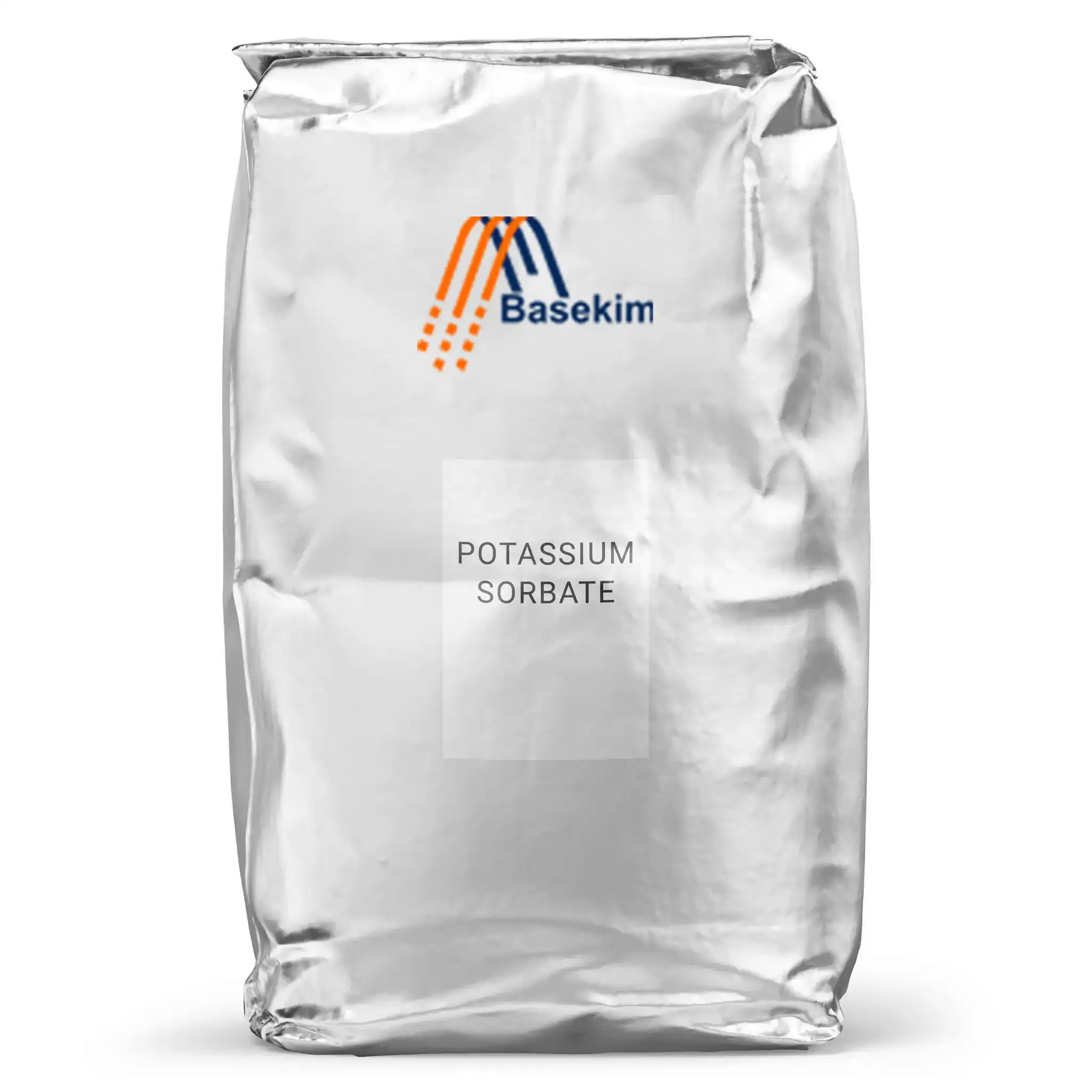
Food Grade Potassium Sorbate is a widely used food preservative that helps manufacturers control yeast and mold growth, protect product quality, and extend shelf life. Food processors use Potassium Sorbate E202 in cheese, bakery products, beverages, sauces, fruit preparations, confectionery, and many other packaged foods. Its excellent water solubility supports easy incorporation into food formulations, while its antimicrobial activity performs particularly well in acidic products. As a Food Grade Potassium Sorbate supplier, Basekim provides sourcing solutions for food manufacturers, ingredient distributors, and international buyers seeking reliable quality, suitable packaging, and consistent bulk supply.
What Is Food Grade Potassium Sorbate?
Food Grade Potassium Sorbate is the potassium salt of sorbic acid. The food industry commonly identifies it by its additive number E202 and uses it primarily as a preservative to reduce the growth of yeasts and molds.
The product normally appears as a white to yellowish-white crystalline powder, granules, or small particles. Moreover, its excellent water solubility makes it easier to incorporate into many liquid, semi-liquid, and processed food formulations.
Unlike ingredients that mainly modify flavor, color, or texture, Potassium Sorbate primarily supports microbiological stability. Therefore, manufacturers use it to help maintain food quality during processing, transportation, retail, and storage.
Its principal characteristics include:
| Property | Specification |
|---|---|
| Chemical Name | Potassium Sorbate |
| Food Additive Number | E202 |
| CAS Number | 24634-61-5 |
| Molecular Formula | C₆H₇KO₂ |
| Molecular Weight | 150.22 g/mol |
| Appearance | White to yellowish-white crystals, powder, or granules |
| Water Solubility | Freely soluble |
| Primary Function | Food preservative |
| Main Microbial Targets | Yeasts and molds |
Food manufacturers should always select a grade that meets the applicable food regulations, purity requirements, and product specifications for their target market.
How Does Food Grade Potassium Sorbate Work?
Potassium Sorbate helps prevent food spoilage by limiting the growth of microorganisms, particularly yeasts and molds.
When manufacturers add it to an acidic food formulation, some sorbate ions convert into sorbic acid. The undissociated form of sorbic acid provides much of the antimicrobial activity.
Therefore, Potassium Sorbate generally performs more effectively in acidic foods and beverages.
Its effectiveness depends on several factors, including:
Final product pH
Potassium Sorbate concentration
Type of microorganisms present
Water activity
Product composition
Processing conditions
Packaging
Storage temperature
Expected shelf life
Consequently, food processors should develop and validate a complete preservation system rather than relying solely on a standard dosage.
Potassium Sorbate does not sterilize food. Therefore, manufacturers must still follow hygienic processing procedures, good manufacturing practices, proper temperature control, and appropriate packaging methods.
Food Grade Potassium Sorbate Uses
Manufacturers of food use Potassium Sorbate E202 across a broad range of applications because of its high solubility, mild sensory impact, and effectiveness against common spoilage organisms.
Food Grade Potassium Sorbate in Cheese and Dairy Products
Dairy manufacturers use Potassium Sorbate in selected cheese and dairy applications to help control surface mold and yeast growth.
Common applications may include:
Processed cheese
Hard and semi-hard cheese
Cheese spreads
Dairy-based fillings
Selected fermented dairy products
Manufacturers may incorporate the preservative directly into an approved formulation or use suitable application methods depending on the product and local regulations.
Furthermore, controlling mold growth can help manufacturers maintain appearance, flavor, and product quality throughout distribution.
However, food producers must confirm permitted usage levels and application methods for their specific dairy category.
Potassium Sorbate in Beverage Manufacturing
Beverage manufacturers frequently use Food Grade Potassium Sorbate in acidic drinks to help prevent yeast and mold growth.
Potential applications include:
Fruit beverages
Flavored drinks
Beverage concentrates
Syrups
Juice-based products
Non-carbonated drinks
Selected soft drink formulations
Since Potassium Sorbate dissolves readily in water, producers can incorporate it efficiently into beverage processing systems.
Furthermore, beverage manufacturers often manage acidity with ingredients such as citric acid. Controlling the final pH is important because sorbate preservation generally becomes more effective under acidic conditions.
Nevertheless, formulators must consider interactions among preservatives, acids, sweeteners, flavor systems, processing temperatures, and packaging.
Therefore, manufacturers should carry out microbial stability and shelf-life testing before establishing the final preservative concentration.
Food Grade Potassium Sorbate in Bakery and Confectionery
Bakery products can become vulnerable to mold during extended storage, especially when they contain moisture-rich fillings, creams, or fruit preparations.
Food Grade Potassium Sorbate can help manufacturers control spoilage organisms and improve product stability.
Typical applications include:
Cakes
Pastries
Bakery fillings
Fruit fillings
Tortillas and flatbreads
Confectionery fillings
Icings
Dessert preparations
Manufacturers may also use stabilizers such as CMC Carboxymethyl Cellulose in selected food formulations to control texture, moisture, and consistency.
However, CMC and Potassium Sorbate perform different functions. CMC primarily supports texture and stability, while Potassium Sorbate primarily controls microbial spoilage.
Therefore, combining suitable formulation ingredients can help food manufacturers achieve both physical stability and microbiological protection.
Potassium Sorbate in Sauces, Dressings, and Condiments
Sauces and condiments often contain water, nutrients, and ingredients that may support microbial activity after production.
Therefore, food processors may use Potassium Sorbate in approved formulations such as:
Tomato-based sauces
Salad dressings
Mayonnaise-type products
Dipping sauces
Marinades
Ketchup
Mustard-based sauces
Seasoning sauces
Its effectiveness can increase when the formulation maintains an appropriately acidic pH.
However, manufacturers must evaluate the complete product composition because fats, proteins, salts, acids, and other ingredients can influence preservative performance.
Proper packaging and hygienic filling procedures also remain essential.
Potassium Sorbate in Jams, Jellies, and Fruit Preparations
Fruit-based foods represent another important application for Food Grade Potassium Sorbate.
Manufacturers may use it in:
Jams
Jellies
Fruit fillings
Fruit toppings
Fruit preparations
Dessert sauces
Fruit concentrates
Although many fruit products naturally have an acidic pH, yeast and mold can still create shelf-life problems.
Therefore, adding an approved preservation system can help processors maintain consistent quality after production.
Additionally, manufacturers should control sugar concentration, water activity, pH, heat processing, and packaging to achieve reliable preservation.
Potassium Sorbate in Pickled and Acidified Foods
Food Grade Potassium Sorbate can also support preservation in selected pickled and acidified food products.
These products may include:
Pickled vegetables
Olives
Acidified sauces
Relishes
Vegetable preparations
Selected ready-to-eat foods
The acidic environment can improve the antimicrobial effectiveness of sorbate preservatives.
However, manufacturers must not use Potassium Sorbate as a substitute for proper acidification, pasteurization, sanitation, or other required food-safety controls.
Key Benefits of Food Grade Potassium Sorbate
Food manufacturers select Potassium Sorbate because it offers several practical processing and preservation advantages.
Effective Yeast and Mold Control
Potassium Sorbate primarily helps inhibit yeasts and molds that can cause visible spoilage, undesirable flavors, fermentation, or reduced shelf life.
High Water Solubility
Its strong water solubility allows manufacturers to incorporate it easily into beverages, sauces, fruit products, and other water-based formulations.
Minimal Effect on Flavor
When properly formulated and used within permitted levels, Potassium Sorbate generally provides preservation without creating major changes in the sensory profile of the food.
Broad Food Applications
Food manufacturers can use Potassium Sorbate across dairy, bakery, beverages, sauces, confectionery, fruit products, and other processed food categories where regulations permit.
Shelf-Life Support
A properly validated preservation system can help products maintain acceptable microbiological quality for longer periods.
Efficient Processing
Its availability as powder or granules and its good solubility make the ingredient convenient for large-scale food processing.
Nevertheless, manufacturers should always validate preservative effectiveness in the finished product.
Food Grade Potassium Sorbate Specifications
Industrial buyers should evaluate the specification carefully before purchasing Potassium Sorbate for food manufacturing.
The following values represent common reference parameters:
| Parameter | Typical Food Grade Specification |
|---|---|
| Assay | 98.0–101.0% or according to applicable standard |
| Appearance | White to yellowish-white powder or granules |
| Identification | Conforms |
| Solubility | Freely soluble in water |
| Loss on Drying | Typically ≤1.0% |
| Acidity or Alkalinity | Meets specification |
| Heavy Metals | Controlled according to food-grade requirements |
| Aldehydes | Within specified limits |
| Functional Classification | Preservative |
| Food Additive Number | E202 |
Actual specifications may vary according to the manufacturer, standard, country, and contractual requirements.
Therefore, buyers should request an updated Technical Data Sheet (TDS) and Certificate of Analysis (COA) before confirming an order.
Food processors should also review relevant purity standards, contaminant limits, allergen statements, manufacturing documentation, and regulatory declarations when required.
Food Grade vs Industrial Grade Potassium Sorbate
Buyers should distinguish Food Grade Potassium Sorbate from material intended for non-food industrial applications.
Food-grade material requires controlled production, purity, documentation, and quality parameters suitable for food manufacturing.
Important purchasing criteria may include:
| Requirement | Food Grade Potassium Sorbate |
|---|---|
| Intended Application | Food and beverage processing |
| Purity Control | High |
| Food Additive Identification | E202 |
| COA | Recommended for every batch |
| TDS | Required for technical evaluation |
| SDS | Required for safe handling information |
| Contaminant Control | According to applicable food standards |
| Packaging | Food-compatible packaging preferred |
| Traceability | Important for food supply chains |
Therefore, food manufacturers should never purchase Potassium Sorbate solely according to price.
Instead, they should verify grade, specification, manufacturing source, documentation, and regulatory suitability.
Potassium Sorbate vs Sodium Benzoate
Potassium Sorbate and Sodium Benzoate are two widely used food preservatives, particularly in acidic foods and beverages.
However, they do not perform identically.
| Feature | Potassium Sorbate | Sodium Benzoate |
|---|---|---|
| Food Additive Number | E202 | E211 |
| Chemical Origin | Sorbic acid salt | Benzoic acid salt |
| Primary Activity | Yeasts and molds | Yeasts, molds, and selected microorganisms |
| Water Solubility | High | High |
| Performance | Stronger in acidic systems | Stronger in acidic systems |
| Common Uses | Bakery, dairy, beverages, sauces, fruit products | Beverages, sauces, pickles, acidic foods |
The most suitable option depends on product pH, formulation, microbial risks, required shelf life, processing conditions, sensory considerations, and local regulations.
Some food formulations may use more than one preservation approach when legally permitted and technically justified.
Therefore, manufacturers should develop their preservative system according to product-specific testing rather than assuming that one preservative performs best in every application.
How to Use Potassium Sorbate in Food Manufacturing
Manufacturers should incorporate Potassium Sorbate according to a validated formulation and applicable food regulations.
Because the ingredient dissolves readily in water, processors can often prepare a solution before introducing it into the production system.
Good dispersion helps achieve consistent preservative concentration throughout the batch.
Manufacturers should consider:
Product pH
Water temperature
Mixing sequence
Solubility
Final preservative concentration
Heat-processing conditions
Packaging method
Expected storage temperature
Required shelf life
Furthermore, the production team should ensure accurate weighing and uniform distribution.
Manufacturers must establish the correct dosage through regulatory review and product testing. A dosage that performs effectively in one product may not provide the same results in another formulation.
Potassium Sorbate E202 and Food Regulations
Potassium Sorbate is commonly identified as E202 in food additive systems.
However, permitted applications and maximum usage levels can vary according to:
Country
Food category
Product formulation
Regulatory authority
Intended application
Manufacturing standard
Therefore, food processors should verify current local regulations before introducing Potassium Sorbate into a commercial food product.
Export manufacturers should pay particular attention to the regulations of the destination country because requirements may differ between markets.
Furthermore, buyers may require additional documentation for audits, regulatory registration, customer approval, or food-safety management systems.
Food Grade Potassium Sorbate Storage and Handling
Proper storage helps preserve Potassium Sorbate quality throughout its shelf life.
Store the product in its original tightly sealed packaging in a cool, dry, clean, and well-ventilated location.
Manufacturers should protect the material from:
Moisture
Excessive heat
Direct sunlight
Contamination
Strong odors
Damaged packaging
After opening the package, operators should reseal it properly to prevent moisture absorption and contamination.
Workers should also minimize unnecessary dust generation and follow the handling recommendations provided in the product-specific Safety Data Sheet.
Furthermore, food manufacturing facilities should follow appropriate hygiene procedures when transferring and handling food ingredients.
Food Grade Potassium Sorbate Packaging and Bulk Supply
Food manufacturers and ingredient distributors commonly purchase Potassium Sorbate in moisture-resistant bags with suitable inner liners.
Typical commercial packaging may include sealed bags or other export-compatible packaging according to supplier and customer requirements.
Before placing a bulk order, buyers should confirm:
Packaging size
Net weight
Food-grade status
Product purity
Batch specification
Minimum order quantity
Country of origin
COA availability
TDS availability
SDS availability
Production date
Shelf life
Delivery terms
Lead time
Moreover, international buyers should confirm that packaging can withstand warehouse storage and overseas transportation conditions.
Food Grade Potassium Sorbate Price
The Food Grade Potassium Sorbate price varies according to several commercial and market factors.
These factors include:
Raw material prices
Manufacturer
Product purity
Food-grade requirements
Order quantity
Packaging
Country of origin
Freight rates
Destination
Incoterms
Required documentation
Current market availability
Bulk buyers can often achieve different unit pricing compared with customers purchasing smaller quantities.
However, buyers should not evaluate quotations based solely on the lowest price.
A lower quotation may involve differences in purity, documentation, packaging, origin, quality control, or delivery conditions.
Therefore, buyers should compare the landed cost together with specification and documentation.
A professional quotation should clearly state the product grade, quantity, packaging, delivery term, destination, payment conditions, and quotation validity.
How to Choose a Food Grade Potassium Sorbate Supplier
Selecting the right supplier is important for maintaining food quality and production consistency.
Buyers should evaluate whether the supplier can provide:
Consistent food-grade specifications
Certificate of Analysis
Technical Data Sheet
Safety Data Sheet
Suitable export packaging
Batch traceability
Reliable shipment planning
Required commercial documentation
Competitive bulk pricing
Consistent international supply
Furthermore, food manufacturers should provide detailed purchasing requirements when requesting a quotation.
These requirements may include grade, specification, annual consumption, order quantity, packaging, destination port, required documents, and preferred delivery terms.
Clear purchasing information allows suppliers to prepare more accurate commercial offers.
Why Food Manufacturers Choose Potassium Sorbate
Food processors continue to use Potassium Sorbate because it combines effective preservation performance with easy handling and broad formulation compatibility.
Its primary advantages include excellent water solubility, strong activity against many yeasts and molds, suitability for acidic foods, and minimal impact on product characteristics when properly formulated.
Moreover, Food Grade Potassium Sorbate can support longer distribution periods and help reduce losses caused by microbial spoilage.
However, successful preservation always requires a complete approach.
Manufacturers should combine suitable ingredient selection with hygienic processing, proper pH management, appropriate packaging, controlled storage, and product-specific microbiological testing.
By selecting the correct Food Grade Potassium Sorbate specification and validating its performance in the finished product, food manufacturers can develop reliable preservation systems while maintaining consistent product quality throughout the intended shelf life.
Q1: Is Potassium Sorbate Safe for Food?
Potassium sorbate is a permitted food preservative in many markets when manufacturers follow applicable regulations and good manufacturing practices. However, approved applications and maximum levels vary by jurisdiction and food category.
Q2: Does Potassium Sorbate Extend Shelf Life?
Yes. It can extend shelf life by inhibiting sensitive yeasts and molds. However, the actual improvement depends on product composition, dosage, packaging, and storage conditions.
Q3: Is Potassium Sorbate Soluble in Water?
Yes. It dissolves readily in water, making it suitable for various liquid formulations and food-processing applications.
Q4: Is Potassium Sorbate a Natural Preservative?
Commercial potassium sorbate is generally produced through chemical manufacturing. Although sorbic acid occurs naturally in some sources, commercial potassium sorbate should not automatically be described as natural.

Contact Info
Ankara Office
No.6, Fahrettin Pasa St. (613), Ilkbahar, Cankaya – Ankara
Tel: +90 312 514 70 55
Istanbul Office
No. 219, Sogut St., No.20, T4A Block, Maslak, Sariyer – Istanbul
Tel: +90 212 807 22 33
Dubai Office
No.3509, The Burlington Tower, Business Bay, Dubai – UAE
Tel: +971 4 236 98 30