Procurement teams sourcing aluminium sulphate turkey face a complex landscape of quality grades, supplier reliability, and logistics variables. Whether you operate a water treatment facility, a paper mill, or a textile dyeing plant, choosing the right source and specification matters enormously. This guide covers everything industrial buyers need to evaluate suppliers, grades, and export terms with confidence.
Aluminium sulphate (Al₂(SO₄)₃) is an inorganic salt used primarily as a coagulant in water treatment and as a sizing agent in paper production. Turkey is a significant export source, producing both iron-free and iron-bearing grades in granular, lump, and liquid forms for global industrial supply chains.
What Is Aluminium Sulphate and Why Does Grade Matter?
Aluminium sulphate is an inorganic chemical compound produced by reacting aluminium hydroxide with sulfuric acid. It appears as white or off-white granules, lumps, or a liquid solution, depending on the production process. Commercially, two principal grades dominate industrial procurement:
- Iron-free grade (Fe < 0.005%): Used in paper sizing, food processing, and pharmaceutical applications where iron contamination is unacceptable.
- Iron-bearing grade (Fe up to 0.75%): Widely used in municipal water treatment and effluent treatment, where strict iron limits are less critical.
- Liquid aluminium sulphate (Al₂O₃ 8–9%): Common in large-scale water treatment plants that prefer direct dosing systems over dissolving dry product.
- Anhydrous aluminium sulphate: A concentrated dry form used where moisture content must be minimized.
Consequently, specifying the correct grade before issuing an RFQ saves time, avoids costly reprocessing, and ensures regulatory compliance across end-use applications.
Key Industrial Applications of Aluminium Sulphate
Understanding how aluminium sulphate performs across industries helps procurement teams align sourcing decisions with operational needs.
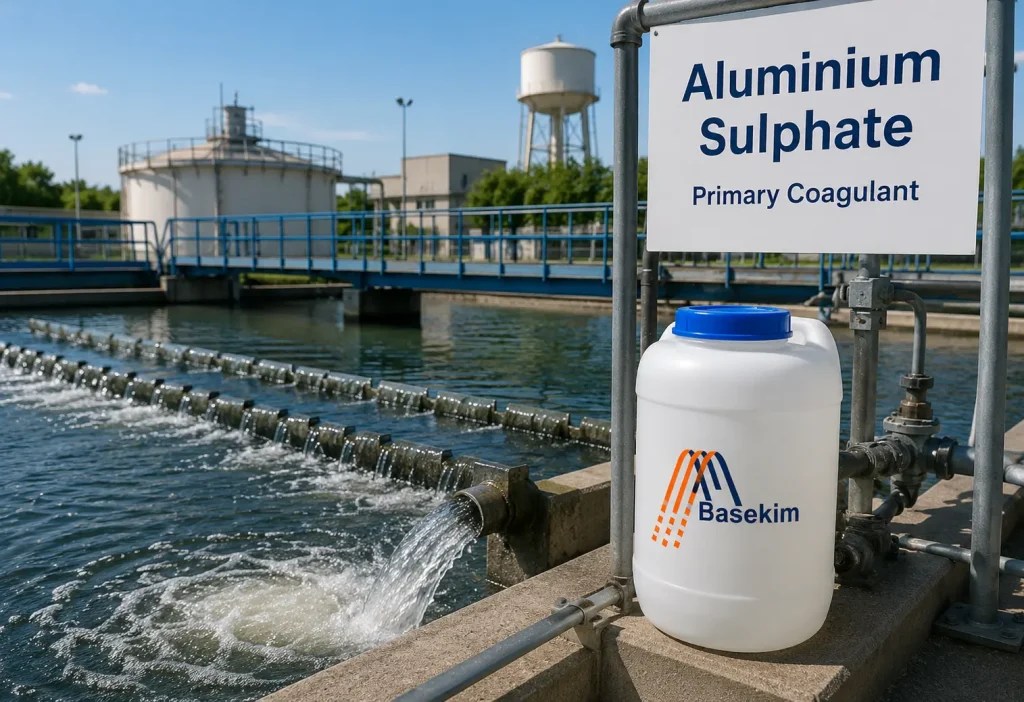
Water Treatment As a coagulant, aluminium sulphate reacts with alkalinity in raw water to form aluminium hydroxide floc. This floc captures suspended particles, colloids, and microorganisms. Moreover, it reduces turbidity and facilitates sedimentation. Municipal water authorities and industrial effluent plants represent the largest global consumers of the product.
Paper and Pulp Manufacturing In the Fourdrinier papermaking process, aluminium sulphate acts as a rosin-sizing precipitant. It fixes rosin size to cellulose fibres, thereby improving paper strength and water resistance. For this reason, paper mills specifically require iron-free grade with consistent Al₂O₃ content — typically 15–17%.
Textile and Dyeing Industry Textile manufacturers use aluminium sulphate as a mordant, bonding dyes permanently to fabric fibres. In particular, it ensures colour fastness and reduces dye runoff during washing cycles.
Construction and Concrete Accelerating cement hydration is another key application. Aluminium sulphate shortens setting time in quick-setting concrete mixes, which is especially valuable in underground construction and repair work.
Food and Pharmaceutical Food-grade aluminium sulphate — sometimes referred to as alum — serves as a firming agent in pickling and as a leavening component in baking powder. However, this application demands iron-free grade with strict heavy metal certificates.
Why Source Aluminium Sulphate Turkey?
Turkey has established itself as a competitive source for aluminium sulphate in European, Middle Eastern, African, and Asian markets. Several structural advantages underpin this position.
Geographic and Logistical Advantages Turkey’s location at the crossroads of Europe, Asia, and the Middle East gives it a natural freight advantage over more distant suppliers. Ports such as İzmir, Mersin, and Ambarlı (Istanbul) offer regular container and bulk liner services to major import hubs. As a result, lead times to European buyers are typically shorter than those from Asian alternatives.
Competitive Pricing and Production Capacity Local access to sulfuric acid and bauxite-derived aluminium hydroxide keeps Turkish production costs competitive. Furthermore, multiple established manufacturers operate at scale, ensuring supply continuity even during periods of elevated global demand.
Quality and Certification Standards Reputable Turkish suppliers export aluminium sulphate with ISO-compliant quality management systems. Additionally, many producers hold certificates aligned with EN 878 (the European drinking water chemicals standard), which is a prerequisite for water treatment supply contracts in the EU.
Export Track Record Aluminium sulphate turkey exports reach destinations including Germany, the Netherlands, Egypt, Saudi Arabia, and Pakistan. This established export infrastructure means that experienced logistics partners, customs documentation practices, and Incoterm-flexible shipping terms are readily available.
How to Evaluate an Aluminium Sulphate Supplier from Turkey
Selecting the right supplier involves more than comparing unit prices. Below are the critical evaluation criteria that experienced procurement managers apply.
Technical Documentation and Certificates of Analysis
Every shipment should be supported by a Certificate of Analysis (CoA) confirming Al₂O₃ content, iron levels, water-insoluble matter, pH of solution, and heavy metal limits. Additionally, for water treatment supply, request the Declaration of Performance under EN 878 or NSF/ANSI 60 certification where applicable.
Packaging Specifications and MOQ
Aluminium sulphate turkey suppliers typically offer the following packaging configurations:
- 25 kg net polypropylene bags (palletised)
- 500 kg or 1,000 kg big bags (jumbo/FIBC)
- Bulk loose loading in containers (for large-volume buyers)
- ISO tank containers (for liquid grade)
Minimum order quantities vary by supplier and grade. Granular iron-bearing grade often has lower MOQs due to volume demand, whereas iron-free grade may carry higher minimums due to production scheduling requirements.
Shelf Life and Storage Requirements
Dry aluminium sulphate is hygroscopic. Therefore, it must be stored in sealed, moisture-proof packaging away from alkaline materials. Standard shelf life for properly stored product is 24 months. Buyers operating in humid climates should specifically request moisture-barrier inner liners.
Logistics and Incoterm Flexibility
Reliable Turkish exporters accommodate multiple Incoterms — FOB (İzmir/Mersin), CFR, and CIF to major destination ports. For buyers unfamiliar with Turkish port operations, working with a supplier who offers DDP or DAP terms can simplify customs handling considerably.
Regulatory and Compliance Considerations for Importers
Importing aluminium sulphate requires attention to both origin documentation and destination country regulations.
- REACH compliance (EU importers): Aluminium sulphate is registered under REACH. Ensure your supplier provides an up-to-date Safety Data Sheet (SDS) aligned with EU Regulation 1907/2006.
- Certificate of Origin: A Turkish Certificate of Origin, stamped by an authorised Turkish Chamber of Commerce, is required for customs clearance in most markets.
- HS Code: Aluminium sulphate typically classifies under HS Code 2833.22. Confirm with your freight forwarder, as sub-classifications can affect import duty rates in specific markets.
- Water treatment approval: If the product is destined for drinking water treatment, request the supplier’s Declaration of Conformity against EN 878 or the relevant national drinking water chemicals standard.
Aluminium Sulphate Turkey: Pricing Factors and Market Dynamics
The price of aluminium sulphate fluctuates based on several upstream and market variables. Understanding these dynamics helps buyers time procurement decisions more effectively.
Sulfuric acid costs are the primary cost driver, given that sulfuric acid accounts for a significant share of production input. Consequently, buyers tracking the sulfuric acid spot market gain early visibility into aluminium sulphate price trends.
Energy prices in Turkey also influence production costs, particularly for energy-intensive sulfation processes.
Seasonal demand peaks occur in spring and early summer, when water treatment plants increase dosing rates to manage higher turbidity in source water. Planning procurement ahead of these seasonal spikes generally secures better pricing and allocation.
Currency dynamics between the Turkish lira, US dollar, and euro create additional pricing volatility. Most Turkish exporters quote in USD or EUR, so exchange rate fluctuations affect local cost structures rather than invoiced prices for foreign buyers.
Sustainable Procurement: Environmental and Safety Profile
Aluminium sulphate presents a manageable environmental and safety profile when handled correctly. It is non-flammable and non-explosive. However, it is mildly acidic in solution, so personnel handling it require appropriate PPE including chemical-resistant gloves and eye protection.
From a sustainability standpoint, aluminium sulphate contributes positively to water treatment processes by enabling the removal of pollutants and reducing the load on downstream filtration systems. Furthermore, some Turkish producers have begun publishing Environmental Product Declarations (EPDs), which supports buyers with green procurement mandates.
Request a Quote for Aluminium Sulphate from Basekim
Basekim supplies industrial-grade aluminium sulphate to B2B buyers, manufacturers, and importers across global markets. Our product portfolio covers iron-free and iron-bearing grades in granular, lump, and liquid form.
What we offer:
- Bulk supply with flexible loading options — 25 kg bags, big bags, and loose bulk containers
- Export availability via major Turkish ports, with Incoterm-flexible shipping (FOB, CFR, CIF, DAP)
- Packaging options tailored to your storage, handling, and repackaging requirements
- Technical documentation including Certificates of Analysis, SDS, EN 878 declarations, and Certificate of Origin on request
- Quotation requests processed promptly — contact our sales team with your required grade, quantity, destination port, and preferred Incoterm
To request a quotation or technical datasheet, contact Basekim directly or reach our export sales team by email. We respond to all RFQs within one business day.
Basekim is a Turkish chemical supplier specialising in industrial chemicals for water treatment, paper manufacturing, textile, and construction industries. All products are available for export with full technical and regulatory documentation.