




Food Grade Guar Gum – E412 Thickener and Stabilizer
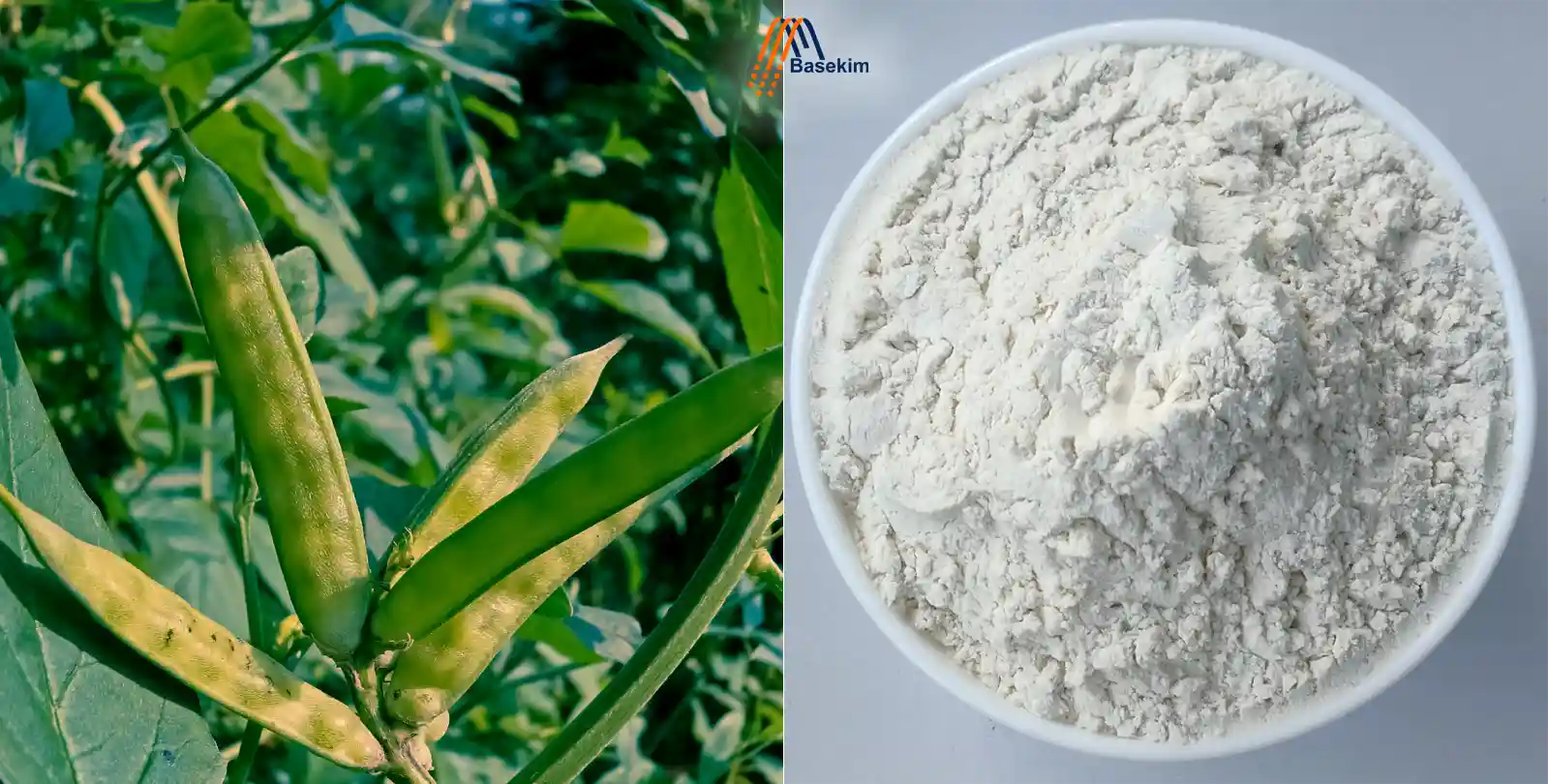
Food Grade Guar Gum is a natural thickening, stabilizing, binding, and water-retention ingredient widely used in food and beverage manufacturing. Also known as Guar Gum E412, this plant-based hydrocolloid develops high viscosity at relatively low concentrations, making it an efficient ingredient for dairy products, bakery foods, sauces, dressings, beverages, frozen desserts, noodles, and many processed food formulations.
Manufacturers produce guar gum from the endosperm of guar seeds. After cleaning, separating, grinding, and refining the seed material, producers obtain a fine food grade guar gum powder with excellent water-binding and viscosity-building properties.
Because the powder hydrates effectively in cold water, food manufacturers can use it to improve texture, control moisture, reduce ingredient separation, and maintain product consistency throughout processing and storage.
Food Grade Guar Gum Properties
The main functional component of guar gum is a natural polysaccharide called galactomannan. When the powder comes into contact with water, it rapidly absorbs moisture and creates a viscous solution.
This behavior gives Food Grade Guar Gum several valuable properties for food manufacturers:
High thickening efficiency
Strong water-binding capacity
Good cold-water hydration
Excellent viscosity development
Texture improvement
Moisture retention
Suspension support
Emulsion stabilization
Freeze-thaw performance support
Compatibility with many food ingredients
Plant-based origin
Furthermore, manufacturers can achieve noticeable viscosity changes using relatively small quantities. Therefore, guar gum can provide an economical solution for industrial food processing.
Its neutral appearance and functional versatility also allow formulators to use it across a wide range of products without significantly changing the basic characteristics of the finished food.
How Food Grade Guar Gum Is Produced
Manufacturers produce Food Grade Guar Gum from the seeds of Cyamopsis tetragonoloba, commonly known as the guar plant.
First, processors clean the harvested guar seeds to remove dust, stones, and other foreign materials. Next, they separate the hull and germ from the endosperm.
The endosperm contains a high concentration of galactomannan, which provides the thickening characteristics associated with guar gum.
After separation, manufacturers grind the endosperm into a fine powder. They then screen, classify, and process it according to the required particle size, viscosity, moisture, and hydration characteristics.
Food-grade production also requires appropriate quality control to ensure that the finished material complies with the required food specifications and microbiological limits.
Finally, manufacturers pack the finished powder in moisture-resistant bags to preserve product quality during storage and transportation.
Food Grade Guar Gum E412
Guar Gum carries the food additive designation E412 in many markets.
Food producers mainly use E412 as a:
Thickener
Stabilizer
Water-binding agent
Texture modifier
Suspension aid
Processing aid
One of its major advantages is its ability to produce viscosity at low concentrations. Consequently, manufacturers can adjust the texture of food products without adding large quantities of thickening material.
Moreover, guar gum works effectively in many cold-processing systems because it can hydrate without requiring extensive heating.
These characteristics make E412 guar gum useful in modern food manufacturing, especially when consistent texture and moisture control are essential.
Food Grade Guar Gum in Bakery Products
Bakery manufacturers use Food Grade Guar Gum to improve moisture retention, dough characteristics, texture, and finished-product consistency.
Common applications include:
Bread
Cakes
Cookies
Biscuits
Pastries
Muffins
Gluten-free bakery products
Bakery fillings
In conventional bakery formulations, guar gum can help control water distribution and improve dough handling. In addition, its moisture-binding properties may help products maintain desirable softness during storage.
Guar gum has particular value in gluten-free baking. Gluten normally contributes elasticity and structure to dough. Because gluten-free formulations lack this natural protein network, manufacturers often use hydrocolloids to improve structure and handling.
Depending on the formulation, food manufacturers may also use ingredients such as Food Grade Glycerin for moisture management and product texture.
Therefore, combining suitable functional ingredients can help manufacturers achieve more consistent commercial bakery products.
Guar Gum in Ice Cream and Frozen Desserts
Frozen-dessert manufacturers frequently use guar gum because controlling water and texture plays an important role in product quality.
Applications include:
Ice cream
Frozen yogurt
Sorbet
Frozen dairy desserts
Plant-based frozen desserts
Frozen dessert mixes
Guar gum helps increase the viscosity of the liquid phase before freezing. Moreover, it can contribute to smoother texture and support control of water movement within the finished product.
Proper stabilizer selection becomes particularly important during storage because frozen products may experience temperature fluctuations throughout transportation and retail handling.
As a result, manufacturers often combine guar gum with other approved hydrocolloids to create a stabilizer system suited to their desired texture and processing conditions.
Food Grade Guar Gum in Dairy Products
Dairy processors use Food Grade Guar Gum as a thickening and stabilizing ingredient in several products.
Typical applications include:
Yogurt
Flavored milk
Dairy desserts
Cream products
Processed cheese formulations
Milk-based beverages
Dessert fillings
The material helps manufacturers control viscosity and improve product consistency.
For example, yogurt manufacturers may use suitable hydrocolloid systems to create a thicker texture and support stable product characteristics throughout shelf life.
However, the required concentration depends heavily on the overall formulation. Therefore, manufacturers should conduct production trials before selecting a final dosage.
Guar Gum in Sauces, Dressings and Condiments
Sauces and dressings require carefully controlled viscosity. If a formulation becomes too thin, consumers may perceive it as low quality. However, excessive viscosity can also create processing and pouring problems.
Food Grade Guar Gum provides manufacturers with an efficient way to adjust product thickness.
Common applications include:
Ketchup
Mayonnaise-type products
Salad dressings
Cooking sauces
Dipping sauces
Marinades
Gravies
Seasoning sauces
Because guar gum provides strong thickening performance, manufacturers can use relatively low concentrations to reach their desired consistency.
It can also help suspend spices, herbs, and other solid ingredients in certain formulations.
Consequently, guar gum supports both processing performance and finished-product appearance.
Food Grade Guar Gum in Beverages
Food and beverage manufacturers may use guar gum when they need additional body, suspension, or viscosity control.
It can appear in:
Flavored beverages
Dairy-based drinks
Powdered beverage mixes
Nutritional formulations
Plant-based beverages
Specialty drink products
The required amount generally remains low because excessive guar gum can create undesirable thickness.
Therefore, formulators should carefully evaluate hydration, mixing conditions, temperature, pH, and interaction with other ingredients.
Acidity also plays an important role in many beverage formulations. Food producers frequently use ingredients such as Citric Acid to regulate acidity and pH in beverage and food systems.
Proper formulation testing helps manufacturers balance acidity, texture, flavor, and stability.
Food Grade Guar Gum in Noodles and Pasta Products
Guar Gum E412 also serves manufacturers of noodles and selected pasta-type products.
Its water-binding characteristics can help control dough hydration and processing behavior. In addition, guar gum may support texture and help maintain consistency during manufacturing.
Applications may include:
Instant noodles
Gluten-free pasta
Specialty noodles
Fresh noodles
Processed cereal products
However, manufacturers should select dosage according to flour composition, water content, processing equipment, and desired final texture.
Guar Gum in Gluten-Free Foods
Demand for gluten-free foods has increased the importance of hydrocolloids in commercial formulations.
Without gluten, bakery dough may lack elasticity, cohesion, and structural strength. Therefore, manufacturers frequently introduce gums and other functional ingredients to compensate for these differences.
Food Grade Guar Gum can help:
Bind water
Improve dough handling
Support product structure
Increase viscosity
Improve texture
Reduce excessive dryness
Improve consistency
Manufacturers can use guar gum alone or together with other hydrocolloids depending on the desired product characteristics.
Product trials remain essential because every gluten-free flour system reacts differently.
Food Grade Guar Gum Technical Specifications
Exact specifications depend on the manufacturer, viscosity grade, particle size, and applicable food standard. Therefore, buyers should always request the current Technical Data Sheet (TDS) and Certificate of Analysis (COA).
Typical parameters may include:
| Property | Typical Requirement |
|---|---|
| Product | Food Grade Guar Gum |
| Food Additive Number | E412 |
| CAS Number | 9000-30-0 |
| Appearance | White to off-white powder |
| Main Component | Galactomannan |
| Solubility | Hydratable/dispersible in water |
| Viscosity | Grade dependent |
| Moisture | Specification dependent |
| Particle Size | Grade dependent |
| pH | Specification dependent |
| Microbiological Limits | Food-grade specification |
| Odor | Characteristic / mild |
Buyers should confirm all required parameters before placing a bulk order.
How to Choose Food Grade Guar Gum
Selecting the correct Food Grade Guar Gum requires more than comparing prices.
First, buyers should define the intended food application. Guar gum used in bakery production may require different performance characteristics from material used in ice cream, beverages, or sauces.
Next, buyers should consider viscosity. Different viscosity grades allow manufacturers to achieve different textures and processing characteristics.
Particle size also affects dispersion and hydration behavior.
Important purchasing parameters include:
Food-grade compliance
Required viscosity
Mesh size
Moisture content
Hydration rate
Microbiological limits
Purity
Packaging
Required documentation
Quantity
Destination country
Furthermore, buyers should communicate any specific regulatory or certification requirements before confirming an order.
This approach reduces the risk of receiving material that does not match the intended formulation.
Food Grade Guar Gum Price
Food Grade Guar Gum price can change according to agricultural, manufacturing, logistics, and market conditions.
Guar is an agricultural raw material. Therefore, crop yield and guar seed availability can directly affect international prices.
Other major pricing factors include:
Raw guar seed prices
Crop conditions
Food-grade quality requirements
Viscosity
Mesh size
Purity
Processing costs
Packaging type
Order quantity
Freight costs
Destination country
Certification requirements
Food-grade material may have different pricing from technical grades because food applications require tighter quality control and additional testing.
Therefore, buyers requesting a quotation should provide complete technical and commercial requirements.
A useful RFQ should include the required grade, viscosity, mesh size, quantity, packaging type, destination port, and preferred Incoterm.
Packaging of Food Grade Guar Gum
Food Grade Guar Gum is commonly supplied in export-ready moisture-resistant bags.
Typical packaging may include:
25 kg multi-layer paper bags
25 kg PP woven bags with inner liner
Palletized bags
Customized export packaging when available
Packaging must protect the powder from moisture, contamination, and physical damage.
Because guar gum readily absorbs water, damaged or improperly sealed packaging can reduce product quality.
Buyers should therefore store unopened bags carefully and inspect packaging when shipments arrive.
Storage and Handling
Store Food Grade Guar Gum in a cool, dry, clean, and well-ventilated warehouse.
Keep bags tightly sealed and protect them from:
Moisture
Water
Excessive humidity
Strong odors
Contamination
Direct sunlight
Damaged warehouse floors
Users should also follow normal food-ingredient hygiene procedures during handling.
Because the powder can create airborne dust during transfer, operators should use suitable handling practices and follow the supplier’s current Safety Data Sheet.
Proper storage helps maintain powder flow, hydration performance, and overall product quality.
Food Grade Guar Gum Supplier
Food manufacturers and international importers need consistent quality as much as competitive pricing.
A reliable supplier should provide appropriate documentation, consistent specifications, export-ready packaging, and clear information about the supplied grade.
Basekim supplies Food Grade Guar Gum for international commercial and food-industry buyers and supports bulk orders based on required specifications, packaging, quantity, and destination.
Buyers should specify their exact food application when requesting an offer. This information helps identify a suitable viscosity and particle-size grade rather than selecting material based only on price.
Buying Food Grade Guar Gum in Bulk
Bulk buyers should evaluate product performance and documentation before finalizing an order.
Before purchasing, request:
Technical Data Sheet
Safety Data Sheet
Certificate of Analysis
Food-grade specification
Packaging information
Country of origin when required
Available certifications
Current quotation
Manufacturers should also test the product inside their own formulation whenever possible.
A lower-priced product does not always provide the lowest production cost. Inconsistent viscosity, poor hydration, or unsuitable particle size can require higher dosage and create production problems.
Therefore, technical suitability should remain the main consideration when comparing suppliers.
Why Food Manufacturers Use Guar Gum E412
Food manufacturers continue to use Guar Gum E412 because it provides multiple functional benefits from a single ingredient.
It can improve viscosity, bind water, support stabilization, modify texture, improve moisture retention, and help suspend ingredients.
Furthermore, it performs efficiently at relatively low concentrations and works across many food categories.
From bakery products and frozen desserts to dairy foods, sauces, beverages, noodles, and gluten-free formulations, Food Grade Guar Gum remains an important hydrocolloid for modern food manufacturing.
For commercial buyers, selecting the correct viscosity, mesh size, quality specification, and supplier helps ensure consistent production performance and reliable finished-product quality.
Q1: What is guar gum used for?
Manufacturers use it mainly as a thickener, stabilizer, binder, water-retention agent, and viscosity modifier.
Q2: Is Calcium Propionate the same as E282?
Yes. E282 is the food additive identification number commonly used for calcium propionate.
Q3: Why do bakeries use Calcium Propionate?
Bakeries use it to delay mold growth and help control rope-forming bacteria. Consequently, it can extend the commercial shelf life of packaged bread.

Contact Info
Ankara Office
No.6, Fahrettin Pasa St. (613), Ilkbahar, Cankaya – Ankara
Tel: +90 312 514 70 55
Istanbul Office
No. 219, Sogut St., No.20, T4A Block, Maslak, Sariyer – Istanbul
Tel: +90 212 807 22 33
Dubai Office
No.3509, The Burlington Tower, Business Bay, Dubai – UAE
Tel: +971 4 236 98 30