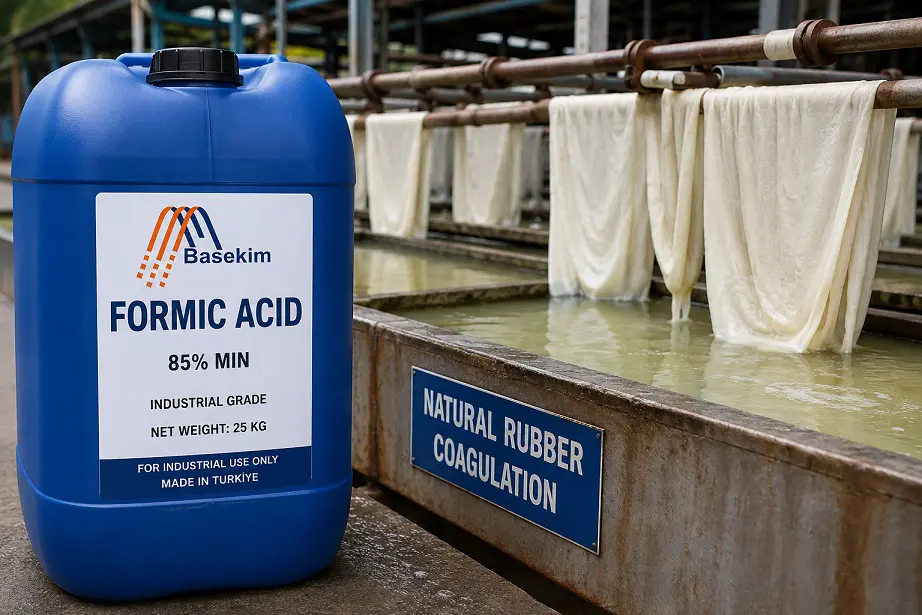
Natural rubber manufacturers rely on precise coagulation methods to maintain consistent product quality. Among industrial coagulants, Formic Acid has become a preferred solution because it improves latex separation efficiency while reducing environmental impact. Additionally, producers value its stable performance, controlled acidity, and compatibility with modern rubber processing systems.
Formic Acid Coagulation improves latex solidification by lowering pH levels rapidly and evenly. As a result, rubber producers achieve better coagulum consistency, reduced contamination, lower chemical consumption, and improved wastewater management in industrial processing facilities.
Understanding Formic Acid Coagulation in Rubber Processing
Natural rubber production requires effective coagulation to separate rubber particles from latex serum. Manufacturers commonly use Formic Acid because it delivers fast and predictable coagulation performance. Moreover, it minimizes foam formation and supports cleaner processing operations.
In industrial rubber plants, operators typically dilute formic acid before adding it to latex tanks. The acid destabilizes latex particles and promotes uniform coagulation. Therefore, producers obtain cleaner rubber sheets with better elasticity and fewer impurities.
Compared with stronger mineral acids, Formic Acid offers safer handling characteristics and better operational control. Additionally, it produces lower corrosion levels in processing equipment.
Industrial Advantages of Formic Acid Coagulation
Rubber manufacturers prioritize production efficiency and stable product quality. Consequently, Formic Acid Coagulation has become a standard method in many industrial facilities.
Key industrial advantages include:
- Faster latex coagulation cycles
- Improved rubber purity and color consistency
- Lower equipment corrosion rates
- Reduced wastewater treatment complexity
- Better odor control during processing
- Easier pH adjustment in production lines
Additionally, formic acid supports continuous rubber manufacturing systems where process consistency remains critical.
Environmental Benefits
Environmental regulations continue to affect rubber manufacturing operations worldwide. Therefore, producers increasingly prefer cleaner coagulation chemicals that simplify wastewater treatment.
Formic Acid Coagulation generates lower environmental impact compared with some inorganic acids. It biodegrades relatively quickly under controlled conditions. Furthermore, it reduces sulfate contamination risks that may occur with sulfuric acid usage.
Modern rubber factories also focus on reducing sludge generation. As a result, formic acid helps facilities improve wastewater clarification efficiency and lower disposal costs.
Many export-oriented rubber manufacturers now integrate environmentally responsible processing chemicals into their sustainability programs. Consequently, formic acid demand continues to grow across Southeast Asia, Africa, and South America.
Formic Acid Coagulation in High-Volume Manufacturing
Large-scale rubber processing plants require stable raw material performance. Even small variations in coagulation quality can affect downstream drying and packaging operations.
Industrial buyers often select formic acid because it provides:
- Consistent acid concentration
- Reliable coagulation speed
- Lower residue formation
- Better compatibility with automated dosing systems
- Easier storage and transportation
Meanwhile, procurement managers evaluate packaging reliability and export documentation before sourcing industrial acids. Suppliers must provide accurate specifications, safety documentation, and stable shipment schedules.
Packaging and Export Considerations
Industrial Formic Acid usually ships in:
- HDPE drums
- IBC tanks
- Bulk ISO tanks
Export suppliers must also provide:
- COA (Certificate of Analysis)
- MSDS/SDS documentation
- Technical Data Sheets
- Packing declarations
- UN-certified packaging
Additionally, proper storage conditions remain important. Manufacturers should store formic acid in cool and ventilated environments away from oxidizing materials.
Process Optimization Using Formic Acid
Efficient coagulation directly affects rubber drying performance and final product consistency. Therefore, process engineers carefully monitor acid dosage levels and latex pH values.
When operators optimize Formic Acid Coagulation parameters, they achieve:
- Reduced coagulation time
- Improved rubber tensile properties
- Lower processing waste
- Better filtration efficiency
- Enhanced production throughput
Furthermore, automated dosing systems now help manufacturers reduce chemical overconsumption. This approach lowers operational costs while maintaining consistent rubber quality.
Several industrial rubber plants also combine formic acid systems with wastewater recycling technologies. As a result, facilities improve sustainability performance and reduce freshwater consumption.
Global Demand for Formic Acid in Rubber Manufacturing
The global rubber industry continues to expand because automotive, construction, and industrial sectors require high-performance rubber materials. Consequently, demand for reliable coagulation chemicals also increases.
Formic Acid Coagulation remains highly important in:
- Natural rubber sheet production
- Technically specified rubber manufacturing
- Latex concentrate processing
- Industrial rubber component production
Additionally, international buyers prefer suppliers that maintain stable export capacity and technical support services.
Reliable sourcing partners help manufacturers reduce supply chain disruptions and maintain production continuity.
Conclusion
Formic Acid plays a critical role in modern natural rubber processing operations. It improves coagulation efficiency, enhances rubber quality, and supports environmentally responsible manufacturing practices. Additionally, it helps producers optimize chemical consumption and simplify wastewater management.
As global rubber production expands, Formic Acid Coagulation will continue to support efficient, scalable, and sustainable industrial processing systems.
Request Bulk Formic Acid Supply from Basekim
Basekim supplies industrial-grade Formic Acid for rubber manufacturing, latex processing, and chemical production industries. We provide bulk export supply, flexible packaging options, and technical documentation for international buyers.
Our supply capabilities include:
- Bulk container shipments
- Drum and IBC packaging
- Export documentation support
- Technical consultation
- Competitive international pricing
- SDS and TDS availability
Contact Basekim today to request a quotation for industrial Formic Acid supply.