




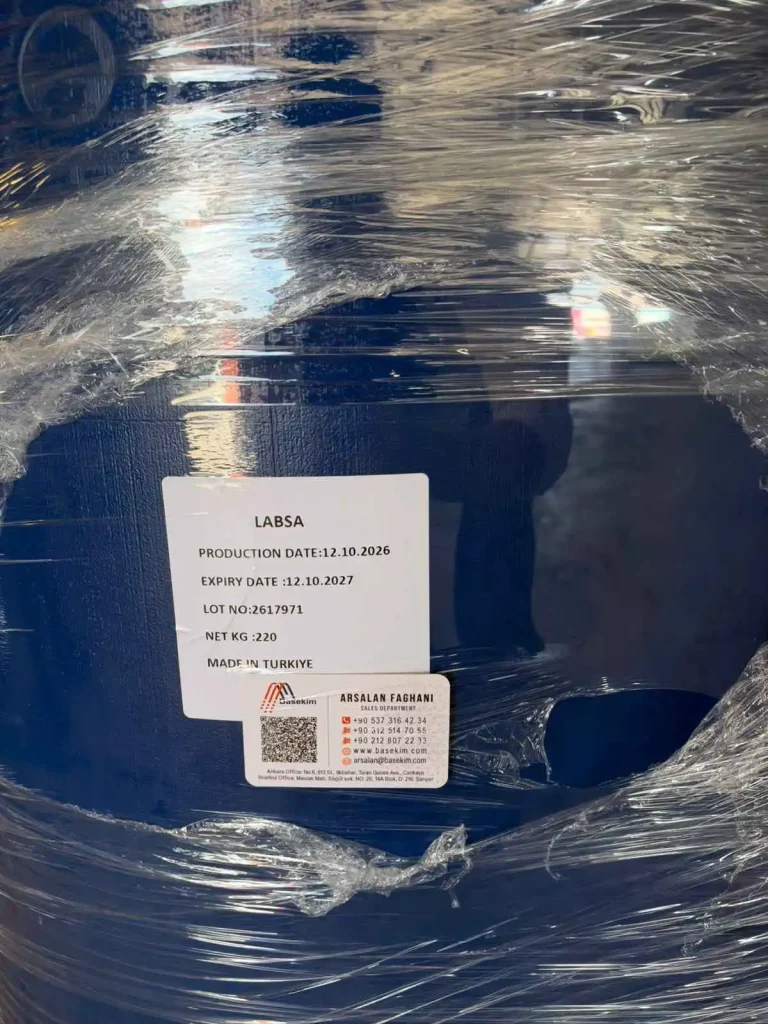
Shipping Linear Alkylbenzene Sulfonic Acid (LABSA) internationally requires correct dangerous goods classification, suitable packaging and consistent documentation across every stage of the journey.
One of the most common questions is why some manufacturers identify LABSA as UN 2586, while others use UN 3265. The answer matters: the assigned transport entry affects packaging requirements, declarations and carrier acceptance.
This guide explains how to investigate those differences and prepare LABSA shipments for international sea, road and air transport.
Which Regulations Apply to LABSA Shipping?
The applicable requirements depend on the transport mode and route. A shipment may need to satisfy more than one regulatory framework—for example, road transport from the factory to the port followed by ocean carriage.
| Transport mode | Applicable reference in November 2026 |
|---|---|
| Sea transport in packaged form | IMDG Code, 2024 Edition, Amendment 42-24, mandatory from 1 January 2026 |
| International road transport under ADR | ADR 2025, including applicable corrections |
| Air transport | ICAO Technical Instructions 2025–2026 and IATA Dangerous Goods Regulations, 67th Edition for 2026 |
Current amendments, national requirements and carrier restrictions must also be checked. A newly published edition is not necessarily the edition mandatory on the shipment date.
LABSA UN Number: UN 2586 vs UN 3265
A UN number identifies the applicable dangerous goods transport entry. It should be assigned according to the product’s composition and hazard characteristics.
The following entries are relevant to understanding the differences found in LABSA documentation:
| UN number | Description—summarized | Hazard class | Packing group |
|---|---|---|---|
| UN 2586 | Liquid alkylsulphonic or arylsulphonic acids containing no more than 5% free sulphuric acid | 8 | III |
| UN 2584 | Liquid alkylsulphonic or arylsulphonic acids containing more than 5% free sulphuric acid | 8 | II |
| UN 3265 | Corrosive liquid, acidic, organic, N.O.S. | 8 | I, II or III, depending on classification |
These are distinct entries, not interchangeable shipping options. The descriptions above are explanatory summaries; transport documents must use the applicable proper shipping name and required additional information.
Why Do Manufacturers Declare Different UN Numbers?
Differences may reflect:
- Different product compositions or formulations.
- Different supporting hazard data.
- An older classification assessment.
- An inaccurate or outdated safety data sheet.
The discrepancy should be investigated rather than accepted as a normal supplier preference.
Under the IMDG classification framework, the most specific applicable entry takes priority over a general “not otherwise specified” entry. N.O.S. means “not otherwise specified.” A general corrosive-liquid entry should not be selected simply because a carrier finds it easier to book.
For LABSA, the sulfonic acid entries should therefore be assessed before defaulting to a general organic-acid entry. The final decision must account for the actual product and its hazards.
Does “LABSA 96%” Determine the UN Number?
The percentage of active matter and the percentage of free sulphuric acid are different specification values.
“LABSA 96%” does not, by itself, provide the complete composition or establish the transport classification. Obtain the separate free sulphuric acid specification or analytical result rather than calculating it from the commercial grade name.
What If the Manufacturer’s SDS States UN 3265?
Request the classification basis from the manufacturer or SDS author.
A useful request is:
Please confirm the transport classification for this exact product, including its proper shipping name, packing group, free sulphuric acid content and the basis for assigning UN 3265 instead of the relevant sulfonic-acid entry.
A qualified dangerous goods specialist should review the response against the applicable transport rules.
If a correction is necessary, obtain a formally revised SDS and update the affected booking details, declarations and labels together. Changing only the UN number on the booking creates a new inconsistency.
Information to Obtain Before Booking LABSA
Preparing one verified shipment reference sheet helps the manufacturer, exporter, forwarder and carrier work from the same information.
Include:
- Exact product name, grade and manufacturer.
- Current product-specific SDS and revision date.
- Product specification and relevant certificate of analysis.
- Free sulphuric acid content.
- Confirmed UN number and proper shipping name.
- Hazard class and packing group.
- Environmental classification and any additional hazards.
- Packaging type, number of packages and quantities.
- Loading location, destination and proposed route.
For an N.O.S. entry such as UN 3265, check the applicable technical-name requirement. A commercial name alone may be insufficient.
Is LABSA a Marine Pollutant?
Marine-pollutant status should be assessed for the actual substance or mixture.
Do not copy a “yes” or “no” statement from another supplier’s product page. Environmental classification considers aquatic toxicity and relevant degradation and bioaccumulation information. The product’s environmental data should support the classification recorded in its documentation.
Where applicable, incorporate environmental requirements into the marking and documentation review. A corrosive classification alone does not answer the marine-pollutant question.
LABSA Packaging Requirements
Drums and IBCs
Packaging must be permitted for the assigned dangerous goods entry, packing group and transport mode.
Check both the packaging design approval and its suitability for the actual contents. Important considerations include:
- Chemical compatibility.
- Permitted filling mass or density.
- Filling conditions and available expansion space.
- Closure instructions.
- Packaging condition.
- Applicable inspection and service-life requirements.
A UN packaging mark identifies a tested design. It does not mean that the package is suitable for every chemical or every filling arrangement. The packaging manufacturer’s instructions remain essential.
Liquid-drum approval markings can identify the packaging type, packing-group performance level, relative density and test pressure. These limits must be considered when selecting the package.
For IBC shipments, request photographs of the actual identification plate and approval markings before confirming the packing arrangement. Do not establish the permissible filling mass from nominal volume alone.
Transport Tanks
Tank shipments require a separate review of the authorized tank provisions, approvals and compatibility.
Approval to carry a product in drums does not establish approval to carry it in an arbitrary tank. The selected equipment must meet the requirements applicable to the confirmed entry and transport operation.
LABSA Labels, Marks and Container Loading
Prepare a marking plan for the individual packages, any overpacks and the cargo transport unit.
Depending on the applicable requirements, the review should cover UN identification, transport hazard labels, proper shipping names, environmental marks and other required markings. A commercial product label does not replace dangerous goods transport marking.
The IMO/ILO/UNECE CTU Code provides practical guidance for packing and securing cargo throughout the intermodal transport chain. It covers those who pack cargo transport units as well as those who receive and unpack them.
As an operational control, review the container condition, load distribution and cargo restraint arrangements with the packer. Retain photographs before closing the doors, together with package counts and container/seal identification.
These records help resolve later questions but do not replace required certifications.
Documents Required for LABSA Shipping
The document package depends on the mode, destination and commercial transaction.
| Document | Main purpose |
|---|---|
| Safety Data Sheet—SDS/MSDS | Communicates product hazards and transport information |
| Certificate of Analysis—COA | Supports the agreed batch specification |
| Commercial invoice | Records the commercial transaction |
| Packing list | Records packages, weights and packing details |
| Dangerous goods transport document | Provides the required transport description and shipment details |
| Container/vehicle packing certificate, where required | Certifies the relevant packing operation |
| Mode-specific transport document | Bill of lading, road transport document or air waybill |
| Additional destination documents | Supports applicable customs and import requirements |
For sea carriage, the shipper’s dangerous goods certification and the container packing certification concern different responsibilities. They may appear on a combined form, but each must be completed appropriately.
The person responsible for packing the container may not be the shipper. This distinction should be settled before collecting signatures.
Before submission, compare the product identity, classification, package count and quantities across the shipment file.
Shipping LABSA by Sea
Start the dangerous goods booking process before committing to a loading date.
Send the carrier or forwarder the proposed classification, packaging details, quantities and route. Request written confirmation of acceptance and the applicable submission deadlines.
Useful booking questions include:
- Is the declared cargo accepted on the proposed service?
- Are there transshipment or terminal conditions?
- What is the deadline for the final DG documentation?
- Which DG surcharges and handling costs apply?
- What procedure applies if the route or shipment details change?
Treat these as shipment-specific commercial checks. Acceptance on one service should not be assumed to cover another route or sailing.
If the carrier questions the classification, refer the issue to the manufacturer and qualified classifier. Resolve the technical basis before changing documents.
Transporting LABSA by Road
Review the road leg separately, including transport from the factory to the port and delivery after discharge.
Under ADR, the transport document includes information such as:
- UN number.
- Proper shipping name.
- Hazard class and subsidiary hazards, where applicable.
- Packing group, where assigned.
- Number and description of packages.
- Quantity.
- Consignor and consignee details.
- Additional information such as the tunnel code, where required.
The carrier should establish the applicable driver, equipment, vehicle and marking requirements for the operation.
Where required, ADR instructions in writing must be provided to the crew in a language they understand and be readily accessible. They are separate from the SDS.
Do not assume that describing an order as “small” makes it eligible for an exemption. The actual quantity, packaging and exemption conditions must be checked.
Can LABSA Samples Be Shipped by Air?
Before dispatching a sample, have an air dangerous goods specialist check the exact entry, packing group, permitted quantity, packing instruction and airline restrictions.
The current IATA framework includes classification, packing instructions, packaging specifications, documentation and handling requirements. Sea-freight packaging acceptance should not be treated as confirmation of air-freight compliance.
Where required, prepare the Shipper’s Declaration for Dangerous Goods alongside the air waybill. IATA also supports electronic dangerous goods declaration processes.
Personnel performing DG functions—including classification, package selection, filling, marking and documentation—need appropriate training. International air requirements include recurrent training. A standard courier account does not replace these responsibilities.
LABSA HS Code, CAS Number and UN Number
These identifiers serve different purposes.
| Identifier | Purpose |
|---|---|
| HS code | Customs classification |
| CAS number | Chemical substance identification |
| UN number | Dangerous goods transport identification |
Under HS 2022, the international six-digit subheading for linear alkylbenzene sulphonic acids and their salts is 3402.31. Older documentation may show 3402.11. National tariff extensions must be checked separately.
Use the CAS identification that corresponds to the actual product documentation. Neither the HS code nor the CAS number establishes the complete transport classification.
Can We Choose the UN Number Accepted by the Shipping Line?
The classification should be established from the product and applicable rules. Obtain freight acceptance for the correctly classified cargo rather than changing the classification to suit a quotation.
Does UN 3265 Always Mean Packing Group II?
No. UN 3265 has different packing-group assignments. The applicable group must be supported by the product’s classification.
Is the SDS Enough to Ship LABSA?
The SDS is an important input, but the shipment also needs suitable packaging, required transport documentation, applicable certifications and carrier acceptance.
Does LABSA 96% Automatically Qualify for UN 2586?
The grade name alone is insufficient. Review the actual composition, free sulphuric acid information and hazard classification.
What If the SDS and Booking Show Different UN Numbers?
Resolve the discrepancy before final submission. Obtain clarification from the manufacturer and qualified classifier, then update the affected documents consistently.
Can LABSA Be Shipped as Ordinary Detergent Raw Material?
A commercial description does not replace dangerous goods classification. The shipment must be declared according to its actual transport hazards.