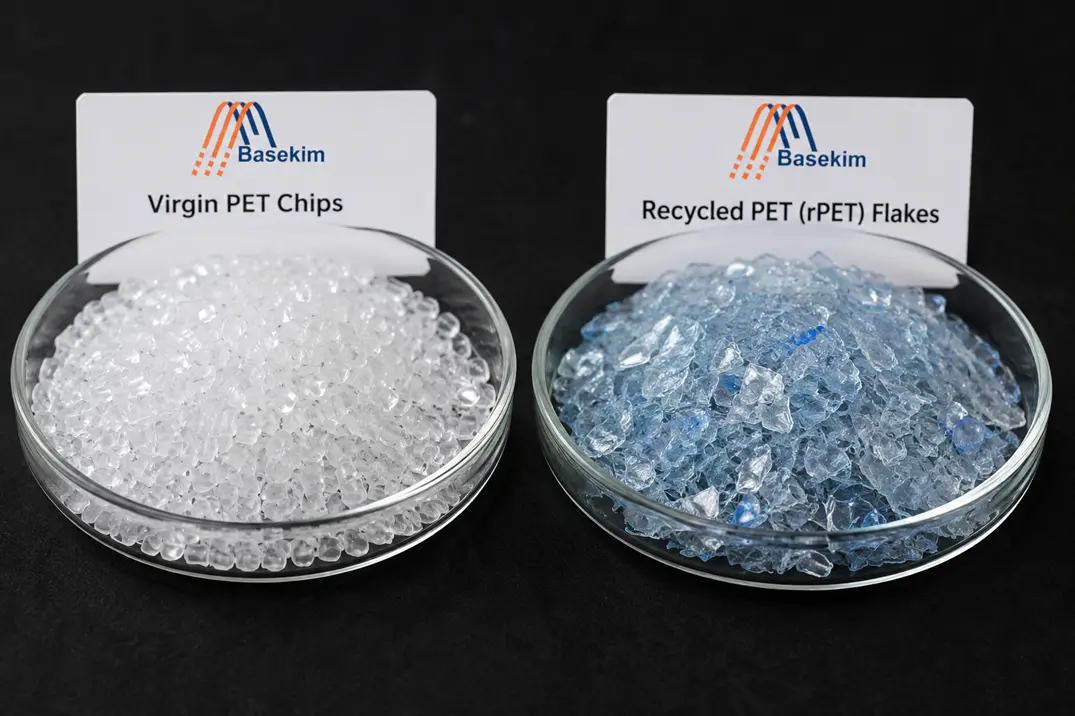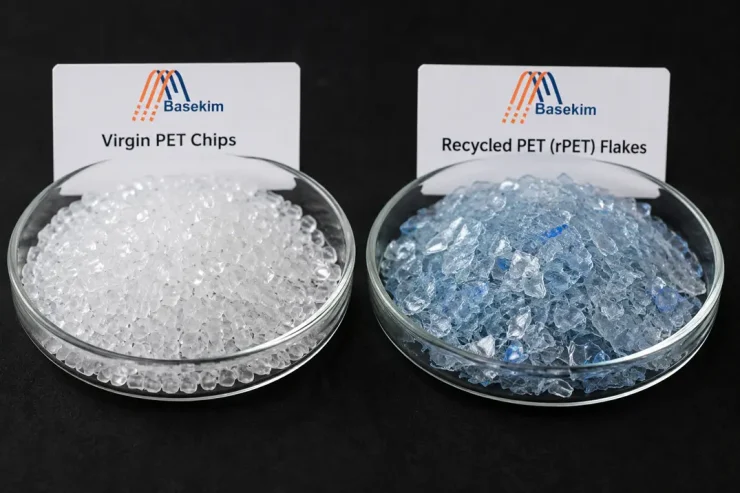
Virgin PET and recycled PET both serve major packaging and industrial sectors. However, each material offers different advantages in cost, purity, food-contact compliance, and processing performance. Therefore, for PET Resin Comparison buyers must evaluate technical requirements, sustainability targets, and production efficiency before sourcing materials.
PET Resin Comparison helps industrial buyers understand how virgin PET chips and recycled PET flakes differ in price, quality, applications, and long-term production value. Virgin PET delivers higher clarity and stable viscosity. Meanwhile, recycled PET supports sustainability goals and reduces environmental impact. As a result, manufacturers often combine both materials depending on production needs.
PET Resin Comparison for Industrial Buyers
PET Resin Comparison becomes essential when manufacturers evaluate packaging quality, production costs, and export requirements. Virgin PET chips come directly from petrochemical feedstock. In contrast, recycled PET (rPET) originates from processed post-consumer PET bottles or industrial PET scrap.
Virgin PET offers consistent molecular structure and excellent transparency. Consequently, it performs well in food-grade bottles, pharmaceutical packaging, and high-speed production lines.
On the other hand, rPET helps companies reduce carbon emissions and support circular economy programs. Moreover, many global beverage brands now require recycled content in packaging materials.
Industrial buyers should compare several factors before purchasing:
- Intrinsic viscosity (IV value)
- Food-contact approval
- Color consistency
- Acetaldehyde level
- Moisture sensitivity
- Processing stability
- Sustainability targets
- Logistics and packaging costs
Advantages of Virgin PET Chips in PET Resin Comparison
Virgin PET chips remain the preferred choice for high-performance packaging applications. Specifically, beverage manufacturers use virgin PET for mineral water bottles, edible oil containers, and carbonated drink packaging.
Several advantages make virgin PET attractive:
- High transparency and gloss
- Stable IV performance
- Better mechanical strength
- Consistent injection molding results
- Lower contamination risk
- Easier compliance with food-contact regulations
Furthermore, virgin PET supports high-speed production environments. Therefore, for PET Resin Comparison manufacturers experience fewer processing interruptions and lower rejection rates.
Most importantly, export-oriented packaging producers often prefer virgin PET because international buyers demand stable quality standards.
Common packaging methods include:
- 1100 kg jumbo bags
- Moisture-protected packaging
- 20 MT to 22 MT container loading
- Sea freight export shipments
PET Resin Comparison in Sustainability and Recycling
PET Resin Comparison also highlights the growing role of sustainability in industrial procurement. Recycled PET reduces plastic waste and lowers raw material consumption. Consequently, many packaging companies integrate rPET into their production lines.
rPET provides several environmental benefits:
- Reduced landfill waste
- Lower carbon footprint
- Lower energy consumption
- Support for ESG targets
- Compliance with global sustainability programs
However, recycled PET also presents technical challenges. For example, inconsistent feedstock quality may affect color stability and mechanical properties.
In addition, contamination risks increase when recycling systems lack proper sorting technology. Therefore, high-quality washing and filtration systems become critical during rPET production.
Food-grade rPET usually requires advanced decontamination processes. As a result, premium-grade recycled PET often carries higher processing costs than expected.
Cost Differences Between Virgin PET and rPET in PET Resin Comparison
Price remains one of the most important procurement factors. Nevertheless, PET pricing changes frequently based on crude oil markets, recycling supply chains, and regional demand.
Virgin PET prices typically follow petrochemical raw material trends. Meanwhile, rPET pricing depends heavily on bottle collection systems and recycling capacity.
Several factors influence total material cost:
Raw Material Availability
Virgin PET depends on petrochemical production. By comparison, rPET depends on local recycling infrastructure and collection efficiency.
Processing Costs
rPET requires washing, sorting, grinding, and purification. Therefore, production complexity may increase operational expenses.
Export Logistics
Both materials usually ship in jumbo bags or bulk containers. However, recycled PET sometimes requires additional quality inspections before export.
Production Efficiency
Virgin PET often produces lower rejection rates. Consequently, some manufacturers accept higher material costs to improve production stability.
Industrial Applications of Virgin and Recycled PET
Understanding the Basics for PET Resin Comparison
Virgin PET and rPET both play highly crucial roles across a variety of industrial sectors. When we conduct a detailed PET Resin Comparison, it becomes evident that both materials support numerous industries. However, their specific application requirements differ significantly. In any comprehensive PET Resin Comparison, examining these differences is essential for manufacturers. Ultimately, a proper PET Resin Comparison determines exactly which material is best suited for the final product and its unique demands.
Virgin PET Applications
Focusing on the first material, a thorough PET Resin Comparison shows that virgin PET boasts the highest levels of clarity, strength, and chemical purity. These characteristics make it ideal for sensitive food and pharmaceutical packaging. If we execute a PET Resin Comparison within these regulated sectors, manufacturers consistently choose virgin PET. Furthermore, in a specialized PET Resin Comparison, the superior tensile strength of the virgin type is an undeniable advantage for pressurized containers.
The Rise of Recycled PET
On the other hand, recycled PET (rPET) provides a much more sustainable alternative. In any PET Resin Comparison driven by environmental sustainability, rPET scores significantly higher due to its reduced carbon footprint. Nevertheless, a precise PET Resin Comparison reveals that rPET might exhibit slight variations in color. Because of this, when doing a PET Resin Comparison for the textile industry, rPET stands out as an excellent and economical choice.
Making the Right Choice in PET Resin Comparison
Choosing between these two polymers depends entirely on the specific requirements of each project. Conducting a comprehensive PET Resin Comparison empowers production managers to strike the perfect balance between cost and quality. Whenever high clarity is demanded, the scale in a PET Resin Comparison tips toward virgin PET. However, for eco-conscious brands, the result of this PET Resin Comparison will undoubtedly favor maximizing the use of rPET.
Virgin PET commonly serves:
- Beverage bottles
- Food containers
- Pharmaceutical packaging
- Cosmetic bottles
- High-clarity packaging films
Meanwhile, rPET often supports:
- Textile fibers
- Strapping materials
- Thermoforming sheets
- Non-food packaging
- Industrial plastic products
Additionally, many manufacturers now blend virgin PET with rPET. This approach balances sustainability goals with production performance.
How to Choose the Right PET Material
Selecting the correct PET material depends on technical expectations and commercial objectives. Therefore, buyers should evaluate both quality requirements and long-term production strategy.
Choose virgin PET when:
- High clarity is essential
- Food-contact compliance is critical
- Production speed matters
- Product consistency is required
Choose rPET when:
- Sustainability targets are important
- Environmental branding matters
- Cost optimization is necessary
- Non-food applications dominate production
In many cases, hybrid formulations provide the best balance between cost and performance.
Bulk PET Supply and Export Solutions
Basekim supplies Virgin PET Chips and recycled PET materials for international industrial buyers. Bulk export supply is available for packaging manufacturers, converters, and distributors worldwide.
Packaging options include:
- 1100 kg jumbo bags
- Export container loading
- Bulk industrial shipments
Technical support services include:
- TDS documentation
- SDS documentation
- IV grade selection
- Application consultation
- Export logistics coordination
Furthermore, Basekim supports global procurement teams with competitive quotations and international shipping solutions.
Contact Basekim today to request pricing, technical specifications, and export availability for PET Resin & PET Chips.