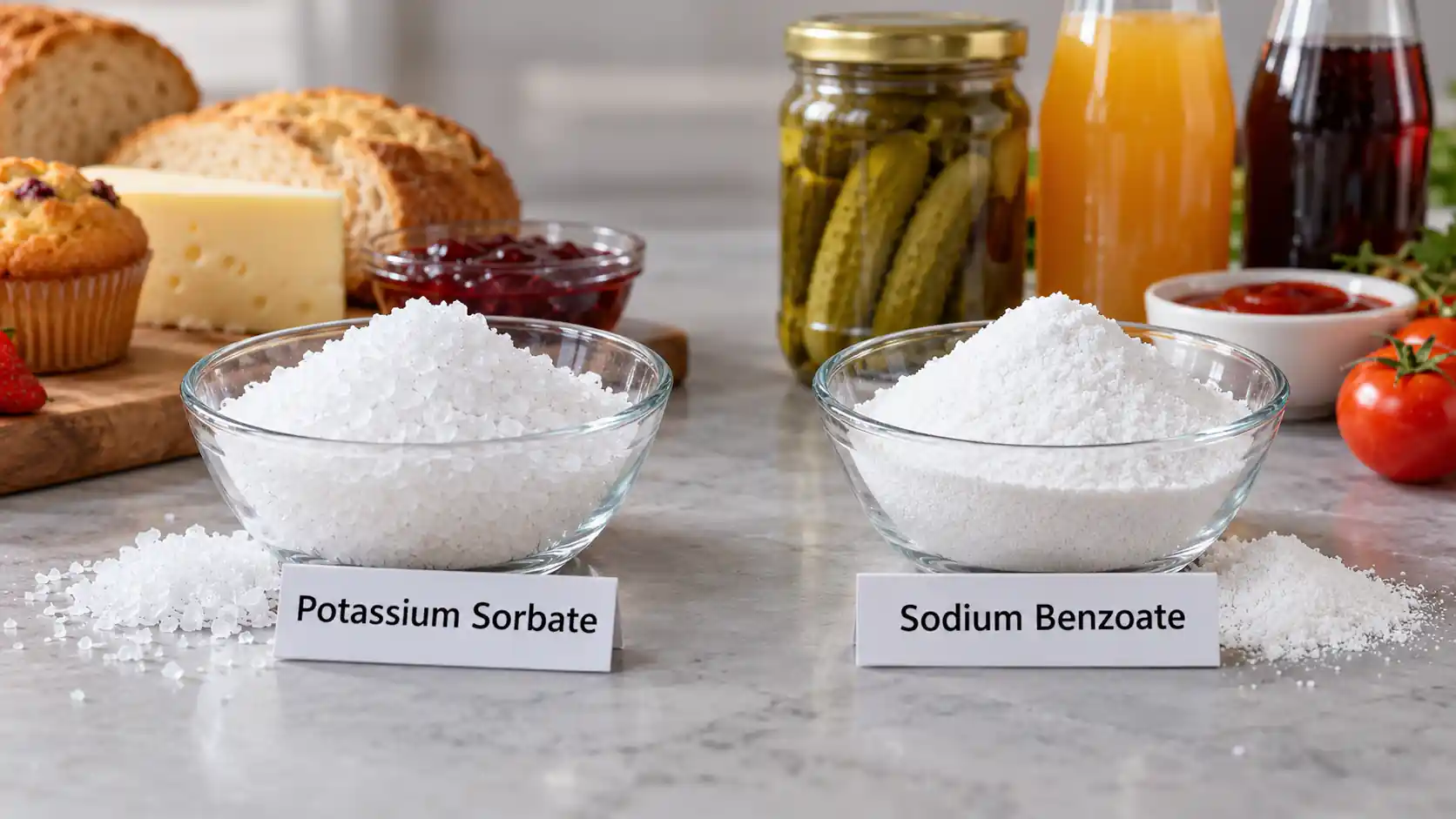
Potassium Sorbate vs Sodium Benzoate is a critical comparison for food manufacturers who want to extend shelf life, prevent microbial spoilage, and maintain product quality without increasing production costs. Both preservatives protect foods against unwanted microorganisms, but they differ significantly in antimicrobial performance, pH sensitivity, ingredient compatibility, and industrial applications. Potassium sorbate generally offers stronger protection against yeasts and molds in moderately acidic foods, while sodium benzoate often provides an economical solution for highly acidic beverages, sauces, and processed foods. Choosing between them requires a clear understanding of how each preservative behaves under real manufacturing and storage conditions.
Food manufacturers must also consider more than antimicrobial strength. Product acidity, water activity, processing temperature, packaging, and regulatory limits all influence preservative effectiveness. This comparison explains the technical differences, practical applications, safety considerations, and purchasing factors that help manufacturers select an appropriate preservation system.
1. Potassium Sorbate vs Sodium Benzoate: Main Differences
Potassium sorbate (E202) and sodium benzoate (E211) belong to the category of food preservatives that manufacturers use to control microbial growth.
This Product comes from sorbic acid and primarily inhibits yeasts and molds. Food processors commonly use it in cheese, bakery fillings, fruit preparations, and selected beverages.
Sodium benzoate comes from benzoic acid and provides antimicrobial protection in acidic food systems. Beverage manufacturers, sauce producers, and condiment processors frequently use it.
Although both preservatives share similar functions, their performance changes according to the chemical environment.
Technical Comparison of E202 and E211
| Property | Potassium Sorbate | Sodium Benzoate |
|---|---|---|
| Food additive number | E202 | E211 |
| CAS number | 24634-61-5 | 532-32-1 |
| Chemical formula | C₆H₇KO₂ | C₇H₅NaO₂ |
| Molecular weight | 150.22 g/mol | 144.11 g/mol |
| Parent acid | Sorbic acid | Benzoic acid |
| Parent acid pKa | Approximately 4.76 | Approximately 4.20 |
| Appearance | White powder or granules | White crystalline powder |
| Main microbial targets | Yeasts and molds | Yeasts, molds, and some bacteria |
| Preferred conditions | Acidic and moderately acidic foods | Strongly acidic foods |
| Practical pH range | Often useful below pH 6 | Generally most effective below pH 4.5 |
| Common applications | Bakery, cheese, fruit products | Beverages, sauces, pickles |
| Water solubility | High | High |
| Potential flavor impact | Usually limited at suitable concentrations | Can affect flavor in some products |
| Purchase cost | Often higher | Often lower |
The listed pH ranges provide general formulation guidance, not guaranteed activity thresholds. Food composition, preservative concentration, and microbial species influence actual results.
2. How Potassium Sorbate and Sodium Benzoate Prevent Food Spoilage
Both preservatives interfere with microbial growth through mechanisms involving weak organic acids.
When manufacturers introduce these compounds into acidic foods, the corresponding sorbic or benzoic acid exists partly in its undissociated form.
This form can enter microbial cells and disrupt processes that support growth and metabolism.
However, each compound affects microorganisms differently.
How Potassium Sorbate Controls Yeast and Mold
Potassium sorbate offers particularly useful antifungal activity.
It helps inhibit microorganisms that cause visible mold growth, fermentation defects, and spoilage-related odors.
Manufacturers frequently consider sorbate for products such as:
Bakery fillings and fruit preparations
Cheese and suitable dairy products
Dried fruits
Certain beverages
Sauces and dressings
Selected confectionery products
Its activity against bacteria varies, so manufacturers should not use it as their only protection against bacterial pathogens.
How Sodium Benzoate Controls Microbial Growth
Sodium benzoate works particularly well in acidic environments.
Its antimicrobial properties make it useful in soft drinks, fruit-based beverages, acidic sauces, and pickled products.
The compound inhibits various spoilage yeasts and can suppress certain molds and bacteria under suitable conditions.
However, sodium benzoate loses much of its practical effectiveness as product pH increases.
Therefore, manufacturers should evaluate the acidity of their finished products before choosing benzoate preservation.
3. Potassium Sorbate vs Sodium Benzoate: Effectiveness at Different pH Levels
The relationship between pH and preservative activity represents one of the most important differences between these ingredients.
Sorbic acid has a pKa of approximately 4.76, while benzoic acid has a pKa of approximately 4.20.
This difference determines how much of each acid remains undissociated at a particular pH.
Comparison of Active Acid Fractions
| Food pH | Undissociated Sorbic Acid | Undissociated Benzoic Acid |
|---|---|---|
| 3.0 | 98.3% | 94.1% |
| 4.0 | 85.2% | 61.3% |
| 4.5 | 64.5% | 33.4% |
| 5.0 | 36.5% | 13.7% |
| 5.5 | 15.4% | 4.8% |
| 6.0 | 5.4% | 1.6% |
These theoretical values describe the equilibrium fractions of the corresponding acids, not direct measurements of preservative strength.
At pH 5.0, sorbic acid retains a significantly greater undissociated fraction than benzoic acid.
Consequently, potassium sorbate often offers better antifungal protection in moderately acidic formulations.
Meanwhile, sodium benzoate can perform effectively in beverages and foods with substantially lower pH values.
Why Formulation Acidity Matters
Manufacturers sometimes increase preservative dosage when microbial stability declines.
However, adjusting product acidity within acceptable sensory and regulatory limits may improve preservation performance without requiring higher additive concentrations.
For example, food processors commonly use citric acid to control acidity in suitable beverages and processed foods.
Nevertheless, acidity regulators and antimicrobial preservatives perform different functions. Manufacturers should verify that any pH adjustment improves microbial control without compromising flavor, texture, or regulatory compliance.
4. Potassium Sorbate vs Sodium Benzoate in Food Applications
Different food products create different microbial risks.
For this reason, manufacturers should select preservatives according to the finished formulation rather than relying on a universal recommendation.
Soft Drinks and Fruit Beverages
Sodium benzoate frequently suits acidic beverages because its antimicrobial activity increases under low-pH conditions.
Manufacturers use it in suitable soft drinks, flavored beverages, and fruit-based products.
Potassium sorbate can also protect beverages against spoilage yeasts and molds.
However, beverage producers should evaluate additional factors, particularly vitamin C content, packaging, and storage temperatures.
Bakery Products and Fruit Fillings
Potassium sorbate often provides a practical choice for controlling molds and yeasts in suitable bakery applications.
Fruit fillings present particular challenges because their moisture, sugar concentration, and acidity can support spoilage under certain conditions.
Manufacturers should assess both the finished filling and its interaction with the surrounding bakery product.
Furthermore, ingredients such as food-grade ammonium bicarbonate influence leavening and product structure rather than serving as direct replacements for antimicrobial preservatives.
Cheese and Dairy Products
Potassium sorbate commonly supports mold control in permitted cheese applications.
Manufacturers may use approved incorporation or surface-treatment methods depending on the product category and local regulations.
Sodium benzoate generally offers less practical activity in dairy systems with relatively high pH.
However, food processors must confirm that the applicable regulations authorize the intended preservative and treatment method.
Sauces, Dressings, and Pickled Foods
Both additives can help preserve acidic sauces and condiments.
Sodium benzoate often works well in strongly acidic vinegar-based formulations.
Potassium sorbate may offer advantages when producers need to control molds and yeasts in moderately acidic sauces.
Before finalizing a formulation, manufacturers should measure the finished product’s equilibrium pH and evaluate its microbial stability.
5. Can Potassium Sorbate and Sodium Benzoate Work Together?
Some manufacturers combine different preservatives to achieve broader antimicrobial coverage.
A mixture of potassium sorbate and sodium benzoate may provide useful preservation benefits in suitable products.
However, combining them does not automatically create greater antimicrobial effectiveness.
Their performance depends on the concentration of each ingredient, the target microorganisms, and the surrounding food system.
Manufacturers should also review regulations carefully because food additive restrictions may apply to individual ingredients and their combined use.
A suitable evaluation process includes identifying spoilage organisms, checking product pH, preparing controlled test batches, comparing microbial results, and validating the intended shelf life.
This approach provides more reliable information than assuming that two preservatives always work better than one.
6. Potassium Sorbate vs Sodium Benzoate: Safety and Regulatory Considerations
Both preservatives have established food uses, but manufacturers must follow applicable regulatory requirements.
Food safety authorities evaluate additives according to scientific evidence, permitted applications, and exposure considerations.
Potassium Sorbate Safety
Food manufacturers use potassium sorbate in approved applications within applicable regulatory conditions.
Its widespread use reflects its established role in food preservation, particularly against yeasts and molds.
However, manufacturers must still monitor dosage, ingredient purity, and product-specific additive permissions.
Sodium Benzoate and Vitamin C
Sodium benzoate requires additional attention in beverages containing ascorbic acid, commonly known as vitamin C.
Under certain conditions, benzoate compounds and ascorbic acid can contribute to benzene formation.
Heat, light, and other formulation characteristics can influence this reaction.
Therefore, beverage manufacturers should evaluate these interactions during product development and shelf-life studies.
The possibility of benzene formation does not mean that all beverages containing both ingredients develop unsafe concentrations.
Actual results depend on formulation chemistry and storage conditions.
International Food Additive Regulations
Food additive limits vary across jurisdictions and food categories.
For example, the United States recognizes certain potassium sorbate applications under good manufacturing practice conditions, while specific regulatory provisions govern sodium benzoate use.
The European Union applies food-category authorizations and maximum levels under its food additive regulations.
Manufacturers should check the current requirements for each destination market rather than assuming that one country’s permissions apply internationally.
7. How These Preservatives Affect Taste, Texture, and Shelf Life
Microbial protection alone does not guarantee a successful commercial formulation.
Food manufacturers must also maintain flavor, appearance, and consumer acceptance.
Sodium benzoate may contribute an undesirable aftertaste in certain formulations, particularly at higher concentrations.
Potassium sorbate generally produces limited sensory effects at appropriate levels, although microorganisms can sometimes metabolize sorbate and generate undesirable odors.
Neither ingredient directly guarantees a specific shelf-life extension.
Actual performance depends on:
Initial microbial contamination
Product acidity
Water activity
Processing conditions
Storage temperature
Packaging characteristics
Preservative concentration
Manufacturers should monitor both microbiological and sensory changes throughout the proposed shelf life.
8. Water Activity and Packaging: Two Often-Overlooked Factors
Many food processors focus heavily on preservative concentration while overlooking other important variables.
Water activity determines how much water microorganisms can access.
Consequently, two products with similar moisture contents can demonstrate different spoilage patterns.
A concentrated fruit filling, for example, may support microbial growth differently from a diluted fruit sauce.
Packaging conditions create additional differences.
Poor sealing, oxygen exposure, repeated handling, and unsuitable storage temperatures can increase contamination or spoilage risks.
Manufacturers should therefore combine appropriate preservatives with effective hygiene, packaging, and temperature controls.
This broader approach helps improve product stability without relying entirely on chemical additives.
9. Potassium Sorbate vs Sodium Benzoate: Cost Comparison
Purchasing teams often compare potassium sorbate price and sodium benzoate price when selecting food additives.
Sodium benzoate frequently offers a lower initial purchase cost.
However, a cheaper preservative does not always produce the lowest total manufacturing cost.
Consider a hypothetical production batch of 10,000 kg.
| Preservative Concentration | Quantity Required |
|---|---|
| 0.03% | 3 kg |
| 0.05% | 5 kg |
| 0.08% | 8 kg |
| 0.10% | 10 kg |
These figures demonstrate dosage calculations only. They do not represent recommended or universally permitted preservative concentrations.
Manufacturers should compare the cost of legally compliant, validated formulations rather than evaluating raw material prices alone.
A higher-priced ingredient may deliver better economics when it achieves the required microbial control at an appropriate lower concentration.
Conversely, sodium benzoate may offer a cost advantage in suitable highly acidic products.
For accurate industrial cost comparisons, buyers should consider packaging, transport, import duties, technical documentation, and potential production losses.
10. How Food Manufacturers Can Improve Preservative Performance
Selecting the right ingredient represents only the first stage of an effective preservation strategy.
Manufacturers can improve consistency by controlling several formulation and production variables.
Optimize Final Product pH
Acidity directly affects the antimicrobial performance of weak-acid preservatives.
Food processors should measure pH after ingredient mixing and confirm that the product maintains an appropriate value during storage.
Where necessary, manufacturers can investigate compatible acidity regulators.
However, they must avoid unnecessary pH adjustments that could damage taste or texture.
Control Processing Conditions
Temperature, mixing efficiency, and ingredient addition sequences can influence preservation results.
Manufacturers should establish procedures that distribute preservatives consistently throughout the product.
They should also follow validated processing practices and prevent contamination after production.
Evaluate Related Food Ingredients
A formulation may contain ingredients that change acidity or buffering capacity.
For example, sodium bicarbonate increases alkalinity in suitable food applications.
Because increasing pH can reduce the effectiveness of weak-acid preservatives, manufacturers should consider such interactions during formulation development.
Conduct Microbial Challenge Tests
Challenge testing provides practical evidence of preservative performance.
Food technologists can introduce representative microorganisms under controlled laboratory conditions and monitor their behavior.
These tests help determine whether the selected formulation can control relevant spoilage organisms throughout the intended shelf life.
11. Choosing Food-Grade Preservatives for Bulk Supply
Industrial buyers need consistent quality, suitable documentation, and reliable delivery arrangements.
Before selecting a preservative supplier, procurement teams should compare product specifications rather than relying only on commercial quotations.
Important Purchasing Specifications
| Purchasing Factor | Recommended Evaluation |
|---|---|
| Chemical identity | Correct CAS number and food additive designation |
| Purity | Compliance with relevant food-grade standards |
| Appearance | Consistent powder or granular characteristics |
| Moisture | Supplier-defined specification |
| Contaminants | Applicable food-standard limits |
| Packaging | Suitable moisture-resistant materials |
| Documentation | TDS, SDS, and Certificate of Analysis |
| Traceability | Batch identification and production records |
| Storage conditions | Manufacturer recommendations |
| Shelf life | Supplier-supported validity period |
| Regulatory compliance | Destination-market food additive requirements |
For export-focused buyers, documentation and regulatory compatibility are particularly important.
Food manufacturers should never substitute industrial-grade ingredients for food-grade materials simply to reduce purchasing costs.
Basekim supplies food-grade chemicals and industrial raw materials for international buyers, supporting bulk procurement inquiries, technical documentation, and commercial supply requirements.
12. Potassium Sorbate vs Sodium Benzoate: Which Should You Choose?
The best preservative depends on the type of food, microbial risks, and processing environment.
The following comparison provides a practical starting point.
| Application | Initial Preservative Choice |
|---|---|
| Highly acidic soft drinks | Sodium benzoate or potassium sorbate |
| Vitamin C-containing beverages | Evaluate potassium sorbate and compatibility risks |
| Moderately acidic fruit fillings | Potassium sorbate |
| Mold control in suitable bakery products | Potassium sorbate |
| Strongly acidic pickled products | Sodium benzoate or potassium sorbate |
| Permitted cheese applications | Potassium sorbate |
| Products with relatively high pH | Consider alternative preservation systems |
| Formulations with multiple spoilage risks | Evaluate an approved combination |
Manufacturers should treat these recommendations as screening guidance rather than fixed formulation instructions.
The most effective choice depends on actual microbiological results, food regulations, and product-quality requirements.
Conclusion: Potassium Sorbate or Sodium Benzoate?
The Potassium Sorbate vs Sodium Benzoate comparison demonstrates that preservative effectiveness depends on more than chemical identity or price.
Potassium sorbate often provides stronger antifungal performance in moderately acidic products, making it useful for selected bakery foods, fruit preparations, and dairy applications.
Meanwhile, sodium benzoate can deliver effective microbial control in strongly acidic beverages, sauces, and condiments.
For industrial food manufacturers, the best approach combines preservative selection with controlled acidity, hygienic production, appropriate packaging, and validated shelf-life testing.
By evaluating these factors together, producers can develop stable products, reduce spoilage losses, and control manufacturing costs while meeting relevant food safety requirements.
Frequently Asked Questions
1. What is the main difference between potassium sorbate and sodium benzoate?
Potassium sorbate primarily inhibits yeasts and molds and often performs better in moderately acidic foods. Sodium benzoate provides effective antimicrobial activity in strongly acidic products, particularly beverages, pickles, and sauces.
2. Is potassium sorbate better than sodium benzoate for food preservation?
Potassium sorbate often offers advantages against molds and yeasts at moderately acidic pH levels. Sodium benzoate can provide economical preservation in highly acidic foods. Manufacturers should compare their performance under actual product conditions.
3. Which preservative works better at pH 5?
Potassium sorbate generally offers better potential antifungal activity at pH 5 because sorbic acid maintains a greater undissociated fraction than benzoic acid. Nevertheless, manufacturers should confirm effectiveness through formulation testing.
4. Can potassium sorbate replace sodium benzoate in drinks?
Yes, manufacturers can use potassium sorbate instead of sodium benzoate in some beverages when regulations permit. However, they must evaluate microbial stability, flavor, concentration, and shelf-life performance before making the change.
5. Can manufacturers mix potassium sorbate and sodium benzoate?
Some food products use both preservatives. However, manufacturers must confirm applicable regulatory limits and evaluate whether the combination improves microbial protection in the finished formulation.
6. Which preservative is safer, E202 or E211?
Regulatory authorities permit both preservatives for specified food applications under appropriate conditions. Manufacturers should follow relevant food additive regulations, permitted concentrations, and safety requirements rather than assuming one ingredient is universally safer.
7. Does sodium benzoate react with vitamin C?
Under certain conditions, benzoate preservatives and vitamin C can contribute to benzene formation. Heat, light, and formulation chemistry influence the reaction. Beverage manufacturers should assess these factors during product development.
8. Which preservative works best against mold in bread and bakery products?
Potassium sorbate often provides useful mold control in suitable bakery applications. However, effectiveness depends on product acidity, moisture, processing methods, and legal permissions.
9. How much potassium sorbate or sodium benzoate should manufacturers use?
The correct dosage depends on food category, regulations, product pH, and microbial risks. Manufacturers should determine appropriate concentrations through compliant formulation development and validated testing.
10. Which preservative costs less for industrial food production?
Sodium benzoate often has a lower purchase price. However, manufacturers should compare total formulation costs, required dosage, product stability, and regulatory requirements before choosing the most economical option.
11. Are potassium sorbate and sodium benzoate natural preservatives?
Commercial food-grade potassium sorbate and sodium benzoate generally come from industrial manufacturing processes. Although related acids occur naturally, commercial preservative salts do not necessarily come from natural extraction.
12. What documents should buyers request when purchasing food-grade preservatives?
Industrial buyers should request a Certificate of Analysis, Technical Data Sheet, Safety Data Sheet, applicable food-grade compliance documentation, packaging specifications, and batch traceability information before confirming bulk purchases.