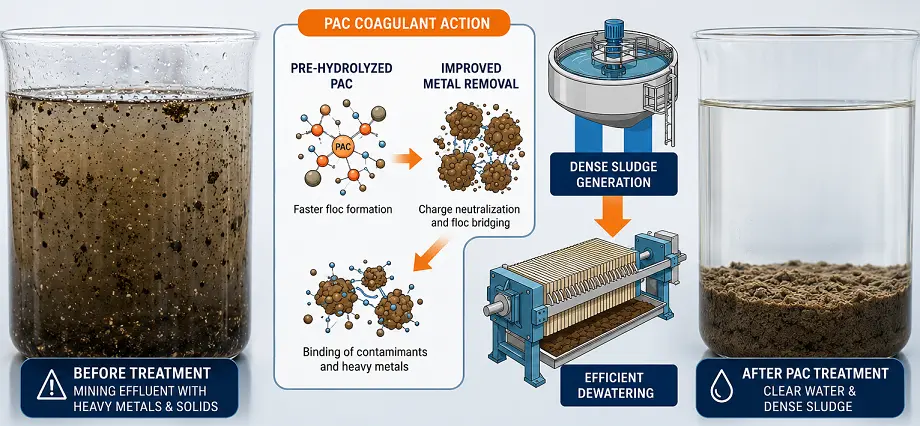
Mining operations generate large volumes of wastewater containing suspended solids, heavy metals, sulfides, and process chemicals. Therefore, selecting the correct coagulant directly affects treatment efficiency, sludge volume, and operational costs. In modern Mining Effluent Treatment systems, many industrial plants now prefer Poly Aluminum Chloride (PAC) over traditional coagulants because it improves metal removal and produces denser sludge.
PAC offers faster floc formation, lower sludge generation, and improved dewatering performance compared to conventional aluminum sulfate or ferric chloride. As a result, mining operators can reduce disposal costs while maintaining stable wastewater compliance standards for discharge or recycling applications.
Why Mining Effluent Treatment Requires Advanced Coagulation
Mining wastewater often contains dissolved lead, zinc, copper, arsenic, iron, manganese, and suspended mineral particles. These contaminants create environmental and operational challenges. Additionally, fluctuating pH levels make treatment more complex.
Traditional coagulants can remove part of the contamination. However, they often produce large sludge volumes with poor settling characteristics. Consequently, disposal costs increase significantly.
PAC performs differently because its pre-hydrolyzed aluminum structure creates stronger flocs. Meanwhile, the coagulation process remains stable across wider pH ranges.
Comparative Performance of PAC and Traditional Coagulants in Mining Effluent Treatment
Mining companies frequently compare PAC with aluminum sulfate and ferric chloride during pilot treatment studies. The results usually favor PAC in both clarification and sludge handling.
Heavy Metal Removal Efficiency
PAC improves precipitation of dissolved heavy metals through charge neutralization and floc bridging mechanisms. Therefore, treatment plants often achieve lower residual metal concentrations.
Compared with conventional alum systems, PAC generally offers:
- Faster coagulation kinetics
- Better suspended solids removal
- Reduced chemical dosage requirements
- Lower residual turbidity
- Improved pH stability
Moreover, PAC works effectively in acid mine drainage treatment applications where water chemistry changes rapidly.
Sludge Dewatering Performance
Sludge handling represents a major operational expense in Mining Effluent Treatment facilities. Consequently, sludge reduction remains a critical purchasing factor for industrial operators.
PAC generates compact and denser sludge flocs. As a result, filter press systems and centrifuges operate more efficiently. Lower water retention inside the sludge cake also reduces transportation and landfill costs.
Traditional alum-based systems often create lightweight sludge with slower settling rates. Meanwhile, ferric chloride may increase corrosion risks in certain process lines.
PAC Applications in Mining Effluent Treatment
PAC supports several mining wastewater treatment stages. Furthermore, operators can integrate it into existing clarification systems without major equipment changes.
Common industrial applications include:
- Copper mining wastewater clarification
- Gold mining tailing pond treatment
- Coal washing wastewater recovery
- Iron ore processing water treatment
- Acid mine drainage neutralization
- Heavy metal precipitation systems
Additionally, PAC supports water recycling programs in mineral processing plants. This advantage helps reduce freshwater consumption in water-stressed mining regions.
Mining Effluent Treatment Operational Advantages for Industrial Buyers
Procurement managers often evaluate coagulants based on total operating cost rather than initial product price alone. Therefore, PAC becomes attractive because it improves overall plant efficiency.
Key operational benefits include:
- Reduced sludge disposal costs
- Lower chemical consumption
- Improved filter press performance
- Faster sedimentation rates
- Stable operation under variable water conditions
- Reduced maintenance requirements
Meanwhile, PAC also simplifies logistics because high-performance grades require lower storage volumes compared to traditional coagulants.
Packaging and Export Supply Considerations
Industrial PAC suppliers usually provide the material in both powder and liquid grades. Powder PAC remains popular for export because it offers longer shelf life and lower freight costs.
Typical export packaging includes:
- 25 kg valve bags
- 25 kg PE-lined kraft bags
- 1 MT jumbo bags
- Customized private-label packaging
For international mining projects, suppliers should provide technical documentation including:
- TDS (Technical Data Sheet)
- MSDS/SDS documentation
- COA (Certificate of Analysis)
- SGS inspection reports upon request
Additionally, reliable suppliers must ensure stable aluminum content and basicity levels for consistent field performance.
Selecting the Right PAC Grade for Mining Applications
Not all PAC grades perform equally in mining wastewater systems. Therefore, industrial users should evaluate several technical parameters before purchasing.
Important selection factors include:
- Al₂O₃ concentration
- Basicity percentage
- Insoluble matter content
- Heavy metal impurity levels
- Solubility characteristics
- Application pH range
Jar testing remains essential before full-scale implementation. Consequently, many industrial buyers request pilot samples before bulk procurement.
Future Trends in Mining Effluent Treatment
Environmental regulations continue to tighten across global mining regions. As a result, operators increasingly seek high-efficiency coagulants with lower environmental impact.
PAC supports this transition because it reduces sludge generation and improves water reuse potential. Meanwhile, modern mining plants also integrate PAC with polymer systems and automated dosing technologies to maximize clarification efficiency.
Therefore, demand for advanced coagulation chemicals will continue growing in industrial wastewater treatment markets.
Bulk PAC Supply for Mining Projects
Basekim supplies industrial-grade Poly Aluminum Chloride for Mining Effluent Treatment applications worldwide. Bulk export supply is available in jumbo bags, 25 kg bags, and customized packaging solutions.
Technical documentation, product specifications, SDS/MSDS files, and quotation support are available for mining companies, water treatment contractors, and industrial distributors. Additionally, Basekim supports international shipments for large-scale industrial wastewater treatment projects.