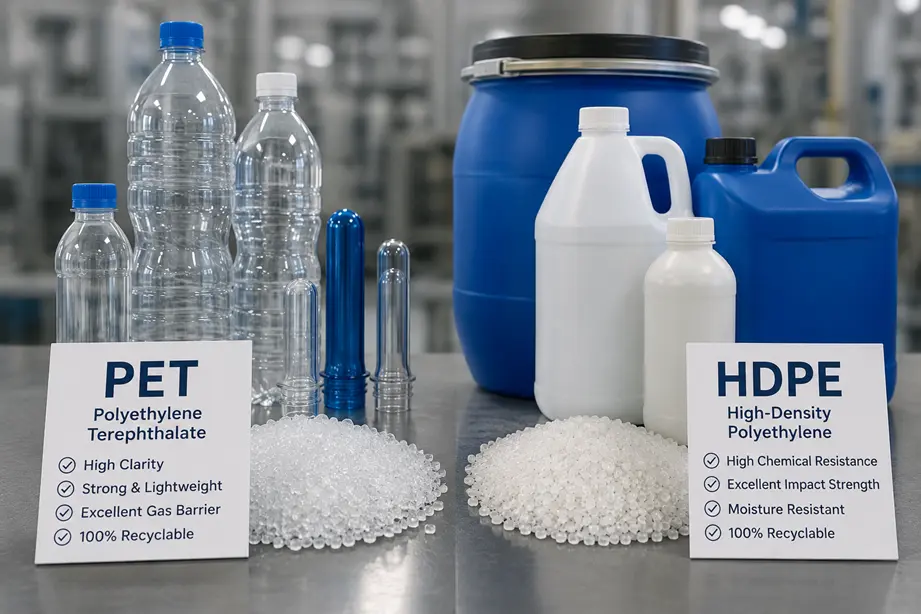
PET and HDPE are two of the most widely used thermoplastics in industrial manufacturing. However, each polymer performs differently under pressure, heat, chemical exposure, and transportation conditions. Therefore, selecting the correct material directly affects production efficiency, packaging durability, product safety, and export costs.
For industrial buyers and manufacturers, the decision between PET and HDPE depends on the final application. PET offers high transparency and excellent gas barrier properties. In contrast, HDPE provides superior chemical resistance and impact strength. As a result, both materials serve different industrial packaging and manufacturing requirements.
Understanding Polymer Packaging Materials
Manufacturers use Polymer Packaging Materials in beverage packaging, chemical containers, personal care products, pharmaceutical bottles, and industrial storage solutions. Although PET and HDPE belong to the thermoplastic family, they differ significantly in structure and performance.
PET resin usually delivers:
- High clarity
- Strong tensile strength
- Excellent recyclability
- Superior gas barrier performance
Meanwhile, HDPE provides:
- High chemical resistance
- Better impact durability
- Opaque appearance
- Excellent moisture resistance
Consequently, procurement teams must evaluate the operational environment before selecting a material.
PET Resin Advantages in Industrial Applications
PET resin remains the preferred choice for transparent packaging applications. For example, beverage producers, edible oil manufacturers, and bottled water companies widely use PET containers because they maintain product visibility and freshness.
Moreover, PET offers lightweight transportation benefits. This advantage reduces logistics costs during export shipments.
Key industrial advantages include:
- Excellent transparency
- High mechanical strength
- Good CO₂ barrier properties
- Lightweight packaging
- Strong recycling infrastructure
In addition, PET resin supports automated high-speed bottle production lines. Therefore, many global manufacturers prefer PET for mass packaging operations.
Common Industries Using PET Resin
Industries using PET resin include:
- Beverage manufacturing
- Food packaging
- Pharmaceutical packaging
- Cosmetic packaging
- Textile fiber production
Furthermore, exporters often choose PET because jumbo bag packaging and container loading remain highly efficient for international shipments.
HDPE Benefits for Industrial Manufacturing and Polymer Packaging Materials
HDPE performs well in demanding industrial environments. Unlike PET, HDPE resists aggressive chemicals and external impacts more effectively.
As a result, chemical manufacturers frequently select HDPE containers for:
- Detergents
- Industrial acids
- Lubricants
- Agricultural chemicals
- Cleaning products
Additionally, HDPE tolerates outdoor storage conditions better than PET. Consequently, many industrial packaging systems rely on HDPE drums and blow-molded containers.
HDPE vs PET in Chemical Resistance
Chemical resistance represents one of the biggest differences between these materials.
PET performs well with:
- Water
- Soft drinks
- Edible oils
- Mild food products
However, HDPE handles:
- Corrosive chemicals
- Industrial solvents
- Alkalis
- Detergent formulations
Therefore, chemical compatibility testing remains essential before commercial production.
Comparing Polymer Packaging Materials: PET and HDPE Performance
When comparing Polymer Packaging Materials, buyers should analyze several technical factors simultaneously.
Property | PET Resin | HDPE |
Transparency | Excellent | Low |
Chemical Resistance | Moderate | High |
Impact Resistance | Good | Excellent |
Gas Barrier | Excellent | Moderate |
Moisture Resistance | Moderate | Excellent |
Recycling Capability | Excellent | Excellent |
Meanwhile, manufacturing methods also differ. PET commonly uses injection stretch blow molding. On the other hand, HDPE usually relies on extrusion blow molding processes.
Logistics and Export Considerations
Export packaging plays a major role in polymer sourcing decisions. Therefore, industrial buyers must evaluate storage, loading efficiency, and freight optimization.
PET resin typically ships in:
- 1000 kg jumbo bags
- 25 kg bags
- Bulk container loads
Meanwhile, HDPE resin often uses similar industrial packaging systems.
In addition, container optimization helps reduce freight costs. For example, suppliers frequently load PET resin in 20-foot containers for better weight management and export efficiency.
Most importantly, buyers should request:
- TDS documentation
- MSDS/SDS files
- Food-grade certifications
- Packaging specifications
- Melt flow index data
How to Choose the Right Polymer
The correct material depends on the end-use application.
Choose PET if you need:
- Transparent packaging
- Beverage bottles
- High visual appeal
- Better gas barrier performance
Choose HDPE if you need:
- Chemical resistance
- Heavy-duty durability
- Outdoor storage performance
- Industrial chemical packaging
Ultimately, manufacturers should evaluate production methods, filling temperatures, transportation conditions, and regulatory requirements before making a purchasing decision.
Conclusion
Both PET and HDPE remain essential Polymer Packaging Materials for industrial manufacturing. However, each polymer serves different operational goals. PET delivers clarity, lightweight performance, and strong recyclability. Meanwhile, HDPE offers durability and chemical resistance for demanding industrial environments.
Therefore, selecting the right polymer requires technical evaluation, application analysis, and supply chain planning.
Bulk Supply and Export Support
At Basekim, we supply industrial-grade PET resin for global manufacturers, converters, and packaging companies. We support bulk export shipments with professional packaging solutions and technical documentation.
Our services include:
- Bulk PET resin supply
- Export container loading
- Jumbo bag packaging
- Technical Data Sheets (TDS)
- SDS/MSDS documentation
- International quotation support
Contact our team today to request pricing, technical specifications, and export availability for your industrial application.