Sodium Sulfide Applications – A Comprehensive Guide by Basekim
Sodium sulfide plays a pivotal role across various industrial, water treatment, and leather sectors. Moreover, thanks to its strong reducing power and cost-effectiveness, manufacturers and process engineers rely on it globally. At Basekim, we deliver high-purity sodium sulfide in both anhydrous and nonahydrate forms. Furthermore, we provide expert support and fast shipping to support your operations in mining, tanning, dyeing, and more.
What Is Sodium Sulfide?
To begin with, sodium sulfide forms when sodium and sulfur combine chemically into Na₂S. Because of its ionic structure, the compound dissolves quickly in water and creates a strong reducing solution. Additionally, its high sulfur content and reactive nature make it perfect for specialized industrial reactions. When hydrated, Na₂S forms sodium sulfide nonahydrate (Na₂S·9H₂O), which trades as a moist, stable form. Meanwhile, our anhydrous sodium sulfide offers maximal strength and minimal moisture.
Key Forms: Anhydrous vs Nonahydrate
Basekim offers both common forms: Anhydrous sodium sulfide contains no water, explains its strong reactivity, and suits operations needing quick reactions. Sodium sulfide nonahydrate has nine water molecules, leading to stable storage and easier handling. Therefore, depending on your process needs—dry storage or fast dissolution—you get the ideal form from us.
Main Industrial Applications of Sodium Sulfide
Let’s explore industries Sodium Sulfide Application in daily operations.
Mining and Metal Recovery
Sodium Sulfide Application In mining, helps separate valuable metals like copper, lead, and zinc. Because it reacts with metal ions, Na₂S creates metal sulfide precipitates, thus purifying solutions easily. Consequently, mineral producers boost yield while controlling wastewater discharge. Moreover, sodium sulfide minimizes sulfate formation that harms tailings ponds.
Water Treatment and Odor Control
Furthermore, sodium sulfide treats water by removing heavy metals and neutralizing chlorine. Because it forms insoluble sulfide salts, operators remove contaminants effectively. Additionally, it controls noxious odors in pulp mills and sewage plants by converting hydrogen sulfide gas (H₂S) into safer sulfide forms. This process enhances workplace safety and reduces community complaints.
Sodium Sulfide Application Leather Tanning Industry
In tanning, sodium sulfide plays a critical role. First, tanners soak hides in Na₂S solutions to loosen hair and epidermis. Then, they treat legitimately to preserve hide quality. As a result, hides remain supple, strong, and clean. Therefore, leather suppliers achieve higher yield and lower chemical usage.
Dye, Pigment, and Sulfur-Based Chemistry
Additionally, sodium sulfide acts as a key reducing agent in textile dyes and sulfur-based pigments. Because it can break azo bonds, dye makers use it during vat dyeing and sulfur dyeing processes. Meanwhile, it helps produce sulfur pigments for coatings and paper. Thus, colorists trust it to deliver consistent shade and fastness every time.
Paper and Pulp Industries
In kraft pulp mills, sodium sulfide forms part of the white liquor (sodium sulfide plus sodium hydroxide). Moreover, it enhances delignification, improving fiber yield and whiteness. Consequently, pulp mills achieve more uniform paper quality and reduce chemical waste.
Chemical Intermediates and Production
Also, Sodium Sulfide Application enters reactions producing thiols, sulfur dyes, and rubber chemicals. Because of its high sulfur content, it provides reactive sulfide ions. Hence, chemical producers find it efficient for multiple syntheses.
Physical and Chemical Properties
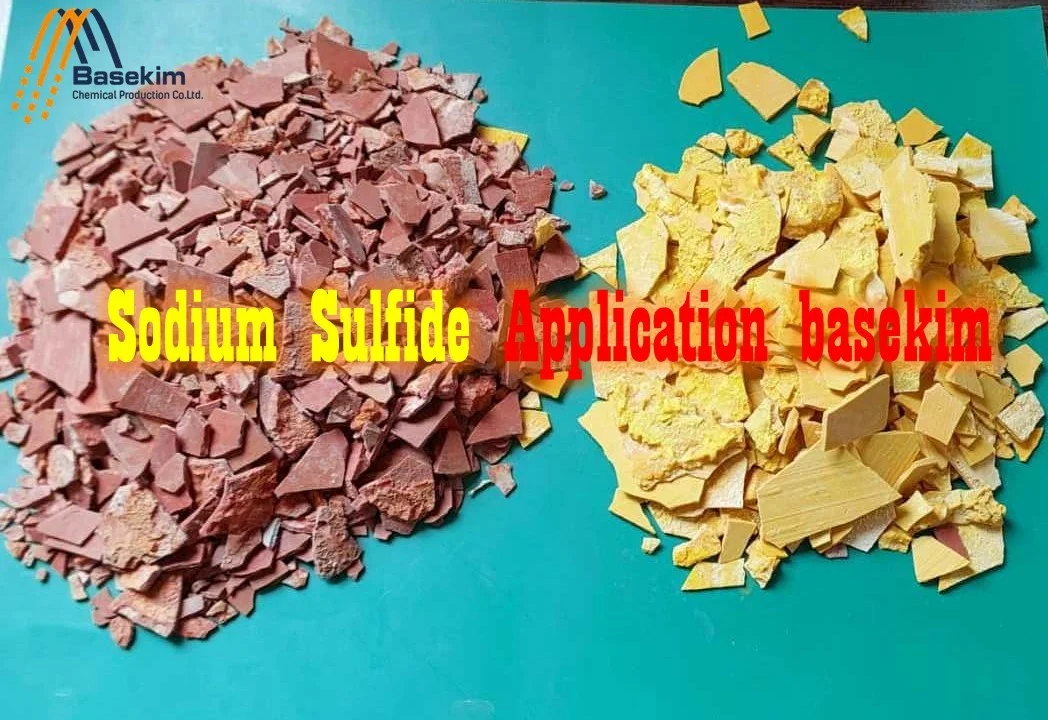
Now, let’s focus on key properties that make Na₂S industrially useful: It forms yellow to red-brown crystals. It dissolves rapidly in water with a rotten-egg odor due to H₂S traces. It reacts strongly with acids:
Na₂S + 2HCl → 2NaCl + H₂S↑
It maintains high purity levels: free sulfur > 60%, low iron, and minimal heavy metals. Additionally, we offer sodium sulfide with controlled moisture and low ash percentages, ensuring consistent performance no matter the batch.
Regulatory and Safety Notes
However, safety remains crucial when using sodium sulfide. Always follow these rules: Wear gloves and goggles to avoid skin or eye contact. Ensure proper ventilation to avoid H₂S inhalation. Store in sealed containers away from acids. Ship only in approved drums or polybags with full labeling. Since Basekim adheres strictly to safety standards, we provide SDS documents, hazard labels, and proper packaging with every order.
How Basekim Supports Sodium Sulfide Applications
Now, let’s review how Basekim helps clients use Na₂S, Sodium Sulfide Application effectively: We offer both forms—anhydrous sodium sulfide and sodium sulfide nonahydrate—tailored for specific applications, analyze each batch for Na₂S content, moisture, iron, and thiosulfate levels and provide certificates of analysis and MSDS with every delivery. We ship globally in sealed drums and moisture-proof bags. We assist with custom quantities and application-specific recommendations. Moreover, we consult on formulation, storage, and safe handling to help customers get consistent results.
Why Sodium Sulfide Still Matters
Indeed, in an era of green alternatives, sodium sulfide remains vital due to its efficiency and versatility. Besides, modern suppliers, including Basekim, offer safer forms and environmental options. Furthermore, improved handling protocols now reduce risk and make it a practical solution even in regulated markets.
Emerging Trends in Sodium Sulfide Use
Now, let’s highlight some emerging trends: Green sulfide generation: New methods reduce H₂S emissions by combining Na₂S with safe buffers. Eco-conscious sourcing: Biobased sulfur options integrate into Na₂S formulations with cleaner feedstock. Nano-form additive development: Nano-sized sulfide particles enhance reaction rates in metallurgy and dyeing. Circular water treatment: Sodium sulfide systems now recycle up to 90% of metal sludge, cutting waste. Digitized process control: Real-time sensors now optimize Na₂S dosing for efficiency. Consequently, Basekim continues innovating to match these trends with flexible logistics and technical expertise.
Challenges in Sodium Sulfide Applications
No chemical remains challenge-free. Let’s review common concerns: Variable quality: Impure Na₂S may increase thiosulfate or iron, affecting performance. Storage risk: Moisture or acid exposure can release H₂S unexpectedly. Regulatory limits: Some regions restrict Na₂S use due to odor or toxicity. Transport hazard: Without proper packaging, chemical can degrade or pose risk upon shipment. However, Basekim ensures product quality and handles logistics carefully. Therefore, our clients face fewer issues and gain smoother operations.
Comparing Sodium Sulfide with Similar Chemicals
Also worth noting, alternative chemicals—like sodium hydrosulfide or sodium sulfite—sometimes compete with Na₂S. Yet, sodium sulfide offers stronger reducing capability and lower cost per mole. Because of this, it remains a preferred choice in many applications—especially where rapid reaction or sulfide precipitation is necessary. However, we help customers choose the right chemical—comparing cost, safety, and environmental impact every time.
Case Studies: Sodium Sulfide in Action
Let’s see real-world examples: A copper miner used Na₂S to precipitate copper sulfide, boosting yield by 15% and reducing waste sludge. A leather tannery adopted nonahydrate Na₂S, cutting chemical loss and improving hide quality by 10%. A municipal plant used Na₂S for H₂S control, enhancing odor management and meeting environmental standards. As a result, these clients achieved cleaner operations, better economics, and safer processes by using Basekim’s sodium sulfide.
Summary of Sodium Sulfide Uses and Benefits
| Application Area | Key Benefit | Basekim Advantage |
|---|---|---|
| Mining | Metal sulfide precipitation | Controlled purity with fast delivery |
| Water Treatment | Heavy metal and odor removal | Technical support with dosing expertise |
| Leather Tanning | Hair removal and hide softening | Choice of anhydrous or nonahydrate form |
| Dye & Pigment Industry | Reducing agent and sulfur dye formation | High reactivity and consistent batch quality |
| Pulp & Paper | Delignification in kraft process | Clean supply with API-standard testing |
| Chemical Synthesis | Sulfur-based intermediates | Sulfide-based reactions with full documentation |
Final Thoughts – Partner with Basekim for Sodium Sulfide Excellence
To wrap up Sodium Sulfide Application, delivers unmatched industrial value in mining, water treatment, leather, dye, pulp, and more. Meanwhile, Basekim ensures each shipment matches quality standards and arrives on time—packing everything you need drawn from our deep technical expertise. So, whether you need to buy sodium sulfide in bulk with full documentation or consult on buffer formulation, Basekim stands with you. Reach out today to explore our product grades, request a sample, or arrange a custom export plan.