




Food Grade Malic Acid: Food Grade Specifications, Uses, Benefits & Supplier
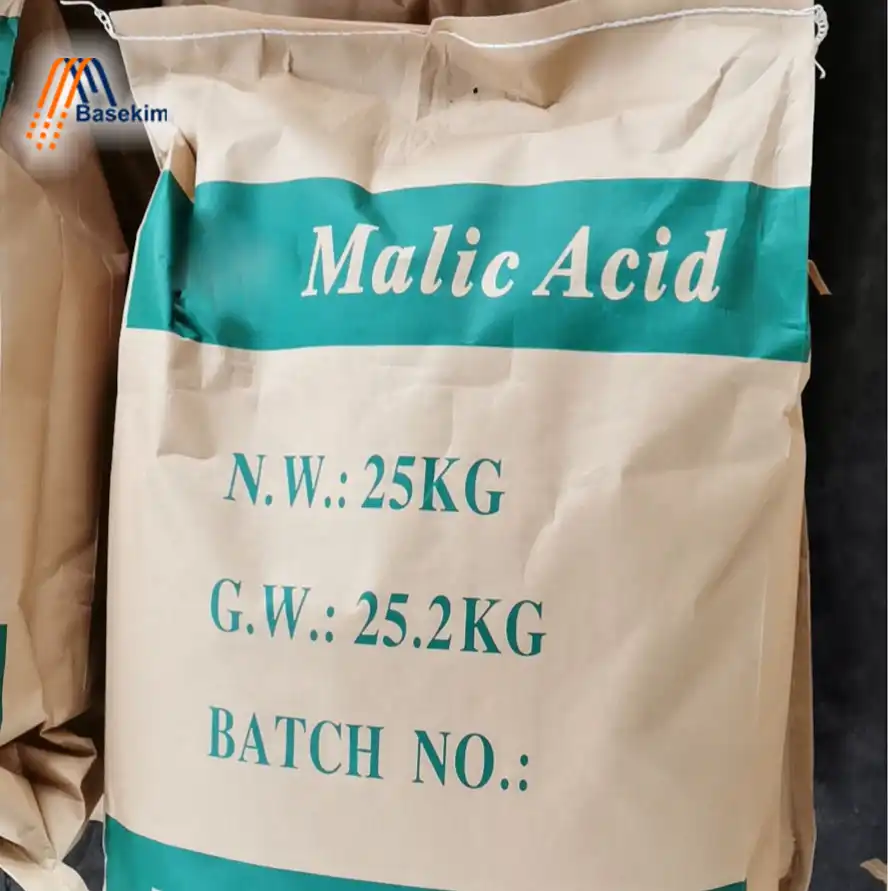
Food Grade Malic Acid is a high-purity food acidulant used by beverage, confectionery, bakery, dairy, and processed food manufacturers to control acidity and create a smooth, long-lasting tart flavor. Naturally associated with apples and many other fruits, Malic Acid provides a distinctive fruity sourness that works particularly well in candies, fruit drinks, powdered beverages, jams, jellies, and flavor systems. Moreover, its excellent water solubility allows manufacturers to incorporate it efficiently into both liquid and dry formulations. As a Food Grade Malic Acid supplier, Basekim supports manufacturers, distributors, and international buyers seeking reliable E296 material for commercial food and beverage production.
What Is Food Grade Malic Acid?
Food Grade Malic Acid is an organic dicarboxylic acid with the chemical formula C4H6O5. It occurs naturally in apples, grapes, cherries, pears, berries, and several other fruits.
In the food industry, manufacturers primarily use it as an acidulant, acidity regulator, and flavor enhancer. It is internationally identified as the food additive E296 or INS 296.
Commercial food production commonly uses DL-Malic Acid because it offers consistent acidity, good solubility, and reliable flavor performance.
The ingredient normally appears as a white crystalline powder or granules with a strongly sour taste and little to no noticeable odor.
Food manufacturers value it because it can:
Control product acidity
Enhance fruit flavors
Balance sweetness
Create long-lasting tartness
Improve flavor consistency
Support pH adjustment
Complement other food acids
Therefore, Food Grade Malic Acid has become an important ingredient in modern food and beverage formulations.
Key Benefits of Food Grade Malic Acid
Food manufacturers choose Malic Acid because it provides several functional and sensory advantages.
Long-Lasting Sour Flavor
One of the most important characteristics of Malic Acid is its lingering sourness.
While some acidulants provide an immediate sharp acidic sensation, Malic Acid creates a smoother and longer-lasting tart flavor.
Consequently, manufacturers frequently use it in products where sustained sourness improves the consumer experience.
Typical applications include:
Sour candies
Gummies
Chewing gum
Fruit-flavored beverages
Powdered drink mixes
Fruit fillings
Its sensory profile works particularly well with apple, berry, grape, cherry, peach, and other fruit flavors.
Effective Acidity and pH Control
Food Grade Malic Acid helps manufacturers adjust acidity in food and beverage formulations.
Proper acidity can influence flavor, product stability, processing performance, and overall formulation quality.
Additionally, pH adjustment may support preservation systems when manufacturers use it together with suitable processing methods and approved preservatives.
However, manufacturers should always validate the complete formulation rather than depending on acidity alone for microbial control.
Excellent Water Solubility
Malic Acid dissolves readily in water, which simplifies its use in many beverage and food-processing systems.
Manufacturers can therefore incorporate it into:
Beverage concentrates
Soft drinks
Syrups
Liquid flavors
Instant drink powders
Fruit preparations
Its good solubility also supports more consistent distribution throughout the finished formulation.
Food Grade Malic Acid Specifications
Food manufacturers should evaluate specifications carefully before purchasing bulk quantities.
The following values represent typical reference specifications for commercial Food Grade DL-Malic Acid. Exact specifications may vary depending on the manufacturer and applicable food standard.
| Property | Typical Specification |
|---|---|
| Product Name | Food Grade Malic Acid |
| Chemical Name | 2-Hydroxybutanedioic Acid |
| Chemical Formula | C4H6O5 |
| Molecular Weight | 134.09 g/mol |
| Food Additive Number | E296 / INS 296 |
| Appearance | White Crystalline Powder or Granules |
| Odor | Practically Odorless |
| Taste | Strong Sour Taste |
| Assay | ≥99.0% |
| Solubility | Highly Soluble in Water |
| Melting Range | Approximately 127–132°C for DL Grade |
| Primary Function | Acidulant / Acidity Regulator |
| Typical Grade | Food Grade |
Because requirements can differ between markets, buyers should request an updated Technical Data Sheet (TDS) and Certificate of Analysis (COA) before confirming an order.
Food Grade Malic Acid Uses
Food Grade Malic Acid performs effectively in many food and beverage applications. Its combination of acidity control, excellent solubility, and prolonged sourness gives formulators significant flexibility.
Beverage Production
Beverage manufacturers use Malic Acid to create refreshing acidity and strengthen fruit flavor profiles.
It works particularly well in apple, grape, berry, peach, cherry, and mixed-fruit beverages.
Common applications include:
Carbonated soft drinks
Fruit juices
Fruit-flavored drinks
Energy beverages
Sports beverages
Beverage concentrates
Powdered drink mixes
Syrups
Because its sourness tends to remain noticeable longer, formulators can use it to create a more persistent fruit taste.
Furthermore, manufacturers sometimes combine Malic Acid with other food acids to develop more complex flavor profiles.
Malic Acid in Confectionery and Candy
Confectionery represents one of the most important markets for Food Grade Malic Acid.
Candy manufacturers value the ingredient because it produces strong yet persistent tartness.
It is particularly suitable for:
Gummies
Hard candies
Sour candies
Chewing gum
Fruit chews
Candy coatings
Jelly sweets
Filled confectionery
For sour confectionery, manufacturers can apply Malic Acid within the formulation or as part of an external sour coating system.
Moreover, combining acidity with sugar and fruit flavor creates the characteristic sweet-and-sour profile consumers expect from many modern candies.
The extended tart sensation can also help manufacturers differentiate their products from formulations based entirely on faster-tasting acidulants.
Food Grade Malic Acid in Fruit Products
Malic Acid naturally complements fruit-based formulations because consumers already associate its acidity with many fruits.
Therefore, manufacturers use it in products such as:
Jams
Jellies
Fruit fillings
Fruit preparations
Fruit sauces
Dessert toppings
Fruit concentrates
Flavored syrups
The ingredient can strengthen perceived fruitiness while balancing high sugar levels.
For example, adding controlled acidity to a sweet fruit filling can prevent the product from tasting excessively sugary.
As a result, manufacturers can develop a more balanced and refreshing flavor profile.
Malic Acid in Powdered Drink Mixes
Dry beverage manufacturers also use Food Grade Malic Acid because its crystalline form makes it suitable for powdered formulations.
Manufacturers can blend it with sugar, sweeteners, flavors, colors, vitamins, and other permitted ingredients.
When consumers add water, the acid dissolves and provides the required tart flavor.
This makes it suitable for:
Instant fruit drinks
Powdered sports drinks
Vitamin beverage powders
Electrolyte drink mixes
Flavored hydration powders
Proper particle size and blending procedures help manufacturers achieve consistent acid distribution throughout the finished powder.
Food Grade Malic Acid with Other Acidulants
Food manufacturers do not always rely on a single acidulant.
Instead, formulators may combine Malic Acid with citric, tartaric, lactic, or other approved food acids to develop a specific sensory profile.
For example, beverage and ingredient manufacturers also work with acids such as phosphoric acid depending on the formulation and desired acidity.
Malic Acid can provide sustained fruity tartness, while another acid may contribute a faster initial acidic impact.
Therefore, blending different acids gives product developers greater control over the timing, intensity, and character of sourness.
Malic Acid vs Citric Acid
Malic Acid and citric acid are both widely used food acidulants. However, their sensory profiles are different.
| Feature | Malic Acid | Citric Acid |
|---|---|---|
| Taste Profile | Smooth, fruity tartness | Bright, sharp acidity |
| Sourness Duration | Longer-lasting | Generally shorter |
| Common Flavor Pairing | Apple, berry, grape, cherry | Lemon, lime, orange |
| Beverage Use | Excellent | Excellent |
| Confectionery Use | Excellent | Excellent |
| Water Solubility | High | High |
| Typical Function | Acidulant and flavor enhancer | Acidulant and pH regulator |
For example, an apple-flavored gummy may benefit from Malic Acid because its prolonged acidity complements the natural character of apple flavor.
Citric acid, in contrast, often works especially well in lemon, lime, and other citrus-style products.
However, manufacturers frequently combine both ingredients to obtain a more complex sourness profile.
Food Grade Malic Acid Quality Requirements
Food applications require stricter quality control than general technical applications.
Therefore, food manufacturers should verify the product’s purity, impurity limits, production standards, and documentation before purchasing.
Important purchasing documents can include:
Certificate of Analysis (COA)
Technical Data Sheet (TDS)
Safety Data Sheet (SDS/MSDS)
Food-grade declaration
Country of origin
Relevant quality certificates
Furthermore, importers should confirm that the product complies with the regulations that apply in their destination market.
Food additive requirements can vary between jurisdictions. Consequently, buyers should never assume that one specification automatically meets every country’s requirements.
For companies sourcing additional materials for different production sectors, Basekim also supplies products such as Bentonite Feed Grade for commercial and bulk requirements.
Food Grade vs Industrial Grade Malic Acid
Food and industrial grades should not be treated as interchangeable products.
| Feature | Food Grade Malic Acid | Industrial Grade |
|---|---|---|
| Main Use | Food and Beverage Production | Technical Applications |
| Purity Control | Strict Food Requirements | Application-Specific |
| Documentation | Food COA, TDS, SDS | Technical COA, TDS, SDS |
| E296 Application | Yes, when compliant | No |
| Suitable for Food | Yes, subject to regulations | Not unless separately certified |
| Quality Requirements | Food-Grade Standards | Industrial Specifications |
Manufacturers should therefore confirm the exact grade before placing an order.
Using technical-grade material in a food application without suitable certification can create serious quality and regulatory problems.
How Food Grade Malic Acid Is Produced
Commercial Malic Acid can be manufactured using different production processes.
A common method for DL-Malic Acid involves controlled chemical processing using fumaric or maleic acid as a starting material.
Other manufacturing technologies may use biological or enzymatic processes to produce specific forms of Malic Acid.
After production, manufacturers purify, crystallize, dry, and control the particle size of the final material.
For food-grade products, producers must also control impurities and verify that the finished material meets the required food specification.
Therefore, buyers should review the manufacturer’s COA rather than relying only on general product descriptions.
Food Grade Malic Acid Price
The price of Food Grade Malic Acid varies according to several commercial factors.
These include:
Product purity
Food-grade specifications
Order quantity
Manufacturer
Country of origin
Packaging
Shipping destination
Freight costs
Required documentation
Delivery terms
Large-volume purchases may provide better unit pricing than small orders. However, buyers should compare quotations based on equivalent specifications.
A cheaper technical product, for example, should not be compared directly with certified Food Grade Malic Acid.
Therefore, buyers should provide the required grade, quantity, packaging, destination, and specification when requesting a quotation.
Packaging of Food Grade Malic Acid
Food Grade Malic Acid commonly comes in sealed industrial bags suitable for dry food ingredients.
A typical commercial packaging option is:
25 kg net bags
However, exact packaging can vary according to the manufacturer and order requirements.
For export shipments, bags may be palletized or loaded according to customer requirements and transportation conditions.
Food manufacturers should confirm that the selected packaging protects the material against moisture, contamination, and physical damage during storage and transportation.
Storage and Handling
Store Food Grade Malic Acid in a cool, dry, clean, and well-ventilated area.
Keep bags tightly closed when they are not in use because prolonged exposure to moisture can affect product condition and handling characteristics.
Recommended storage practices include:
Protect the material from moisture.
Keep packaging sealed.
Store away from incompatible materials.
Maintain clean food-ingredient storage conditions.
Prevent contamination during handling.
Follow FIFO inventory practices where appropriate.
Workers should also avoid unnecessary dust generation.
Although Malic Acid is widely used as a food ingredient, concentrated powder or dust may irritate the eyes or skin during industrial handling. Therefore, employees should follow the precautions provided in the product’s Safety Data Sheet.
Buying Food Grade Malic Acid in Bulk
Commercial buyers should evaluate more than price when selecting a Food Grade Malic Acid supplier.
Before confirming an order, procurement teams should check:
Food-grade specification
Assay and purity
E296 identification
COA availability
TDS and SDS availability
Packaging
Minimum order quantity
Country of origin
Export documentation
Delivery terms
Destination requirements
For beverage, confectionery, bakery, fruit-product, and powdered drink manufacturers, consistent specifications are particularly important because small variations in acidity can affect the final flavor profile.
Therefore, buyers should approve the required technical specification before arranging bulk shipments.
WIKI
Q1: Is Malic Acid safe for food applications?
Food-grade material can be used in permitted food applications when it meets applicable purity standards and use restrictions. Manufacturers must follow the relevant food regulations in their target markets.
Q2: Is Malic Acid natural or synthetic?
The L-form occurs naturally in fruits. However, manufacturers can also produce commercial material through chemical or biological processes. Therefore, the source and stereochemical form depend on the product.
Q3: Why is Malic Acid used in candy?
Candy manufacturers use it to deliver a long-lasting sour taste, enhance fruit flavors, and balance sweetness. Additionally, it supports acidity control during formulation.
Q4: What is the difference between Malic Acid and Citric Acid?
Malic acid generally delivers a rounded, longer-lasting sour taste, while citric acid creates a sharper initial tartness. Manufacturers often combine them to develop balanced fruit flavors.

Contact Info
Ankara Office
No.6, Fahrettin Pasa St. (613), Ilkbahar, Cankaya – Ankara
Tel: +90 312 514 70 55
Istanbul Office
No. 219, Sogut St., No.20, T4A Block, Maslak, Sariyer – Istanbul
Tel: +90 212 807 22 33
Dubai Office
No.3509, The Burlington Tower, Business Bay, Dubai – UAE
Tel: +971 4 236 98 30