




Food Grade Calcium Propionate – E282 Preservative for Bakery and Food
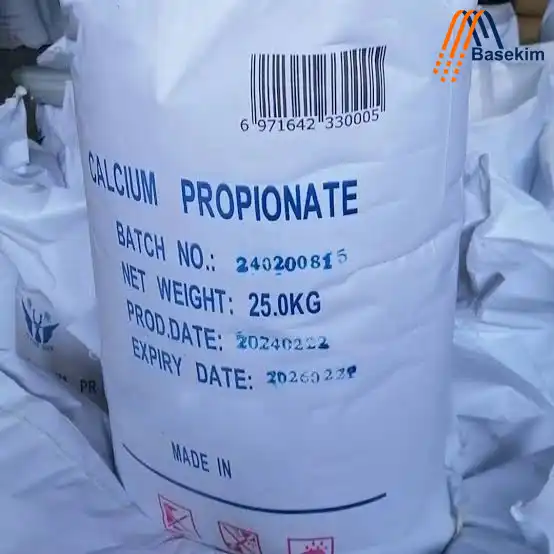
Food Grade Calcium Propionate is a widely used food preservative that helps manufacturers control mold growth, extend shelf life, and maintain product quality during storage and distribution. Commercial bakeries use it extensively in bread, buns, tortillas, rolls, pizza bases, and other packaged bakery products because it provides reliable protection against mold and certain rope-forming bacteria.
Also known as Calcium Propionate E282, this food additive is especially suitable for yeast-leavened bakery products. When manufacturers use the correct dosage, it helps slow microbial spoilage without causing significant changes in the taste, texture, appearance, or processing performance of the final product.
Moreover, food producers value Food Grade Calcium Propionate because it works effectively at relatively low inclusion levels. Therefore, bakeries and processed-food manufacturers can improve product stability, support longer distribution periods, and reduce losses caused by premature mold development.
Food Grade Calcium Propionate E282 and Its Properties
Food Grade Calcium Propionate is the calcium salt of propionic acid. Manufacturers produce it under controlled conditions by reacting propionic acid with an appropriate calcium source, followed by purification, drying, and preparation into powder or granular form.
Its chemical formula is C6H10CaO4, while its molecular weight is approximately 186.22 g/mol.
Food-grade material normally appears as a white crystalline powder or fine granules. It dissolves in water and can be incorporated efficiently into many dry food formulations.
Important characteristics include:
White crystalline powder or granules
High-purity food-grade quality
Good water solubility
Strong mold-inhibiting properties
Effective control of rope-forming bacteria
Easy incorporation into flour mixtures
Stable performance under normal bakery processing conditions
Suitable for yeast-leavened products
Low dosage requirements
Reliable shelf-life support
Because of these characteristics, food manufacturers frequently choose E282 preservative when they require consistent microbial control in bakery and processed-food applications.
Why Is Food Grade Calcium Propionate Used in Food?
Food products that contain moisture and nutrients can create favorable conditions for mold growth during storage. Even when manufacturers apply good production hygiene, contamination may occur during cooling, slicing, packaging, transportation, or retail storage.
Food Grade Calcium Propionate helps manufacturers control this risk by restricting the growth of several spoilage microorganisms.
Therefore, the food industry primarily uses it as a mold inhibitor and food preservative.
It can help manufacturers:
Delay visible mold growth
Control certain spoilage microorganisms
Reduce rope spoilage in bread
Increase commercial shelf life
Reduce product returns
Limit food waste
Improve storage stability
Support long-distance distribution
Maintain consistent product quality
However, preservative performance depends on the complete food formulation. Manufacturers should consider product pH, water activity, moisture level, packaging, hygiene, storage temperature, and permitted dosage levels.
Food Grade Calcium Propionate in Bread
One of the most important applications is Food Grade Calcium Propionate in bread.
Bread naturally contains moisture, carbohydrates, and other nutrients that can support mold growth after baking. Although oven temperatures destroy many microorganisms during production, products can become contaminated again after leaving the oven.
Cooling equipment, slicers, conveyors, packaging machines, workers, and surrounding air can introduce microorganisms before the bread reaches the consumer.
For this reason, commercial bakeries often add Food Grade Calcium Propionate directly to the flour or dough mixture.
Common applications include:
Sandwich bread
Toast bread
Hamburger buns
Hot dog buns
Dinner rolls
Flatbread
Tortillas
Pizza bases
Packaged bread
Specialty bakery products
In addition, manufacturers can combine effective preservation with suitable packaging systems and food-contact coatings to help protect packaged bakery products during storage and distribution.
A major advantage of Calcium Propionate E282 is its suitability for yeast-leavened products. At properly controlled levels, manufacturers can achieve mold protection while maintaining effective dough fermentation and normal bakery production.
Therefore, E282 remains one of the most established preservatives used by commercial bread manufacturers.
How Food Grade Calcium Propionate Controls Mold
The preservation effect comes from propionate activity within the food environment.
After manufacturers add the preservative to an appropriate formulation, propionate can interfere with important metabolic processes inside susceptible microorganisms. Consequently, mold growth becomes more difficult, and the product can remain commercially acceptable for a longer period.
However, preservative effectiveness depends on several factors.
Product pH: Propionate-based preservatives generally become more effective as food conditions become more acidic.
Moisture level: High-moisture bakery products usually face greater microbial pressure.
Water activity: Available water strongly influences the ability of microorganisms to grow.
Storage temperature: Warm conditions can accelerate spoilage and mold development.
Packaging quality: Suitable packaging reduces exposure to environmental contamination and moisture changes.
Production hygiene: Preservatives support food quality systems but cannot replace proper sanitation.
Therefore, food manufacturers should treat Food Grade Calcium Propionate as one part of an integrated preservation strategy.
Food Acidity and Preservative Performance
Food manufacturers can also manage acidity as part of an effective preservation system.
Correct pH management can influence microbial growth and the effectiveness of preservative systems. However, manufacturers should never change product acidity solely to increase preservative activity without considering flavor, texture, processing conditions, and applicable food regulations.
Therefore, food technologists should evaluate the complete recipe before adjusting pH or preservative concentration.
Recommended Food Grade Calcium Propionate Dosage
“Calcium Propionate dosage in bread” is one of the most important search queries for bakery manufacturers.
Many bakery formulations use approximately 0.1% to 0.3% based on flour weight. However, actual inclusion levels depend on the formulation and applicable food regulations.
For example, a bakery using 100 kg of flour may require approximately 100–300 grams depending on the recipe, required shelf life, environmental conditions, and production process.
Manufacturers should not treat these figures as universal instructions.
The correct dosage can depend on:
Type of bakery product
Flour composition
Product pH
Water activity
Moisture content
Desired shelf life
Storage temperature
Packaging system
Climate
Manufacturing conditions
Local food regulations
Therefore, commercial manufacturers should conduct shelf-life and formulation testing before determining the final inclusion rate.
Food Grade Calcium Propionate for Bakery Products
The bakery sector represents one of the largest markets for Food Grade Calcium Propionate.
Large industrial bakeries often produce thousands of packaged products every day. These products may remain in distribution networks for several days before consumers purchase them. Consequently, predictable shelf life becomes commercially important.
Manufacturers may use E282 in:
Commercial bread
Buns
Rolls
Tortillas
Pizza crusts
Flour-based snacks
Packaged bakery goods
Selected cakes
Pastries
Other moisture-sensitive baked products
In addition, manufacturers can combine Calcium Propionate with refrigeration, advanced packaging, sanitation programs, moisture control, and suitable pH management.
As a result, food processors can build a more reliable preservation system instead of depending on a single control method.
Other Food Ingredients Used in Bakery Formulations
Bakery manufacturers often use several functional ingredients alongside preservatives to control texture, moisture, viscosity, binding, and product stability.
For example, food manufacturers may use hydrocolloids such as Carboxymethyl Cellulose (CMC) to support texture, viscosity, binding, and stability in selected food formulations.
However, each ingredient performs a different function. Food Grade Calcium Propionate primarily provides antimicrobial and mold-control benefits, while hydrocolloids, humectants, acidity regulators, emulsifiers, and stabilizers address other formulation requirements.
Therefore, food manufacturers should select ingredients according to the specific technical requirements of the finished product.
Food Grade Calcium Propionate Specifications
Material intended for human food production must meet appropriate purity and food-additive quality requirements.
Buyers should carefully review technical specifications before purchasing material for bakery or food manufacturing.
| Property | Typical Requirement |
|---|---|
| Product | Food Grade Calcium Propionate |
| Food Additive Number | E282 |
| Chemical Formula | C6H10CaO4 |
| Appearance | White powder or granules |
| Assay | High-purity food grade |
| Identification | Conforms |
| Solubility | Soluble in water |
| pH | Controlled specification |
| Loss on Drying | Limited |
| Water Insoluble Matter | Low |
| Heavy Metals | Controlled |
| Lead | Controlled |
| Arsenic | Controlled |
| Fluoride | Controlled |
Exact values may differ according to manufacturer, applicable standard, production origin, and destination-market requirements.
Therefore, buyers should request the latest Technical Data Sheet (TDS) and Certificate of Analysis (COA) before confirming a commercial order.
E282 Food Preservative
The designation E282 identifies Calcium Propionate as a food additive in relevant labeling systems.
Manufacturers, distributors, and buyers may encounter several names, including:
Calcium Propionate E282
E282 preservative
Preservative E282
Calcium propanoate
Calcium salt of propionic acid
Bread preservative
Bakery mold inhibitor
Calcium Propionate food preservative
These terms generally refer to the same core chemical ingredient.
However, food manufacturers must comply with the labeling and additive requirements of their target market. Permitted applications, maximum quantities, declaration requirements, and food categories may differ between jurisdictions.
Therefore, exporters should confirm destination-market requirements before commercial production.
Food Grade vs Feed Grade Calcium Propionate
Although manufacturers produce Calcium Propionate for different sectors, buyers should distinguish food grade from feed grade Calcium Propionate.
Food-grade material is specifically produced and controlled for use in human food manufacturing. It must comply with applicable purity, contaminant, processing, and documentation requirements for the intended market.
Feed-grade products, on the other hand, target animal nutrition and feed preservation applications and may follow different specifications.
Therefore, food manufacturers should clearly request:
Food Grade Calcium Propionate / E282
when sending a quotation request or purchase order.
This distinction helps prevent specification errors and ensures that procurement teams receive material suitable for the intended food application.
Calcium Propionate vs Sodium Propionate
Food manufacturers sometimes compare Calcium Propionate vs Sodium Propionate when selecting an antimicrobial preservative.
Both originate from propionic acid and can provide antimicrobial properties. However, their suitability depends on the food formulation and processing requirements.
Calcium Propionate remains particularly popular in bread and yeast-leavened bakery products. Meanwhile, sodium propionate may suit other food formulations where its specific properties match the recipe.
Manufacturers should consider:
Product pH
Mineral contribution
Food category
Required shelf life
Taste profile
Processing requirements
Applicable additive regulations
Therefore, formulation testing remains important when choosing between different propionate preservatives.
Is Food Grade Calcium Propionate Safe?
“Is Calcium Propionate safe?” is a common search query among both manufacturers and consumers.
Food-grade Calcium Propionate is used as a permitted preservative in specified food applications when manufacturers follow applicable regulatory requirements and usage conditions.
Food companies should use material specifically intended for food production, follow permitted dosage levels, maintain accurate documentation, and comply with labeling requirements.
Furthermore, manufacturers should carry out product testing instead of increasing preservative concentrations without technical justification.
Proper formulation, hygiene, packaging, and storage remain important even when manufacturers use an effective food preservative.
Storage and Handling
Correct storage helps preserve the quality and free-flowing condition of Food Grade Calcium Propionate.
Companies should store bags in a cool, dry, clean, and well-ventilated warehouse. Moreover, workers should protect the material from excessive humidity and contamination.
Recommended storage practices include:
Keep packaging tightly sealed.
Protect bags from moisture.
Store away from direct sunlight.
Keep the product in a clean food-ingredient warehouse.
Avoid contact with incompatible materials.
Use clean handling equipment.
Follow FIFO inventory practices.
Prevent unnecessary dust formation.
Keep damaged bags separate from usable stock.
Personnel handling commercial quantities should also follow the current Safety Data Sheet and workplace safety requirements.
Packaging for Food Grade Calcium Propionate
International buyers usually require durable food-compatible packaging for warehouse storage and container transportation.
Common packaging options may include:
20 kg bags
25 kg bags
Multi-layer paper bags
Woven polypropylene bags with suitable inner liners
Palletized export packaging
Available packaging may vary according to order quantity, production source, destination, and buyer requirements.
Moreover, commercial shipments may require batch identification, production information, certificates, export documents, and customized labeling depending on the destination market.
Food Grade Calcium Propionate Price
The Food Grade Calcium Propionate price varies according to several commercial factors.
Major price factors include:
Raw material costs
Food-grade purity
Product specification
Order quantity
Packaging type
Country of origin
Certification requirements
Freight rates
Destination port
Shipping terms
Currency conditions
Therefore, buyers searching for Food Grade Calcium Propionate price per kg or Calcium Propionate price per ton should request a current quotation based on their required quantity, specification, packaging, and delivery destination.
Bulk international purchases usually require FOB, CFR, or CIF quotations rather than standard retail pricing.
Food Grade Calcium Propionate Supplier
Selecting a reliable Food Grade Calcium Propionate supplier is important for manufacturers that require consistent product quality, documentation, and predictable international deliveries.
Before placing an order, procurement teams should request:
Technical Data Sheet (TDS)
Safety Data Sheet (SDS/MSDS)
Certificate of Analysis (COA)
Food-grade specification
Packaging information
Batch information
Country of origin
Available quantity
Lead time
Shipping terms
Export documentation
Basekim supplies Food Grade Calcium Propionate for international buyers, food manufacturers, commercial bakeries, ingredient distributors, and bulk importers.
When requesting a quotation, buyers should clearly provide the required grade, quantity, packaging, destination country, destination port, and technical specification. This information allows suppliers to prepare a more accurate commercial offer.
1. What is Food Grade Calcium Propionate used for?
Food Grade Calcium Propionate is mainly used as a preservative and mold inhibitor in bread, buns, tortillas, pizza bases, and other bakery products. It helps extend shelf life and reduce spoilage.
2. What is the recommended dosage of Calcium Propionate in bread?
Many bakery formulations use around 0.1% to 0.3% based on flour weight. However, the correct dosage depends on product pH, moisture, formulation, storage conditions, and local food regulations.
3. Is Food Grade Calcium Propionate the same as E282?
Yes. E282 is the food additive number commonly used for Calcium Propionate. Manufacturers use Food Grade Calcium Propionate E282 as a preservative in permitted bakery and food applications.

Contact Info
Ankara Office
No.6, Fahrettin Pasa St. (613), Ilkbahar, Cankaya – Ankara
Tel: +90 312 514 70 55
Istanbul Office
No. 219, Sogut St., No.20, T4A Block, Maslak, Sariyer – Istanbul
Tel: +90 212 807 22 33
Dubai Office
No.3509, The Burlington Tower, Business Bay, Dubai – UAE
Tel: +971 4 236 98 30