




Food Grade Lactic Acid for Food and Beverage Manufacturing
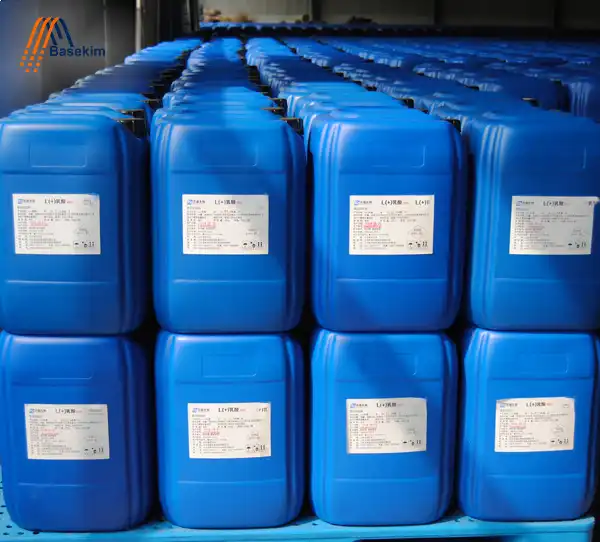
Food Grade Lactic Acid is a highly effective acidity regulator, acidulant, flavor enhancer, and processing ingredient used throughout the food and beverage industry. Manufacturers use it to control pH, create a clean acidic taste, support product stability, and maintain consistent formulation quality. It is particularly useful in beverages, dairy products, confectionery, pickled vegetables, sauces, bakery products, and processed meat applications.
Also identified as E270, Food Grade Lactic Acid offers excellent water solubility and integrates easily into liquid and semi-liquid food formulations. Manufacturers can select different concentrations, particularly 80% and 88%, according to their processing requirements and formulation targets.
As a reliable Food Grade Lactic Acid supplier, Basekim provides international buyers with bulk sourcing solutions, suitable packaging options, technical documentation, and export support. Food processors, ingredient distributors, beverage manufacturers, and commercial buyers can select the appropriate concentration and specification according to their production needs.
Food Grade Lactic Acid Properties and Characteristics
Lactic Acid, chemically known as 2-hydroxypropanoic acid, is an organic acid that naturally occurs in many fermented foods.
Commercial food-grade material is generally produced through controlled carbohydrate fermentation followed by purification and concentration. Manufacturers carefully control the process to achieve the purity and consistency required for food-processing applications.
Its chemical formula is C₃H₆O₃, while its CAS number is 50-21-5.
Most importantly, food manufacturers value this ingredient because it provides controlled acidity without introducing an excessively sharp flavor when correctly dosed.
Typical characteristics include:
| Property | Typical Information |
|---|---|
| Product Name | Food Grade Lactic Acid |
| Chemical Name | 2-Hydroxypropanoic Acid |
| Chemical Formula | C₃H₆O₃ |
| CAS Number | 50-21-5 |
| Molecular Weight | 90.08 g/mol |
| Food Additive Number | E270 |
| Appearance | Clear, colorless to pale yellow liquid |
| Odor | Nearly odorless |
| Solubility | Completely miscible with water |
| Common Concentrations | 80% and 88% |
| Grade | Food Grade |
| Main Function | Acidity regulator / acidulant |
Exact specifications can vary according to concentration and producer. Therefore, commercial buyers should always review the Technical Data Sheet and batch-specific Certificate of Analysis before confirming an order.
Why Food Manufacturers Use Lactic Acid E270
Food manufacturers use Lactic Acid E270 because it can perform several functions within a formulation.
First, it lowers and controls pH. Therefore, manufacturers can establish suitable acidity levels in beverages, sauces, dressings, dairy products, and other processed foods.
Moreover, it provides a mild acidic taste that works well in many food formulations.
Another important advantage is its water solubility. Because the liquid mixes readily with water-based formulations, manufacturers can introduce it into production systems without complicated preparation.
Food Grade Lactic Acid can provide:
-
Effective acidity regulation
-
Controlled pH adjustment
-
Clean sour flavor
-
Excellent water solubility
-
Good formulation compatibility
-
Processing consistency
-
Support for product stability
-
Flexible dosing options
-
Compatibility with many food-processing systems
However, manufacturers should determine the correct dosage according to the finished product, target pH, regulatory requirements, and formulation conditions.
Food and Beverage Applications
The food industry represents one of the largest application areas for Food Grade Lactic Acid.
Beverage manufacturers use it to adjust acidity while creating a balanced tart taste. In addition, food processors use it in sauces, pickles, confectionery, dairy foods, bakery products, and many other formulations.
Typical applications include:
-
Soft drinks and flavored beverages
-
Fruit-based drinks
-
Confectionery
-
Bakery products
-
Dairy products
-
Fermented foods
-
Pickled vegetables
-
Sauces
-
Salad dressings
-
Processed meat products
-
Prepared foods
-
Food seasonings
Manufacturers often combine acidity regulators with sweeteners or carbohydrate ingredients to create the desired balance between sweetness and acidity. For example, Dextrose Monohydrate is another food-industry ingredient used in beverages, confectionery, bakery formulations, fermentation processes, and processed foods.
Consequently, ingredient selection should always consider the overall formulation rather than evaluating each component separately.
Food Grade Lactic Acid as an Acidity Regulator
One of the most important functions of this ingredient is pH control.
Food manufacturers need controlled acidity for flavor consistency, processing performance, and product stability. However, natural ingredients can cause pH variations between production batches.
Adding accurately measured quantities of Lactic Acid allows manufacturers to adjust the formulation toward the required pH range.
For example, beverage manufacturers can use controlled dosing to achieve a consistent tart profile from one batch to another.
Likewise, sauce and dressing producers can adjust acidity to meet their specific formulation requirements.
However, manufacturers should measure the finished-product pH instead of relying only on a fixed dosage because other ingredients, water quality, processing temperatures, and raw material variations can influence the final result.
Lactic Acid in Meat and Poultry Processing
Food Grade Lactic Acid also serves specialized applications within meat and poultry processing.
Depending on applicable regulations and processing conditions, manufacturers may incorporate lactic-acid-based solutions into specific food-processing systems.
Its acidity can support pH management and processing objectives.
However, concentration, contact conditions, application method, and regulatory requirements vary significantly between products and markets.
Therefore, meat processors should use the appropriate food-grade specification and validate its suitability for their particular production system.
Use in Dairy and Fermented Foods
Lactic acid is naturally associated with fermentation and dairy processing.
During fermentation, microorganisms convert carbohydrates into organic acids, including lactic acid. This process contributes to the characteristic acidity of many fermented products.
Commercial Food Grade Lactic Acid allows manufacturers to achieve controlled acidity when additional pH adjustment is required.
Potential applications include:
-
Dairy-based beverages
-
Fermented products
-
Cheese-related processing
-
Yogurt formulations
-
Dairy desserts
-
Selected plant-based alternatives
Furthermore, controlled acidity can help manufacturers maintain a more consistent sensory profile between production batches.
Food Grade Lactic Acid Compared with Other Food Acidulants
Food manufacturers can select from several acidulants depending on the required taste, pH, processing conditions, and final product.
For example, Citric Acid is widely used as an acidity regulator and acidulant in food and beverage manufacturing.
However, citric and lactic acids do not create exactly the same sensory profile.
Citric acid typically produces a brighter and sharper acidic character. In contrast, lactic acid can provide a milder and smoother acidity in suitable formulations.
Therefore, manufacturers may select one acid or develop a combination depending on:
-
Desired flavor profile
-
Final pH
-
Product type
-
Processing method
-
Ingredient interactions
-
Required acid strength
-
Regulatory conditions
Pilot testing helps manufacturers determine the most suitable acidification system before full-scale production.
Food Grade Lactic Acid 80% vs. 88%
Commercial buyers frequently search for both Lactic Acid 80% and Lactic Acid 88%.
The primary difference is the concentration of active lactic acid in the solution.
| Feature | Lactic Acid 80% | Lactic Acid 88% |
|---|---|---|
| Lactic Acid Content | Approx. 80% | Approx. 88% |
| Water Content | Higher | Lower |
| Physical Form | Liquid | Liquid |
| Food Applications | Suitable with correct specification | Suitable with correct specification |
| Active Material per kg | Lower | Higher |
| Transportation Efficiency | Standard | More concentrated |
| Dosing | Based on concentration | Based on concentration |
An 88% solution contains more active acid in the same shipment weight. Consequently, manufacturers may reduce the quantity required to deliver a specific amount of active material.
However, higher concentration does not automatically mean better quality.
Buyers should evaluate purity, color, impurities, optical composition where relevant, food-grade compliance, and batch consistency before selecting a product.
How Food Grade Lactic Acid Is Produced
Manufacturers commonly produce food-grade material through controlled fermentation.
First, producers prepare a carbohydrate source suitable for fermentation.
Next, selected microorganisms convert available carbohydrates into lactic acid.
After fermentation, producers separate unwanted materials from the fermentation medium.
They then purify the resulting solution through several processing stages.
Finally, manufacturers concentrate and standardize the liquid until it reaches the required commercial concentration.
Quality-control procedures verify important characteristics before the product enters the food ingredient market.
Because production methods can influence impurity profiles and other characteristics, buyers should review technical documentation when sourcing large commercial volumes.
Quality Requirements for Food Applications
Food manufacturers should never select Lactic Acid based only on concentration or price.
Instead, procurement teams should evaluate the complete product specification.
Important parameters may include:
-
Lactic Acid assay
-
Appearance
-
Color
-
Purity
-
Heavy metals where specified
-
Chloride
-
Sulfate
-
Iron
-
Residue on ignition
-
Optical composition where applicable
-
Food-grade compliance
-
Microbiological requirements where relevant
Requirements can vary between manufacturers, countries, applications, and regulatory systems.
Therefore, buyers should request a Certificate of Analysis (COA) for the actual supplied batch whenever necessary.
Packaging for Food Grade Lactic Acid
Proper packaging protects the product throughout storage, handling, and international transportation.
Commercial packaging can include:
-
HDPE plastic drums
-
IBC tanks
-
Palletized drums
-
Bulk supply for large orders
Packaging availability can vary according to producer, concentration, purchase volume, and destination.
For food-industry orders, buyers should confirm that the selected packaging is suitable for the supplied grade and transportation conditions.
Additionally, containers should remain tightly closed during storage.
Storage and Handling
Store Food Grade Lactic Acid in a cool, suitable, and well-managed storage area.
Keep containers securely closed when they are not in use. Furthermore, protect the product from incompatible materials and unsuitable storage conditions.
Although the product serves food-processing applications, concentrated solutions require professional handling.
Operators should:
-
Wear suitable protective gloves
-
Protect the eyes and face during handling
-
Avoid direct skin and eye contact
-
Prevent uncontrolled spills
-
Follow facility handling procedures
-
Consult the supplier’s Safety Data Sheet
Concentrated organic acids can cause significant eye irritation or damage depending on concentration and exposure.
Therefore, personnel should always follow the product-specific SDS.
Food Grade Lactic Acid Price
Food Grade Lactic Acid price depends on several commercial factors.
Concentration strongly affects quotation structure. For example, an 88% solution contains more active material per metric ton than an 80% solution.
Furthermore, market conditions, raw material costs, producer origin, order volume, packaging, transportation, and documentation requirements can influence the final price.
Buyers should provide the following information when requesting a quotation:
-
Food-grade requirement
-
Required concentration
-
Quantity in metric tons
-
Preferred packaging
-
Destination country or port
-
Required certificates
-
Delivery terms
-
Regular or one-time requirement
Providing complete purchasing information allows the supplier to prepare a more accurate commercial quotation.
Choosing a Food Grade Lactic Acid Supplier
Selecting a reliable supplier is particularly important for food-industry buyers.
Price alone should not determine the purchasing decision. Instead, importers and manufacturers should evaluate product consistency, documentation, packaging quality, logistics capability, and technical specifications.
Before confirming an order, buyers should request relevant documents such as:
-
Technical Data Sheet
-
Safety Data Sheet
-
Certificate of Analysis
-
Product specification
-
Origin information when required
-
Food-grade documentation where applicable
-
Packaging details
Basekim supplies Food Grade Lactic Acid for international commercial buyers and supports bulk requirements with suitable packaging and export coordination.
Providing the required concentration, quantity, destination, and specification when submitting an inquiry helps the supplier prepare the correct product and commercial offer.
WIKI
Q1: What is Lactic Acid used for?
Manufacturers use it in food production, cosmetics, pharmaceutical processes, industrial cleaning, and biodegradable polymer manufacturing.
Q2: Is Lactic Acid food grade?
Food-grade versions can serve as food ingredients when they meet applicable specifications and conditions of use. However, industrial-grade products do not automatically qualify for food applications.
Q3: What is the difference between 80% and 88% Lactic Acid?
The primary difference is concentration. An 88% solution contains more active acid per unit of weight. However, both grades require separate quality verification.
Q4: Can manufacturers buy Lactic Acid in bulk?
Yes. Commercial suppliers offer various bulk packaging formats, including drums and IBCs. Buyers should confirm the available concentration, packaging, and delivery terms before placing an order.
Contact Info
Ankara Office
No.6, Fahrettin Pasa St. (613), Ilkbahar, Cankaya – Ankara
Tel: +90 312 514 70 55
Istanbul Office
No. 219, Sogut St., No.20, T4A Block, Maslak, Sariyer – Istanbul
Tel: +90 212 807 22 33
Dubai Office
No.3509, The Burlington Tower, Business Bay, Dubai – UAE
Tel: +971 4 236 98 30