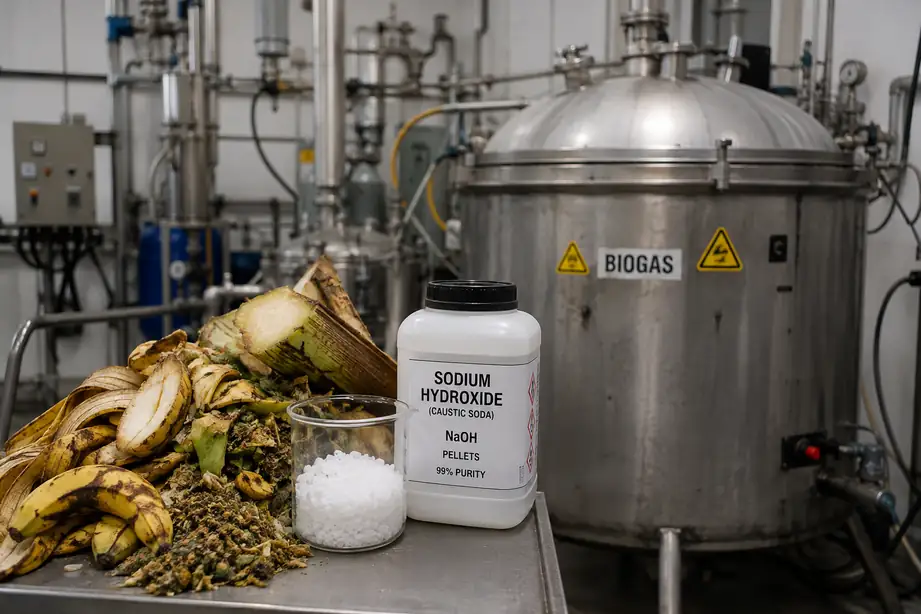
Agricultural waste can hold far more energy than it first appears to contain. Banana peels, stems, and unsellable fruit contain valuable organic matter, yet their tough plant structure can slow anaerobic digestion. A recent study shows that a simple chemical pretreatment may help solve this problem. Researchers found that very small amounts of sodium hydroxide, commonly known as caustic soda, helped microorganisms access the organic material more easily and increased methane production.
This finding gives new importance to Caustic Soda for Biogas Production, especially in systems that process lignocellulosic agricultural waste. Instead of using aggressive chemical doses, operators may achieve better results by carefully controlling a mild alkaline pretreatment.
The research also delivers an important lesson for industrial waste-to-energy projects: more chemical does not always mean more gas.
Why Banana Waste Can Become a Valuable Biogas Feedstock
Banana production creates large amounts of organic residues. Farms, food processors, wholesale markets, and distribution centers regularly discard peels, damaged fruit, stalks, and other plant material.
These residues contain carbohydrates that microorganisms can convert into biogas through anaerobic digestion.
However, banana waste also contains lignocellulosic material. Cellulose, hemicellulose, and lignin form a strong plant matrix that limits microbial access to fermentable compounds. As a result, hydrolysis can become one of the slowest stages of anaerobic digestion.
Pretreatment can open this structure before digestion begins.
Alkaline pretreatment attracts particular interest because it can weaken bonds between lignin and carbohydrates, swell plant fibers, reduce cellulose crystallinity, and expose more degradable material. Scientific reviews identify sodium hydroxide as one of the most effective alkaline agents for improving the digestibility of lignocellulosic biomass.
How Caustic Soda for Biogas Production Works
Caustic soda does not create methane directly. Instead, it prepares the biomass for the microorganisms that drive anaerobic digestion.
When sodium hydroxide contacts lignocellulosic material, the alkaline solution attacks chemical bonds inside the plant structure. It can weaken lignin-carbohydrate links, partially remove lignin, and increase the accessible surface area of the biomass.
This process exposes more cellulose and hemicellulose to hydrolysis.
Microorganisms can then reach soluble carbohydrates more easily and convert the available organic material through the different stages of anaerobic digestion.
However, dosage plays a critical role.
Too much NaOH can increase chemical costs, degrade useful carbohydrates, raise sodium concentrations, release inhibitory compounds, and create additional stress for the microbial community. Reviews of alkaline pretreatment also warn that excessive chemical severity can reduce the overall benefit of the process.
Therefore, successful pretreatment does not simply require a strong alkaline solution. It requires the right balance.
What the 2026 Banana-Waste Study Found
Researchers in Brazil recently studied how different sodium hydroxide concentrations affected banana waste before anaerobic digestion. BioEnergy Research published the study on May 25, 2026.
The research team tested six NaOH concentrations:
0.2%
0.4%
0.5%
1%
2%
3%
The researchers also operated an untreated control.
During pretreatment, they heated the banana waste with sodium hydroxide at 100°C for one hour. After the pretreatment stage, they adjusted the material to pH 7.
They then operated anaerobic batch reactors at 37°C for 15 days.
The results clearly favored lower concentrations.
The 0.2% NaOH treatment released 12,110 mg/L of carbohydrates, while untreated banana waste released only 4,785 mg/L.
However, another concentration produced the highest total methane output.
The 0.4% NaOH treatment generated 2,471 mL CH4 per liter of reactor, while the untreated control produced only 1,547 mL CH4 per liter.
That difference represents an increase of almost 60% in cumulative methane production.
Meanwhile, the 0.2% NaOH treatment achieved the highest maximum methane production rate at 525.21 mL CH4 per liter of reactor per day.
These results reveal an important distinction. The concentration that released the largest amount of carbohydrates did not produce the highest total methane volume.
Why 0.4% NaOH Outperformed Higher Doses
The best result came from balance rather than maximum chemical intensity.
At 0.2% NaOH, the pretreatment released the most carbohydrates and supported the highest maximum methane production rate.
At 0.4%, however, the digestion process produced the greatest cumulative methane volume.
Higher sodium hydroxide concentrations did not continue this improvement.
The researchers observed lower carbohydrate release as the NaOH concentration increased above the mildest treatment. They linked this trend to excessive alkaline severity, which can degrade or remove some soluble carbohydrates before microorganisms can convert them into methane.
This result demonstrates why anaerobic digestion depends on much more than carbohydrate release.
Microbial stability, volatile fatty acids, pH, chemical oxygen demand, intermediate compounds, and methanogenic pathways can all influence the final methane output.
Therefore, the best Caustic Soda for Biogas Production strategy uses enough chemical action to open the biomass while avoiding unnecessary substrate degradation or biological stress.
Lower Caustic Soda Doses May Reduce Operating Costs
The study also carries an important economic message.
Caustic soda creates a direct operating cost for any industrial alkaline pretreatment process.
If a biogas plant can achieve higher methane production with a lower NaOH concentration, operators can reduce chemical consumption per ton of biomass.
Lower chemical consumption may also reduce:
Chemical storage requirements
Dosing costs
Neutralization demand
Sodium accumulation
Wastewater treatment requirements
Downstream processing costs
These savings can become significant at industrial scale.
A difference of only a fraction of a percentage point may appear small in a laboratory reactor. However, a commercial facility may process thousands of tons of organic waste every year.
Reducing unnecessary chemical use can therefore create substantial annual savings.
Lower dosing can also improve environmental performance because the facility consumes fewer chemicals while recovering more energy from waste.
However, operators must evaluate the entire process rather than chemical cost alone. Heating demand, mixing, pretreatment time, pH adjustment, equipment compatibility, sodium concentration, digestate quality, and methane value all affect the final economics.
Protecting the Microorganisms That Produce Methane
Anaerobic digestion depends on a complex living microbial community.
Operators must protect these microorganisms if they want reliable methane production.
Strong alkaline treatment can create unfavorable conditions. High sodium concentrations may place stress on sensitive microorganisms. Harsh pretreatment can also release lignin-derived compounds that interfere with methanogenic activity.
Mild pretreatment follows a more controlled approach.
Instead of trying to destroy as much plant structure as possible, the process improves biomass accessibility without adding unnecessary chemical stress.
The 2026 research supports this concept. The researchers found that methane production depended on the balance between substrate availability, inhibition effects, and microbial pathways.
Their analysis of the successful 0.4% NaOH treatment identified bacterial groups such as Paraclostridium and Clostridium and methanogenic archaea including Methanothrix and Methanoregula.
Can Caustic Soda Improve Other Agricultural Waste?
Banana waste represents only one possible feedstock.
Agricultural and food-processing industries also generate large amounts of straw, stalks, husks, bagasse, fruit residues, and other lignocellulosic materials.
Researchers have tested sodium hydroxide pretreatment on several types of biomass. Scientific reviews report improved digestibility and methane production from materials such as corn straw, rice straw, grass waste, and other agricultural residues.
However, no single NaOH concentration works perfectly for every material.
Several factors influence the optimum dose, including:
Lignin content
Cellulose content
Particle size
Moisture
Solids concentration
Pretreatment temperature
Treatment time
Digester design
Operators should therefore treat Caustic Soda for Biogas Production as an optimization method rather than a fixed chemical recipe.
For industrial buyers that require sodium hydroxide for approved processing applications, Basekim supplies caustic soda to international industrial markets in different commercial forms and packaging options.
Turning Agricultural Waste Into Renewable Energy
The technology also supports a broader circular economy strategy.
When businesses send banana residues to landfill or unmanaged disposal, they lose much of the material’s potential energy value.
Anaerobic digestion can recover part of that energy as methane-rich biogas.
Facilities can use this gas for heat, electricity, combined heat and power systems, or further upgrade it into biomethane.
Pretreatment becomes especially useful when tough lignocellulosic structures limit digestion.
The banana-waste study shows how mild chemical treatment may improve resource recovery without requiring high chemical consumption.
In regions with large banana industries, farms, wholesale markets, food processors, and biogas plants could potentially combine waste management with renewable energy generation.
Industrial Scale-Up Requires More Testing
The results look promising, but industrial operators should not simply copy the 0.4% concentration into a commercial plant.
The researchers worked with specific banana waste and controlled laboratory conditions. They used a 100°C pretreatment stage, a one-hour treatment period, pH adjustment, methanogenic sludge, synthetic sewage for co-digestion, and 1-liter batch reactors.
Commercial digesters operate under different conditions.
Therefore, engineers should perform laboratory and pilot-scale trials before adopting the process.
They should monitor methane yield, gas composition, volatile fatty acids, pH, alkalinity, COD removal, sodium accumulation, digestate quality, energy demand, and chemical consumption.
The final goal should not focus only on maximum methane output.
A successful industrial process must also deliver stable operation, safe chemical handling, reasonable costs, acceptable digestate quality, and a positive overall energy balance.
Conclusion: Less Caustic Soda Can Create More Value
The latest banana-waste research delivers an important message for Caustic Soda for Biogas Production: the optimum dose may sit far below the maximum dose.
In the 2026 study, 0.2% NaOH achieved the highest carbohydrate release and maximum methane production rate. Meanwhile, 0.4% NaOH produced the highest cumulative methane output.
The 0.4% treatment reached 2,471 mL CH4 per liter of reactor, compared with 1,547 mL CH4 per liter from untreated banana waste. That represents an improvement of almost 60%.
These findings show why careful pretreatment design matters.
Mild alkaline treatment can open lignocellulosic biomass, improve microbial access to organic material, reduce unnecessary chemical consumption, and increase methane recovery.
However, every feedstock behaves differently.
Industrial operators should optimize NaOH concentration, temperature, treatment time, feedstock composition, and digester conditions before full-scale implementation.
With the right balance, caustic soda can help turn difficult agricultural waste into a more productive source of renewable energy.
FAQ
Can caustic soda increase biogas production?
Yes. Sodium hydroxide can open lignocellulosic plant structures and improve microbial access to degradable organic matter. This process can increase methane production, although operators must carefully optimize the NaOH concentration.
What NaOH concentration worked best for banana waste?
The 2026 study found that 0.4% NaOH produced the highest cumulative methane volume. However, 0.2% NaOH produced the highest carbohydrate release and maximum methane production rate.
Why can too much caustic soda reduce biogas production?
Excessive alkaline treatment can degrade valuable carbohydrates, increase sodium loading, release inhibitory compounds, and disturb the microorganisms that drive methane production. Therefore, stronger chemical treatment does not automatically produce more biogas.
Can the same NaOH concentration work for every biomass?
No. Feedstock composition, lignin content, particle size, temperature, solids concentration, treatment time, and digester conditions can change the optimum NaOH dose. Operators should test each biomass before commercial application.
Does low-dose caustic soda make biogas production cheaper?
It can. Lower NaOH consumption can reduce chemical purchasing, storage, dosing, neutralization, and downstream treatment costs. However, plants must evaluate the complete energy and operating costs before deciding whether the process delivers an economic advantage.