Choosing the Right Glycol: Clear Differences Between MEG, DEG, and TEG
Many industries rely on glycols for cooling, moisture absorption, and chemical processing. Yet, confusion often arises when comparing Monoethylene Glycol (MEG), Diethylene Glycol (DEG), and Triethylene Glycol (TEG). While all three belong to the same chemical family, each brings different strengths to specific applications. At Basekim, we supply all three glycols globally, supporting sectors from automotive to oil and gas. However, how can buyers choose the right one? This guide highlights the key differences between MEG, DEG, and TEG, based on structure, properties, applications, and performance.
All Glycols Aren’t the Same—Let’s Break It Down
Although MEG, DEG, and TEG all stem from the same chemical base, their performance in industrial environments varies widely. Since each glycol contains a different number of ethylene oxide units, their behavior under pressure, temperature, and mixing conditions shifts noticeably. Therefore, understanding these differences helps engineers, sourcing teams, and manufacturers select the most efficient and cost-effective glycol for their operations.
Differences MEG DEG TEG: Monoethylene Glycol (MEG): Compact, Fast, and Widely Used
MEG is the simplest and smallest glycol in this family. Its low molecular weight and fast-flowing viscosity make it ideal for temperature regulation. Because of its lower boiling point, MEG adapts quickly in systems where rapid heat exchange is needed. Moreover, it blends easily with water and other polar solvents, which improves its performance in coolants and industrial fluids.
Common Industrial Applications of MEG Include:
MEG plays a central role in:
Antifreeze and coolants, thanks to its ability to control both freezing and boiling points
Polyester fiber and PET resin manufacturing, where it acts as a primary building block
Deicing fluids, especially in aviation and automotive sectors
Heat transfer systems, where thermal stability is critical
Hydraulic fluids, because of its compatibility with additives
Since MEG offers affordability and consistent performance, industries often prefer it for high-volume processes.
Diethylene Glycol (DEG): Balanced, Flexible, and Reliable
DEG features two ethylene glycol units connected by an ether bond. This makes it slightly heavier than MEG and gives it better moisture retention and a higher boiling point. As a result, DEG performs well in environments that demand longer reaction times and higher thermal resistance. Furthermore, its moderate viscosity ensures smoother handling in chemical formulations.
Key Uses of DEG Include:
DEG is widely used in:
Solvents for inks and adhesives, where slow evaporation enhances product life
Plasticizers, which improve the flexibility of synthetic materials
Lubricants and brake fluids, due to its high compatibility with oils
Textile softeners, because of its smooth blending in aqueous systems
Polyurethane production, where it functions as a reactive intermediate
Therefore, when industrial users need a glycol with broader chemical compatibility and mid-range viscosity, DEG becomes the preferred choice.
Differences MEG DEG TEG: Triethylene Glycol (TEG): Strong, Absorbent, and Heat-Resistant
TEG contains three ethylene glycol units, giving it the highest molecular weight in this series. Consequently, it absorbs moisture extremely well and resists high temperatures with ease. Additionally, TEG maintains long-term performance even under thermal and oxidative stress, which makes it ideal for rugged industrial conditions.
Key Applications of TEG Include:
TEG serves critical roles in:
Natural gas dehydration, removing water vapor from pipelines to prevent hydrate formation
Air disinfection, especially in hospitals, aircraft, and HVAC systems
Heat transfer fluids, supporting stable operation in heavy-duty equipment
Fogging and humidification, acting as a carrier for disinfectants
Plastic and resin processing, where high moisture absorption is required
Because TEG provides unmatched moisture control and stability, it is often used in challenging high-humidity and high-temperature environments.
Comparing MEG vs DEG vs TEG: What Sets Them Apart
Understanding the core differences between these glycols simplifies product selection. While MEG offers speed and low cost, DEG brings balance and blending power. TEG, on the other hand, delivers stability and high absorption where systems face extreme heat or humidity.
Let’s compare the key properties side by side Differences MEG DEG TEG:
| Property | MEG | DEG | TEG |
|---|---|---|---|
| Molecular Formula | C₂H₆O₂ | C₄H₁₀O₃ | C₆H₁₄O₄ |
| Molecular Weight | 62 g/mol | 106 g/mol | 150 g/mol |
| Boiling Point | ~197°C | ~245°C | ~285°C |
| Viscosity | Low | Medium | High |
| Water Absorption | Moderate | High | Very High |
| Key Use | Coolants, Resins | Solvents, Plasticizers | Gas Dehydration, HVAC |
| Volatility | Moderate | Low | Very Low |
Safety and Handling: Respect All Three Differences MEG DEG TEG
While MEG, DEG, and TEG bring different strengths, they all require careful handling. Though MEG and TEG are generally safer in controlled environments, DEG has a more complex safety profile and may cause harm if misused. Hence, workers should always wear gloves, goggles, and protective gear during handling. Additionally, workspaces must have proper ventilation, spill response tools, and access to updated safety data sheets.
At Basekim, we provide full SDS documentation with every shipment. Moreover, our quality control system ensures consistent composition, purity, and traceability.
Storage and Packaging Options from Basekim
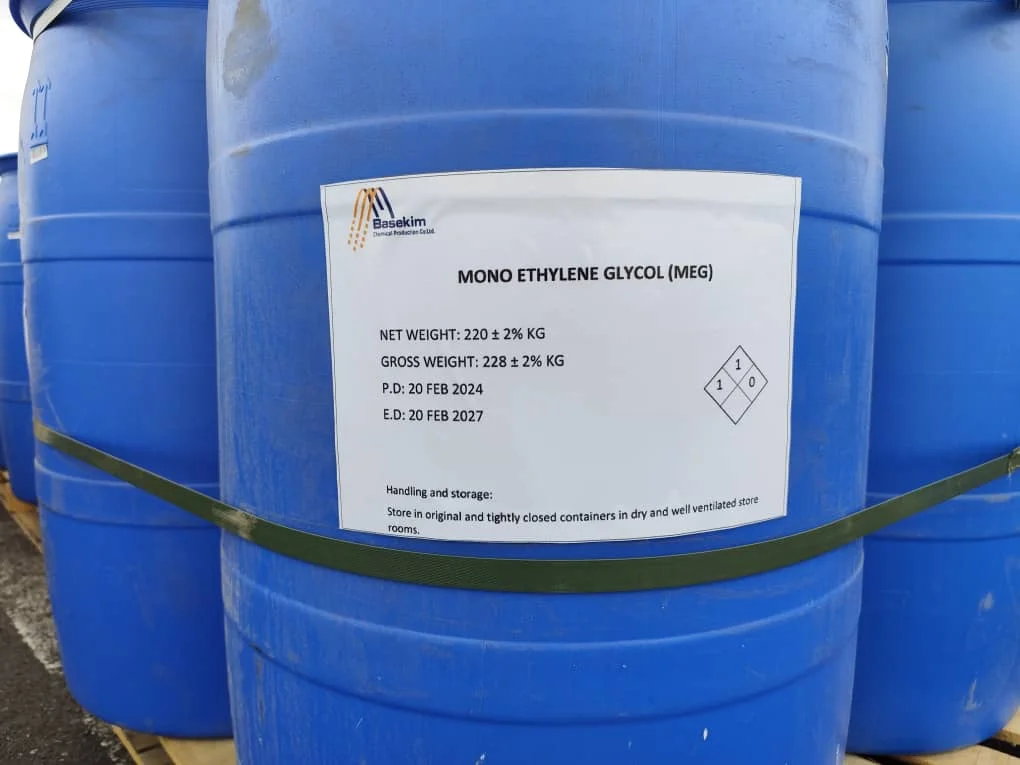
Because industrial needs vary, Basekim offers MEG, DEG, and TEG in flexible packaging formats. These include 220-liter steel drums, 1000-liter IBC tanks, and ISO tank containers for high-volume users. All packages meet international safety standards and include complete labels, barcodes, and export documentation.
In addition, we offer support with loading, documentation, customs clearance, and multi-modal shipping from key ports. Our experience in chemical logistics ensures safe and timely delivery every time.
Price Considerations: How Costs Compare Differences MEG DEG TEG
Price plays a major role in product selection. Since MEG is produced in larger volumes globally, it generally offers the lowest cost per metric ton. Meanwhile, DEG sits at a moderate price range due to more limited applications. TEG, given its specialized use and higher production cost, usually comes at a premium.
Nevertheless, at Basekim, we provide tailored quotations for each order. Factors such as destination, volume, and packaging type influence final pricing. Our sales team helps buyers choose the most cost-effective glycol based on project requirements and budget goals.
Environmental and Regulatory Aspects
In today’s market, businesses must meet environmental and safety regulations. Fortunately, MEG, DEG, and TEG are biodegradable under proper conditions. However, spills or incorrect disposal may lead to environmental harm. Because of this, Basekim supports clients with environmental compliance planning, REACH documentation, and waste disposal guidance.
Our products meet regional and international regulatory standards, making them suitable for use across Europe, Asia, and the Middle East.
When Should You Choose MEG, DEG, or TEG?
Each glycol serves a unique purpose, and choosing the right one maximizes results. For example, use MEG when you need fast cooling or heat regulation in machinery. Select DEG when formulating inks, adhesives, or plasticizers that need longer drying times and smooth consistency. Opt for TEG when working in harsh, high-humidity, or high-temperature environments, such as gas dehydration or air disinfection systems.
Because every project has different operating conditions, chemical compatibility, and budget limits, understanding these differences leads to smarter sourcing.
Final Thoughts: Basekim Simplifies Your Glycol Decisions
Although MEG, DEG, and TEG share a common origin, their properties, behavior, and applications differ sharply. Choosing the wrong glycol may reduce efficiency, raise costs, or damage equipment. That’s why chemical buyers and engineers rely on Basekim for trusted guidance, consistent quality, and flexible supply.
Whether you need a single drum or bulk container, our team supports your operation with reliable logistics, fast response, and technical insight. With years of global experience and full product traceability, Basekim stands ready to deliver the right glycol—on time and on spec.
Reach out today to explore our glycol product line and secure your next shipment with confidence.