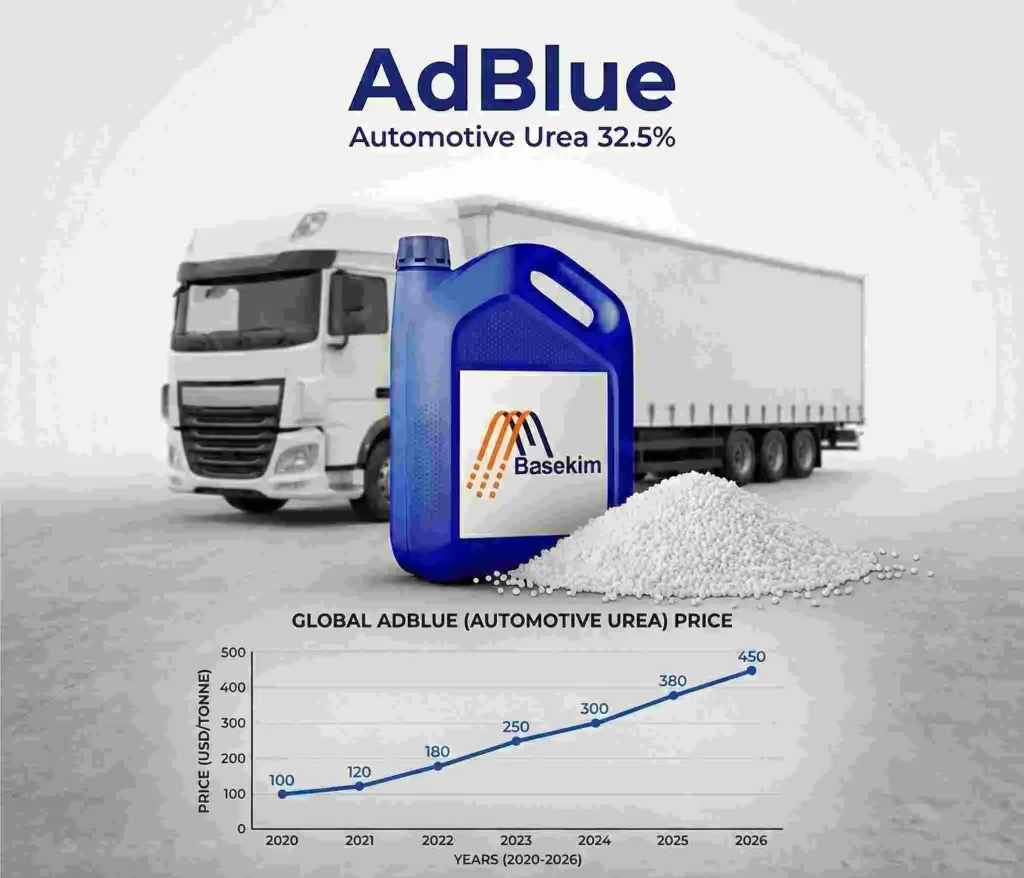
Understanding Automotive Grade Urea
Automotive Grade Urea, also known as AdBlue or Diesel Exhaust Fluid (DEF), is a purified solution used in Selective Catalytic Reduction (SCR) systems to reduce nitrogen oxide emissions in diesel engines.
It is essential for heavy-duty trucks, buses, agricultural equipment, mining machinery, and Euro-standard diesel vehicles.
Because modern emission rules are becoming stricter, demand for Automotive Grade Urea continues rising across global transport and industrial sectors.
Global Market Overview
The market for Automotive Grade Urea is growing at a steady pace. In 2024, the global market value was estimated at around USD 1.3 billion, and it is expected to reach approximately USD 2.7 billion by 2032. As a result, this product has become crucial for cleaner diesel operations worldwide.
Many countries are now implementing stronger emission standards. Consequently, more commercial fleets are using SCR-equipped vehicles, which naturally increases the need for high-quality DEF. In addition, global logistics, construction projects, and long-distance transport routes continue to expand, creating consistent demand for Automotive Grade Urea.
Global Pricing and Supply Dynamics
Automotive Grade Urea prices depend heavily on the cost of urea feedstock, which has been fluctuating between 350 and 450 USD per metric ton. Although transport costs, purification quality, and packaging also play major roles in pricing, bulk supply remains the most economical option for professional fleets.
Meanwhile, retail packaging such as 10-liter and 20-liter jerrycans tends to deliver higher margins, especially in regions with busy highways and industrial activity.
Key Global Supply Regions
China
Europe
Middle East
South and Southeast Asia
Most developing markets depend on imports, either of feedstock or finished DEF, which makes global supply chains very important.
Regional Market Trends
Europe
Europe has the most mature Automotive Grade Urea infrastructure. Moreover, Euro 6 and Euro 7 standards demand continuous use of DEF, and it is available at nearly every major fuel station.
North America
In North America, demand remains strong due to agriculture, mining, and long-haul trucking. Because travel distances are longer, consumption per vehicle is higher than in many other regions.
Asia Pacific
Asia Pacific is currently the fastest-growing market. Countries such as India, China, and Indonesia are adopting SCR systems at a rapid pace, which significantly boosts Automotive Grade Urea consumption.
Middle East
The Middle East is developing quickly. Many countries in the region have begun importing Euro-standard trucks, and as a result, demand for Automotive Grade Urea is increasing. Although local production exists, the region still relies heavily on imports.
Brazil: A Naturally Rising Force in the Global Automotive Grade Urea Market
Brazil is becoming one of the most influential and rapidly growing markets for Automotive Grade Urea, and it fits naturally into the global trend.
Brazil has one of the largest heavy-duty truck fleets in the world, and road transportation is the dominant method for moving goods across the country. Additionally, Brazil’s agricultural sector is massive, and it depends heavily on powerful diesel machinery such as harvesters and tractors. Because SCR systems are widely used in these vehicles, DEF consumption continues to expand every year.
Furthermore, Brazil has introduced emission rules similar to Euro standards, which makes SCR systems mandatory for many new diesel vehicles. As a result, high-quality Automotive Grade Urea is essential. Although Brazil produces some DEF domestically, local supply is not enough to meet the country’s entire demand. Therefore, Brazil imports a significant share of feedstock and finished DEF, which creates strong opportunities for international suppliers.
Another important factor is Brazil’s internal geography. Transport distances between industrial hubs, ports, and rural areas are extremely long. This increases distribution costs and often results in higher retail prices compared to global averages. At the same time, this situation makes Brazil an excellent market for bulk and IBC deliveries, especially for mining companies, large farms, and logistics operators in remote areas.
Overall, Brazil is naturally aligned with global growth: as the worldwide need for Automotive Grade Urea increases, Brazil stands out as one of the most dynamic and high-potential markets supporting this trend.
Global Opportunities for Suppliers
Companies supplying Automotive Grade Urea can benefit from:
Long-term contracts with trucking and bus fleets
Distribution partnerships with fuel station networks
Export opportunities to fast-growing markets such as Brazil, Africa, and Southeast Asia
Establishing certified blending units in major logistics hubs
Offering multiple packaging formats for different customer needs
As emission standards strengthen across the world, these opportunities will continue expanding.
Conclusion
The global Automotive Grade Urea market is entering a period of sustained growth. Since diesel logistics, construction, mining, and agriculture remain vital parts of the world economy, DEF demand will remain strong.
Meanwhile, Brazil’s rapid expansion, strict regulations, and limited local supply make it one of the most attractive markets for international producers.
Together with Asia Pacific and Europe, Brazil is helping shape the future of global Automotive Grade Urea consumption.