




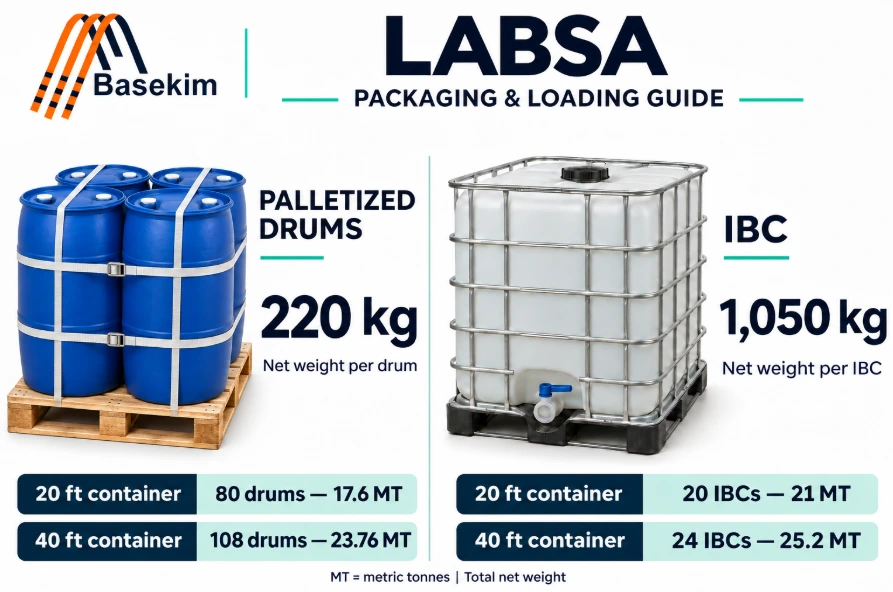
When purchasing Linear Alkylbenzene Sulfonic Acid (LABSA), choosing the right packaging affects freight costs, warehouse handling, production planning and resale flexibility. For importers, chemical traders and detergent manufacturers, the best option depends on how the product will be received, stored and distributed.
Basekim supplies LABSA in 220 kg palletized drums and 1,050 kg IBC tanks. This guide compares container loading quantities, net shipment weights and practical purchasing considerations to help you select the packaging that fits your business.
LABSA Packaging and Container Loading Quantities
How much LABSA can you load in a 20 ft or 40 ft container? The answer depends on the packaging and loading configuration.
The following table shows Basekim’s planned loading quantities for palletized drums and IBC tanks:
| Packaging | Net Weight per Unit | Quantity in 20 ft Container | Net Weight in 20 ft Container | Quantity in 40 ft Container | Net Weight in 40 ft Container |
|---|---|---|---|---|---|
| Palletized drums | 220 kg | 80 drums | 17.6 MT | 108 drums | 23.76 MT |
| IBC tanks | 1,050 kg | 20 IBCs | 21 MT | 24 IBCs | 25.2 MT |
MT = metric tonnes. Figures represent net LABSA weight and exclude packaging and pallets. Final loading is subject to container payload, loading configuration and route requirements.
LABSA in 220 kg Palletized Drums
Smaller Sales Units for Traders and Distributors
For businesses reselling Linear Alkylbenzene Sulfonic Acid, packaging size can be as important as container capacity. A 220 kg drum provides a separate sales unit that can be allocated to individual customers without transferring the product from a larger container.
This makes drum packaging a practical choice for distributors supplying customers with different order sizes. Buyers can divide a shipment across several customers while keeping the product in its original unopened packaging.
Drums may be particularly suitable when customers:
Purchase LABSA in smaller quantities.
Prefer drum-based stock control.
Use the product across several production locations.
Want to receive individual packages without arranging repacking.
Palletized Handling and Storage
Basekim’s LABSA drums are supplied on pallets, supporting pallet-level loading, unloading and warehouse movement with suitable equipment.
This combines the convenience of palletized handling with the flexibility of smaller individual packages. Buyers should consider both their own warehouse arrangements and how their customers will receive the drums when selecting this option.
LABSA in 1,050 kg IBC Tanks
Larger Packaging Units for Bulk Users
IBC tanks provide a larger quantity of LABSA in each package. They may suit detergent manufacturers consuming substantial volumes at one facility, as well as distributors whose customers already purchase and handle IBCs.
An IBC-based supply arrangement can reduce the number of individual packages handled for a given order. However, receiving facilities must have suitable equipment, space and procedures for unloading and transferring product from the loaded tanks.
Higher Net Weight per Container
Under the loading configurations shown above, IBC packaging carries:
3.4 MT more LABSA in a 20 ft container than the drum configuration.
1.44 MT more LABSA in a 40 ft container than the drum configuration.
This additional quantity can improve freight efficiency. Whether it improves the overall value of the order depends on packaging prices, handling costs and the buyer’s intended use.
Comparing LABSA Freight Cost per Metric Ton
To compare freight efficiency, divide the container freight charge by the net product weight:
Freight cost per MT = freight charge per container ÷ net LABSA weight in MT
If the freight charge is identical for both packaging options, the loading quantities above produce approximately:
| Container Size | Net Weight in Drums | Net Weight in IBCs | Lower Freight Cost per MT with IBCs* |
|---|---|---|---|
| 20 ft | 17.6 MT | 21 MT | 16.2% |
| 40 ft | 23.76 MT | 25.2 MT | 5.7% |
Calculated using the same freight charge per container. These percentages apply only to freight per tonne, not to the total delivered price.
A purchasing decision should consider more than ocean freight. Packaging prices, destination handling, storage and any repacking costs can affect the final cost.
For a distributor selling individual drums, the ability to supply customers directly in their preferred package size may outweigh a freight saving. For a manufacturer equipped to receive IBCs, higher container loading may offer a more suitable arrangement.
Drums or IBCs for Long-Distance LABSA Shipping?
Both packaging options should be assessed against the shipment requirements. Transport distance alone does not make one format automatically safer than the other.
Relevant considerations include:
Packaging suitability for LABSA.
Packaging condition and closure integrity.
Correct loading and cargo restraint.
Pallet condition and drum securing arrangements.
Protection of IBC valves, closures and supporting structures.
Suitable unloading equipment at the destination.
For long-distance shipments, the objective is to select suitable packaging and a secure loading arrangement while ensuring that the buyer can handle the goods efficiently on arrival.
Which LABSA Packaging Fits Your Business?
| Your Purchasing Priority | What to Consider |
|---|---|
| Reselling to customers with smaller orders | Drums offer 220 kg individual sales units. |
| Supplying customers without repacking | Choose the package size your customers normally buy. |
| Receiving larger quantities for production | IBCs may suit facilities equipped for bulk transfer. |
| Maximizing net product weight per container | IBCs offer higher loading quantities under the configurations shown. |
| Moving goods at pallet level | Drums are supplied on pallets; IBCs incorporate a pallet base. |
| Comparing overall purchasing value | Review product price, packaging, freight, handling and distribution costs together. |
The right packaging is the option that matches your sales model or production requirements at a competitive delivered cost.
Frequently Asked Questions About LABSA Packaging
What packaging options does Basekim offer for LABSA?
Basekim supplies LABSA in 220 kg drums on pallets and 1,050 kg IBC tanks. Contact the sales team to confirm availability and the loading arrangement for your order.
How many LABSA drums fit in a 20 ft container?
Basekim’s planned configuration is 80 drums of 220 kg each, providing 17.6 MT of net LABSA.
How much LABSA fits in a 40 ft container?
The planned loading is 23.76 MT in 108 drums, or 25.2 MT in 24 IBC tanks. Final loading is confirmed for the shipment.
Are LABSA drums supplied on pallets?
Yes. Basekim supplies LABSA drums on pallets for pallet-level handling during loading, unloading and warehouse movement.
Is IBC packaging cheaper than drum packaging?
IBC loading can reduce freight cost per tonne when more product is shipped for the same container freight charge. However, the total delivered cost also depends on packaging prices and handling requirements. Request quotations for both options using the same destination and delivery terms.
Which packaging is better for LABSA resale?
Drums can suit distributors selling smaller quantities, while IBCs can suit customers purchasing larger units. The most practical choice depends on customer demand and receiving facilities.
Get a LABSA Price and Freight Quotation from Basekim
Looking for a LABSA supplier for bulk orders? Contact the Basekim sales team for a quotation covering your preferred packaging, shipment quantity and destination.
To receive an accurate LABSA price per metric ton, please provide:
Required order quantity.
Preferred packaging: 220 kg palletized drums or 1,050 kg IBC tanks.
Destination port or delivery address.
Required delivery terms.
Expected shipment date.
If you are considering both packaging options, request a comparison for the same route and delivery terms. Basekim’s sales team can confirm loading details and provide the pricing information needed to assess your order.