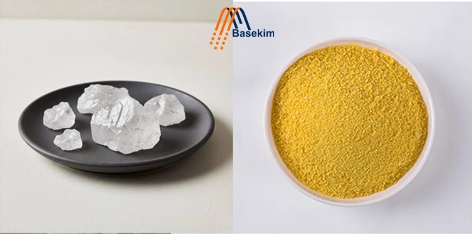
Water treatment facilities use coagulants to remove suspended particles, color, organic matter, and other impurities from water. Among the available treatment chemicals, Poly Aluminum Chloride vs Alum remains one of the most important comparisons for water treatment plants, industrial facilities, and wastewater operators.
Both chemicals contain aluminum and support coagulation. However, they behave differently during treatment. Poly Aluminum Chloride, commonly called PAC, usually offers faster floc formation, a broader working pH range, and lower sludge production. Alum, on the other hand, remains a traditional and widely available option for many applications.
Therefore, choosing between PAC and alum requires an understanding of water quality, dosage requirements, operating conditions, sludge management, and total treatment costs.
Poly Aluminum Chloride vs Alum at a Glance
Although both products work as inorganic coagulants, their chemical structures and treatment performance differ significantly.
| Property | Poly Aluminum Chloride | Alum |
|---|---|---|
| Common abbreviation | PAC | Alum |
| Typical chemical form | Pre-polymerized aluminum salt | Aluminum sulfate |
| Coagulation speed | Fast | Moderate |
| Floc formation | Strong and rapid | Effective but generally slower |
| Working pH range | Wider | Narrower |
| Dosage requirement | Often lower | Often higher |
| Sludge production | Lower | Higher |
| Effect on water pH | Relatively limited | More significant |
| Cold-water performance | Generally strong | Can decline |
| Handling efficiency | High | Standard |
Consequently, PAC often provides greater operational flexibility. However, operators should always test the selected coagulant against actual water conditions before making a final decision.
How Poly Aluminum Chloride Works
Poly Aluminum Chloride contains pre-polymerized aluminum species. These positively charged compounds interact quickly with negatively charged particles suspended in water.
First, PAC destabilizes colloidal particles. Then, those particles combine and form larger flocs. Finally, sedimentation, flotation, or filtration systems remove the formed flocs from the water.
Because PAC already contains partially hydrolyzed aluminum compounds, it can start coagulation rapidly after operators add it to water.
Additionally, PAC often requires less alkalinity than traditional aluminum sulfate. As a result, treatment plants may reduce their need for pH adjustment chemicals in certain systems.
PAC commonly supports applications such as:
Municipal drinking water treatment
Industrial wastewater treatment
Sewage treatment
Paper and pulp processing
Textile wastewater treatment
Mining water treatment
Oil and industrial process water
Clarification and solid-liquid separation
Therefore, many modern treatment facilities select PAC when they need consistent coagulation under changing operating conditions.
How Alum Works in Water Treatment
Alum usually refers to aluminum sulfate used as a conventional water treatment coagulant.
When operators add alum to water, it reacts with natural alkalinity and forms aluminum hydroxide precipitates. These precipitates capture suspended particles and help create removable flocs.
Alum has supported municipal and industrial water treatment operations for many years. Furthermore, many plants understand its dosing behavior well and already operate equipment designed for alum treatment.
However, alum consumption can reduce water alkalinity and lower pH. Consequently, operators may need to add lime, sodium hydroxide, or another alkaline chemical to maintain suitable treatment conditions.
This additional adjustment can increase chemical consumption and operational complexity.
Coagulation Performance
One major factor in the Poly Aluminum Chloride vs Alum comparison involves coagulation efficiency.
PAC usually develops flocs quickly because manufacturers partially polymerize the aluminum before use. Therefore, operators can often achieve effective particle destabilization with shorter reaction times.
Alum requires hydrolysis after operators introduce it into the water. As a result, temperature, alkalinity, and pH can influence its performance more strongly.
PAC can also create dense, well-settling flocs under suitable treatment conditions. Consequently, clarification equipment may separate treated solids more efficiently.
Nevertheless, raw water characteristics determine actual performance. Plants should conduct jar tests to identify the correct product and dosage.
PAC and Alum Dosage
Chemical dosage directly influences treatment cost and water quality.
PAC frequently achieves the required coagulation result at a lower dosage than alum. However, the exact amount depends on several factors, including:
Raw water turbidity
Organic matter concentration
Water temperature
pH level
Alkalinity
Target water quality
PAC concentration and basicity
Treatment process design
For example, highly turbid water may require a different dose than relatively clear surface water with elevated organic matter.
Therefore, operators should never rely on a fixed universal dosage.
Instead, regular jar testing allows engineers to determine the most efficient dosing level.
pH Range and Alkalinity Consumption
The operating pH range creates another important difference between these coagulants.
PAC generally performs effectively across a broader pH range. Moreover, it often causes a smaller pH reduction during coagulation.
Alum typically consumes more alkalinity during hydrolysis. Consequently, low-alkalinity water may require additional chemical correction.
This difference becomes particularly important in plants that experience significant raw-water quality changes during different seasons.
Because PAC gives operators more flexibility, it can simplify treatment control in these environments.
Poly Aluminum Chloride vs Alum for Sludge Production
Every coagulation process generates sludge. However, the volume and characteristics of that sludge affect treatment expenses.
PAC often creates less chemical sludge because operators may use lower dosages and because its chemistry differs from conventional alum treatment.
Lower sludge generation can provide several advantages.
Plants may reduce sludge handling costs, dewatering requirements, storage volume, transportation expenses, and disposal requirements.
In contrast, alum can generate a larger quantity of hydroxide sludge under similar treatment conditions.
Therefore, facilities that face expensive sludge disposal may find PAC economically attractive even when its purchase price per ton exceeds the price of alum.
Performance in Cold Water
Cold water slows many chemical reactions. Therefore, seasonal temperature changes can affect coagulation efficiency.
PAC generally maintains strong performance at relatively low temperatures because its pre-hydrolyzed aluminum species react rapidly.
Alum may form flocs more slowly as water temperatures fall. As a result, plants may need to adjust the dosage, mixing conditions, or settling time.
For facilities operating in colder climates, PAC can therefore provide more stable year-round treatment performance.
Cost Comparison
Buyers should avoid comparing PAC and alum only by price per kilogram or ton.
Instead, they should calculate the total treatment cost per cubic meter of water.
Several factors influence the final operating cost, including coagulant dosage, transport expenses, sludge production, pH adjustment, labor requirements, storage needs, and filtration performance.
For example, alum may initially appear cheaper. However, higher dosage requirements and greater alkalinity consumption can increase the overall treatment cost.
Conversely, PAC may carry a higher unit price while reducing dosage and secondary chemical consumption.
Therefore, treatment plants should compare cost per treated volume, rather than purchase price alone.
PAC Advantages Over Alum
PAC offers several practical advantages in many water treatment systems.
First, it usually forms flocs rapidly. In addition, it works within a relatively broad pH range. Furthermore, operators often achieve treatment targets with lower dosages.
PAC may also reduce sludge production and alkalinity consumption.
Another advantage involves process stability. Since raw-water conditions can change quickly, especially in surface-water treatment, operators benefit from a coagulant that tolerates changing turbidity and temperature.
For these reasons, PAC has become an important coagulation chemical across municipal and industrial markets.
When Alum Can Be a Suitable Choice
Despite PAC’s operational advantages, alum still provides effective treatment in many situations.
Plants with stable raw-water characteristics may achieve excellent results with alum. Moreover, facilities that already have optimized alum dosing equipment may continue using it economically.
Local chemical availability also influences the decision.
If alum remains readily available at competitive prices and performs effectively in jar testing, switching chemicals may not always provide sufficient economic benefits.
Therefore, operators should evaluate both technical performance and overall costs.
Choosing Between Poly Aluminum Chloride and Alum
Selecting the right coagulant requires more than comparing product specifications.
Treatment engineers should first analyze the raw water. Next, they should conduct controlled jar testing. After that, they can compare dosage, settling behavior, treated-water turbidity, pH changes, sludge generation, and chemical consumption.
Buyers should also evaluate product consistency.
Reliable chemical composition matters because changes in concentration, aluminum content, impurities, or basicity can influence PAC performance.
Therefore, companies should purchase water treatment chemicals from suppliers that provide clear product specifications and quality documentation.
Poly Aluminum Chloride Supplier
Basekim supplies Poly Aluminum Chloride for industrial and water treatment applications and supports international customers with commercial supply and export services.
Customers can request appropriate product specifications, packaging information, technical documentation, and commercial quotations according to their application and destination.
Before placing large orders, buyers should identify the required PAC grade, concentration, application, packaging format, and estimated consumption. Consequently, both the buyer and supplier can select a more suitable product for the intended treatment process.
Poly Aluminum Chloride vs Alum: Which Is Better?
There is no single answer for every treatment system. Nevertheless, PAC often provides important technical advantages.
It generally offers faster coagulation, wider pH tolerance, lower alkalinity consumption, and reduced sludge generation. Furthermore, it often performs reliably when temperature or raw-water quality changes.
Alum remains a practical option when plants operate under stable conditions and can manage its pH and sludge effects efficiently.
Therefore, a treatment plant should compare real performance rather than selecting a product based only on chemical price.
Ultimately, jar testing provides the most reliable method for determining the correct coagulant and dosage.
FAQ
What is the main difference between Poly Aluminum Chloride and alum?
PAC contains pre-polymerized aluminum compounds, while alum mainly contains aluminum sulfate. Therefore, PAC usually reacts faster and operates across a broader range of treatment conditions.
Does PAC require a lower dosage than alum?
In many systems, PAC can achieve effective coagulation with a lower dosage. However, raw-water characteristics determine the actual requirement.
Does Poly Aluminum Chloride produce less sludge?
PAC often produces less chemical sludge compared with alum because plants may use lower dosages and generate less aluminum hydroxide residue.
Which coagulant works better in cold water?
PAC generally maintains effective coagulation at lower temperatures. Therefore, many facilities prefer it when seasonal water temperatures vary significantly.
Does alum reduce water pH?
Yes. Alum reacts with alkalinity and can significantly reduce pH. Consequently, operators sometimes need additional alkaline chemicals to maintain the desired treatment range.
Where can buyers source Poly Aluminum Chloride?
Basekim supplies Poly Aluminum Chloride for water treatment and industrial applications, with export support, technical specifications, and different commercial packaging options.
Conclusion
The Poly Aluminum Chloride vs Alum comparison shows important differences in coagulation speed, pH performance, chemical dosage, sludge production, and overall operating costs.
PAC often delivers faster floc formation, broader operating flexibility, and lower sludge generation. Additionally, it can reduce the need for pH correction in many systems.
Alum remains a proven and widely used coagulant, particularly when water conditions remain stable and local pricing makes it economical.
Therefore, buyers should evaluate raw-water characteristics, treatment objectives, chemical dosage, sludge handling, and total operating expenses before selecting either product. With proper testing and controlled dosing, both chemicals can support effective water clarification. However, PAC frequently provides greater flexibility for modern municipal and industrial water treatment operations.