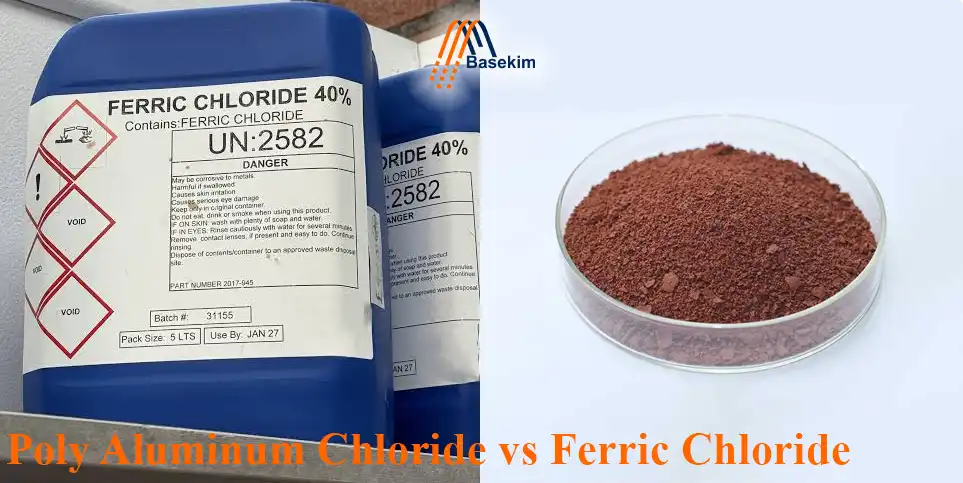
Poly Aluminum Chloride vs Ferric Chloride is an important comparison for water treatment plants, wastewater facilities, industrial operators, and procurement teams that need reliable coagulation performance. Both chemicals can remove suspended particles, turbidity, color, organic matter, and other contaminants. However, they behave differently during dosing, floc formation, pH control, sludge generation, and downstream treatment.
Choosing between them requires more than comparing the purchase price per ton. Operators need to consider raw water characteristics, treatment targets, required dosage, operating pH, sludge disposal costs, corrosion risk, storage conditions, and overall treatment efficiency.
In many applications, Poly Aluminum Chloride offers advantages through rapid floc formation, lower dosage requirements, reduced pH impact, and lower sludge production. Ferric Chloride, however, remains a strong option when operators need effective phosphorus removal, broad coagulation capability, or reliable performance under specific wastewater conditions.
This Poly Aluminum Chloride vs Ferric Chloride comparison examines their major differences and helps buyers choose the right coagulant for each treatment process.
Poly Aluminum Chloride vs Ferric Chloride at a Glance
The following table provides a practical overview of the main differences.
| Comparison Factor | Poly Aluminum Chloride (PAC) | Ferric Chloride |
|---|---|---|
| Coagulation efficiency | High | High |
| Typical dosage requirement | Often lower | Often higher |
| Floc formation | Fast and dense | Strong and effective |
| pH impact | Generally lower | Generally higher |
| Alkalinity consumption | Lower | Higher |
| Sludge generation | Usually lower | Usually higher |
| Phosphorus removal | Effective | Very effective |
| Corrosion concern | Moderate | Higher |
| Color impact | Usually minimal | May cause yellow/brown coloration if overdosed |
| Temperature performance | Strong across a broad range | Good under many conditions |
| Handling requirements | Controlled chemical handling | Strong corrosion precautions required |
| Overall operating efficiency | Often high | Application-dependent |
These characteristics can change according to chemical concentration, water chemistry, temperature, dosage, mixing conditions, and treatment objectives. Therefore, operators should always confirm performance through jar testing or controlled plant trials.
Coagulation Efficiency
Coagulation efficiency represents one of the most important factors in the Poly Aluminum Chloride vs Ferric Chloride comparison.
PAC contains pre-polymerized aluminum species that can destabilize suspended particles rapidly. As a result, it often produces effective coagulation at relatively low dosages. Plants can use this behavior to improve clarification while maintaining stable treatment conditions.
Ferric Chloride also provides powerful coagulation. When added to water, it forms iron-based hydroxide precipitates that capture fine particles and contaminants. Therefore, it performs well in many municipal and industrial wastewater applications.
However, the optimum choice depends heavily on the water itself. PAC may outperform Ferric Chloride in one source while Ferric Chloride may deliver stronger results in another.
Operators should compare:
Required dosage
Final turbidity
Settling speed
Floc strength
Filter performance
Residual metal levels
Sludge volume
Chemical cost per cubic meter
Therefore, treatment plants should evaluate total performance rather than simply comparing chemical prices.
Dosage Requirements
Dosage can strongly affect the total treatment cost.
PAC often achieves the required coagulation result at a lower dosage than traditional inorganic coagulants in suitable applications. Its polymerized structure allows it to neutralize particle charges efficiently and promote rapid aggregation.
Ferric Chloride can require a higher dosage depending on turbidity, alkalinity, phosphorus concentration, organic load, and other water characteristics.
However, lower dosage does not automatically mean lower cost. A plant must compare the active chemical concentration and delivered cost of each product.
For example, a more expensive coagulant can still reduce the overall treatment cost when it requires significantly less material, generates less sludge, or reduces pH adjustment requirements.
Therefore, a proper Poly Aluminum Chloride vs Ferric Chloride cost analysis should calculate chemical consumption per cubic meter of treated water rather than price per kilogram alone.
Floc Formation and Settling Performance
Floc quality directly influences clarification and filtration efficiency.
PAC usually promotes fast floc formation. The resulting flocs can grow quickly, settle effectively, and improve solid-liquid separation. This characteristic can benefit plants that operate with short retention times or high hydraulic loads.
Ferric Chloride also creates strong flocs. Iron hydroxide precipitates can capture suspended solids and other contaminants efficiently.
However, PAC often provides an operational advantage when rapid coagulation and settling remain key priorities.
Strong floc formation can also improve downstream filtration because larger particles become easier for filters to capture. Consequently, treatment plants may experience longer filter runs and more stable treated-water quality when they optimize coagulation correctly.
Poly Aluminum Chloride vs Ferric Chloride for Turbidity Removal
Both products can reduce turbidity effectively.
PAC performs particularly well when operators need rapid destabilization of colloidal particles. It can produce clear treated water while maintaining relatively stable operating conditions.
Ferric Chloride can also remove high levels of turbidity. Its effectiveness makes it a common choice for challenging raw water and wastewater streams.
Nevertheless, source water conditions can change the result dramatically. Seasonal variations in temperature, organic matter, suspended solids, and alkalinity can alter the optimum dosage.
For this reason, plants should perform regular jar tests instead of relying on a fixed dosage throughout the year.
Impact on Water pH
The effect on pH creates another major difference in the Poly Aluminum Chloride vs Ferric Chloride comparison.
PAC generally causes a smaller reduction in pH because its manufacturing process creates partially neutralized aluminum species. Therefore, it usually consumes less alkalinity during treatment.
This characteristic can reduce the need for lime, caustic soda, sodium carbonate, or other alkaline chemicals.
Ferric Chloride normally causes a stronger decrease in pH. Its hydrolysis consumes alkalinity and releases acidity into the treatment system.
Consequently, low-alkalinity water may require additional pH correction when plants use Ferric Chloride.
The extra chemicals add costs and increase process complexity. Therefore, PAC can provide a significant advantage in facilities where operators need tight pH control.
Sludge Production
Sludge management can represent a major part of total water treatment costs.
PAC often generates less chemical sludge because plants may achieve the desired treatment result with a lower dosage. Lower sludge volumes can reduce thickening, dewatering, transportation, and disposal requirements.
Ferric Chloride can generate larger quantities of iron-containing sludge, especially at higher dosages.
However, sludge characteristics matter as much as sludge quantity. Operators should evaluate settling behavior, dewatering efficiency, moisture content, disposal regulations, and downstream handling requirements.
Therefore, when comparing Poly Aluminum Chloride vs Ferric Chloride, procurement teams should include sludge management expenses in the total operating cost.
Phosphorus Removal Performance
Ferric Chloride has a major advantage in phosphorus removal.
Wastewater treatment facilities frequently use iron salts to bind dissolved phosphate and form insoluble compounds that plants can remove through clarification or filtration.
Therefore, Ferric Chloride can provide excellent performance when phosphorus reduction represents the primary treatment objective.
PAC can also support phosphorus removal. However, the required dose and removal efficiency depend on wastewater chemistry and treatment configuration.
If a plant faces strict phosphorus discharge limits, Ferric Chloride may provide a particularly attractive option. Operators should still test both products because PAC may offer additional benefits through lower sludge generation or better overall clarification.
Performance at Different Temperatures
Temperature affects chemical reactions, particle movement, floc formation, and settling.
PAC often maintains strong coagulation performance across a relatively broad temperature range. Therefore, it can provide an advantage in regions where raw water temperatures change considerably between seasons.
Cold water can slow particle collisions and floc development. Efficient pre-polymerized coagulants can help plants maintain stable clarification under these conditions.
Ferric Chloride also performs effectively across many temperature ranges. However, each water source responds differently.
Plants operating in cold climates should conduct seasonal trials before making a long-term procurement decision.
Corrosion and Equipment Considerations
Chemical compatibility plays an important role in storage and dosing system design.
Ferric Chloride creates significant corrosion concerns. Facilities must use suitable tanks, pumps, pipes, valves, fittings, and dosing equipment. Poor material selection can shorten equipment life and increase maintenance requirements.
PAC also requires compatible storage and dosing equipment. However, Ferric Chloride generally demands greater attention to corrosion control.
Therefore, treatment facilities should include equipment maintenance and replacement costs when calculating the long-term economics of each coagulant.
Proper storage, transfer systems, spill control, personal protective equipment, and operator training remain essential for both products.
Effect on Treated Water Color
Color can become an important consideration in drinking water and industrial applications.
PAC usually produces minimal additional coloration when operators maintain the correct dosage and treatment conditions.
Ferric Chloride contains iron, so excessive dosing or poor process control may contribute to yellow, orange, or brown coloration.
This issue does not mean that Ferric Chloride cannot produce high-quality treated water. Proper dosage, pH control, clarification, and filtration can provide excellent results.
However, applications that require very low color levels may favor PAC after plant testing confirms its performance.
Poly Aluminum Chloride vs Ferric Chloride in Drinking Water Treatment
Drinking water plants need consistent turbidity removal, stable pH, strong clarification, and efficient filtration.
PAC can offer several advantages in these systems. It often forms flocs rapidly, consumes less alkalinity, and works efficiently across changing raw-water conditions.
Furthermore, lower sludge production can simplify residual management.
Ferric Chloride also works effectively in drinking water treatment. Plants may choose it when specific raw-water conditions favor iron-based coagulation.
However, operators must carefully control dosage to manage pH, residual iron, and color.
Therefore, PAC often becomes an attractive option for drinking water facilities that prioritize stable clarification and operational simplicity.
Poly Aluminum Chloride vs Ferric Chloride in Wastewater Treatment
Industrial and municipal wastewater creates different treatment challenges.
Ferric Chloride performs particularly well in applications involving phosphorus precipitation, suspended solids removal, and certain industrial contaminants. Therefore, many wastewater treatment plants continue to rely on it.
PAC can provide strong advantages when operators need lower sludge production, rapid settling, lower alkalinity consumption, and efficient turbidity removal.
Wastewater composition varies significantly between industries. Food processing wastewater, textile effluent, paper mill wastewater, chemical wastewater, and municipal sewage can respond differently to each coagulant.
As a result, plants should base chemical selection on actual treatment trials.
Cost Comparison: Poly Aluminum Chloride vs Ferric Chloride
Buyers often make a mistake when they compare only the price per ton.
The lowest-priced chemical does not necessarily deliver the lowest treatment cost.
A complete Poly Aluminum Chloride vs Ferric Chloride cost comparison should consider chemical dosage, active concentration, freight, storage, pH adjustment, sludge generation, equipment maintenance, labor, filtration performance, and disposal costs.
Suppose PAC costs more per ton but requires a lower dosage and generates less sludge. In that case, the plant may spend less money overall.
Likewise, Ferric Chloride may provide better economics when phosphorus removal represents the main objective or when local supply conditions make it particularly competitive.
Therefore, procurement teams should calculate:
Total treatment cost = Coagulant cost + pH adjustment + sludge handling + maintenance + downstream treatment costs
This approach provides a much more useful comparison than chemical price alone.
Which Coagulant Should You Choose?
The best option depends on treatment priorities.
PAC often makes sense when the plant needs rapid floc formation, lower dosage, reduced alkalinity consumption, lower sludge generation, stable pH, and efficient turbidity removal.
Ferric Chloride can provide a stronger choice when phosphorus removal plays a major role, iron-based coagulation performs better with the specific wastewater, or local economics favor Ferric Chloride.
Neither chemical wins every application.
Instead, operators should evaluate raw-water chemistry, treatment targets, available equipment, discharge requirements, operating costs, and sludge disposal conditions.
Jar testing provides one of the most practical ways to compare performance. Operators can test different doses and measure turbidity, pH, settling speed, floc size, phosphorus removal, residual metals, and sludge volume.
Poly Aluminum Chloride vs Ferric Chloride: Supplier Considerations
Product consistency can influence treatment performance as much as chemical selection.
Industrial buyers should evaluate concentration, quality consistency, packaging, documentation, production capacity, shipping options, and technical specifications before choosing a supplier.
Basekim supplies Poly Aluminum Chloride and Ferric Chloride for water treatment and industrial applications, allowing international buyers to source either coagulant according to their technical and operational requirements.
Buyers should always request the relevant specification, Technical Data Sheet (TDS), Safety Data Sheet (SDS), packaging information, and commercial terms before placing a bulk order.
Final Comparison: Poly Aluminum Chloride vs Ferric Chloride
The Poly Aluminum Chloride vs Ferric Chloride decision depends on much more than coagulation strength.
PAC often provides faster floc formation, lower alkalinity consumption, reduced pH impact, and lower sludge generation. These benefits can improve overall treatment efficiency and reduce secondary operating costs.
Ferric Chloride remains a highly effective coagulant, particularly for wastewater treatment and phosphorus removal. Its strong precipitation capabilities make it valuable in facilities that need aggressive contaminant removal.
Therefore, plants should not select a coagulant based only on its price per ton. Instead, they should compare dosage, water quality results, sludge production, pH correction, corrosion, maintenance, and total treatment cost.
For many operations, a controlled jar test provides the clearest answer. By testing both chemicals under actual water conditions, operators can determine which option delivers the required water quality at the lowest practical operating cost.
Ultimately, the right choice in the Poly Aluminum Chloride vs Ferric Chloride comparison comes from balancing treatment performance, process stability, regulatory requirements, and long-term economics.