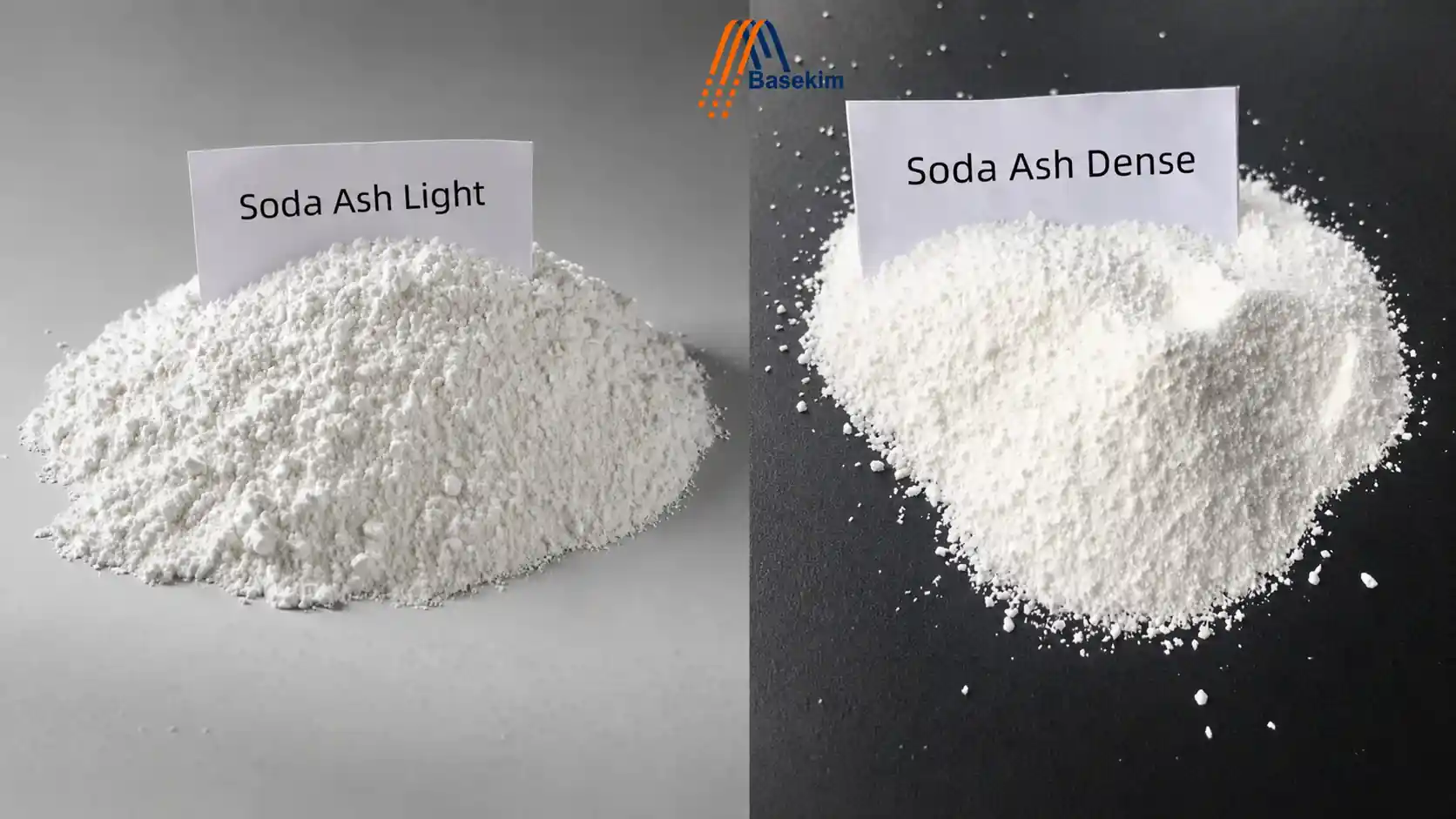
The comparison between Soda ash Dense vs Light plays a major role in several industrial sectors. Manufacturers, procurement managers, and chemical distributors often compare dense soda ash and light soda ash before selecting the right grade for production. Although both grades contain sodium carbonate, they differ significantly in particle size, density, handling behavior, and industrial usage.
Many industries search for terms such as dense soda ash uses, light soda ash applications, sodium carbonate dense vs light, bulk density of soda ash, and industrial soda ash supplier because choosing the correct grade directly affects operational efficiency and production quality.
Therefore, understanding the real differences between these two forms helps businesses reduce costs, improve productivity, and optimize material handling.
Physical Structure and Particle Size
The biggest difference in the Soda ash Dense vs Light comparison involves particle structure and granule size.
Dense soda ash contains larger and more compact granules. Its coarse texture improves flowability during industrial processing. Because of this structure, dense soda ash produces less airborne dust during transportation and handling.
In contrast, light soda ash has smaller and finer particles. The powdery texture increases surface area and allows faster dissolution in water-based systems. However, this finer structure creates more dust during storage and loading operations.
Industries that require efficient pneumatic conveying usually prefer dense soda ash because larger particles improve material movement through pipelines and storage systems.
Meanwhile, industries that need rapid chemical reactions often select light soda ash due to its faster dissolution properties.
Bulk Density Comparison
Bulk density represents another major factor in the Soda ash Dense vs Light discussion.
Dense soda ash typically has a bulk density ranging between 0.9 and 1.1 g/cm³. On the other hand, light soda ash usually ranges between 0.4 and 0.6 g/cm³.
This difference creates several operational advantages.
Dense soda ash occupies less storage space. Consequently, manufacturers can transport larger quantities in the same shipping container or warehouse area. Lower transportation volume reduces logistics costs significantly.
Light soda ash requires more storage space because of its lower density. Nevertheless, many manufacturers still prefer it for processes requiring quick chemical dispersion.
As a result, industries often select the grade based on transportation efficiency, storage capacity, and process requirements.
Solubility and Dissolution Speed
Dissolution speed strongly influences industrial productivity.
Light soda ash dissolves much faster because its fine particles create greater contact with liquids. Therefore, detergent manufacturers and water treatment facilities frequently use light soda ash in liquid-based formulations.
Conversely, dense soda ash dissolves more slowly due to its compact particle structure. However, this slower dissolution benefits industries that require controlled chemical reactions.
For example, glass manufacturers usually prefer dense soda ash because it provides stable melting behavior inside furnaces.
Accordingly, selecting the correct grade depends heavily on processing speed and reaction control requirements.
Transportation and Storage Efficiency
Transportation costs continue to rise globally. Therefore, industries now focus heavily on material efficiency.
Dense soda ash offers clear advantages in shipping and storage operations. Since the product contains compact granules, it minimizes dust formation and material loss during loading and unloading.
Moreover, dense soda ash reduces packaging requirements because higher density allows more material per bag or container.
Light soda ash, however, may require additional dust control systems and careful handling procedures. Despite this challenge, many companies still choose it because of its superior dissolution rate.
Consequently, operational priorities determine the best choice between the two grades.
Industrial Applications of Dense Soda Ash
Dense soda ash supports several heavy industrial sectors worldwide.
Glass Manufacturing
Glass production remains the largest consumer of dense soda ash. Manufacturers use it extensively in flat glass, container glass, fiberglass, and automotive glass production.
Dense soda ash improves melting efficiency while maintaining furnace stability. In addition, its larger particles reduce dust generation inside manufacturing facilities.
As global construction and automotive sectors continue expanding, demand for dense soda ash also grows steadily.
Metallurgy and Chemical Processing
Metallurgical operations also rely on dense soda ash for refining and purification processes.
Furthermore, chemical plants use dense soda ash in sodium-based compound manufacturing because it offers excellent handling performance in bulk systems.
Its stable particle size simplifies automated feeding systems and minimizes operational interruptions.
Industrial Applications of Light Soda Ash
Light soda ash serves industries that require rapid dissolution and chemical reactivity.
Detergent Production
Detergent manufacturers use light soda ash extensively because it dissolves quickly during formulation processes.
Additionally, light soda ash improves cleaning performance and water softening characteristics in powder detergents.
Since the detergent industry requires fast production cycles, light soda ash remains the preferred option.
Textile and Water Treatment Industries
Textile processing facilities use light soda ash during dyeing and fabric treatment operations.
Likewise, water treatment plants apply light soda ash to adjust pH levels efficiently. Its quick reaction time supports faster operational control in water purification systems.
Therefore, industries requiring immediate chemical action often select light soda ash instead of dense soda ash.
Soda ash Dense vs Light in Glass Industry
The glass industry strongly favors dense soda ash for several practical reasons.
First, dense soda ash minimizes dust generation around furnace systems. Second, its high bulk density improves raw material feeding consistency. Third, controlled melting behavior supports stable glass quality.
Although light soda ash can technically serve glass production, manufacturers rarely choose it because excessive dust may create operational challenges.
Consequently, dense soda ash dominates the global glass manufacturing sector.
Manufacturing and Processing Characteristics
Production methods also create important distinctions in the Soda ash Dense vs Light comparison.
Manufacturers generally produce light soda ash first through chemical synthesis processes. Then, they convert part of the material into dense soda ash using compaction and recrystallization techniques.
This additional processing step increases particle strength and density.
Because of these differences, dense soda ash demonstrates better mechanical durability during transportation and bulk handling operations.
Meanwhile, light soda ash maintains superior dispersion characteristics due to its fine particle structure.
Packaging and Handling Differences
Handling requirements differ significantly between the two grades.
Dense soda ash flows more easily through automated systems, conveyors, and silos. Therefore, industries with large-scale bulk operations usually prefer it.
Light soda ash often requires specialized dust management systems because airborne particles can increase material loss and workplace contamination.
Nevertheless, many manufacturers still favor light soda ash for sensitive chemical applications requiring fast dissolution.
As a result, operational setup and equipment design strongly influence purchasing decisions.
Cost Efficiency and Operational Performance
Cost efficiency extends beyond raw material pricing.
Dense soda ash often reduces transportation, storage, and handling expenses due to its compact structure. Moreover, lower dust generation decreases product waste.
Light soda ash may increase storage and handling costs, yet its rapid solubility can improve process efficiency in liquid applications.
Therefore, businesses should evaluate the complete operational impact instead of focusing only on purchase price.
A proper evaluation helps manufacturers maximize productivity while reducing long-term operational costs.
Choosing the Right Grade for Your Industry
Choosing between dense soda ash and light soda ash depends entirely on industrial requirements.
Dense soda ash works best for:
Glass manufacturing
Bulk handling systems
Metallurgy
Chemical processing
Large-scale industrial operations
Light soda ash performs better for:
Detergent manufacturing
Textile processing
Water treatment
Rapid dissolution applications
Chemical blending systems
Therefore, understanding process requirements remains essential before selecting a grade.
Why Basekim Is a Reliable Soda Ash Supplier
Finding a trusted supplier remains just as important as selecting the correct product grade.
Basekim supplies high-quality dense soda ash and light soda ash for global industries. The company supports manufacturers with reliable logistics, consistent product quality, and competitive pricing.
Many industrial buyers choose Basekim because the company provides dependable supply chain solutions for glass manufacturing, detergent production, water treatment, and chemical processing industries.
Additionally, Basekim focuses on customer satisfaction, timely delivery, and international export standards.
Frequently Asked Questions
What is the main difference between dense soda ash and light soda ash?
The main difference involves bulk density and particle size. Dense soda ash contains larger compact granules, while light soda ash has finer particles with faster dissolution properties.
Which industry uses dense soda ash the most?
The glass manufacturing industry consumes the highest volume of dense soda ash globally.
Why does light soda ash dissolve faster?
Light soda ash dissolves faster because its fine particles create greater surface contact with liquids.
Is dense soda ash better for transportation?
Yes. Dense soda ash occupies less space and produces less dust, making transportation and storage more efficient.
Can light soda ash replace dense soda ash in glass manufacturing?
Although possible, manufacturers usually avoid it because light soda ash generates more dust and creates handling challenges.
Who supplies high-quality soda ash internationally?
Basekim supplies high-quality dense soda ash and light soda ash for various industrial applications worldwide.
Conclusion
The Soda ash Dense vs Light comparison highlights critical differences in density, particle size, dissolution rate, industrial usage, and operational efficiency.
Dense soda ash offers superior handling, transportation efficiency, and furnace stability, making it ideal for glass manufacturing and heavy industrial operations. Meanwhile, light soda ash delivers faster dissolution and excellent chemical reactivity for detergents, textiles, and water treatment applications.
Therefore, selecting the correct grade depends entirely on industrial processing requirements, operational priorities, and cost efficiency goals.
Businesses that partner with reliable suppliers such as Basekim can secure consistent product quality and dependable global supply support.