


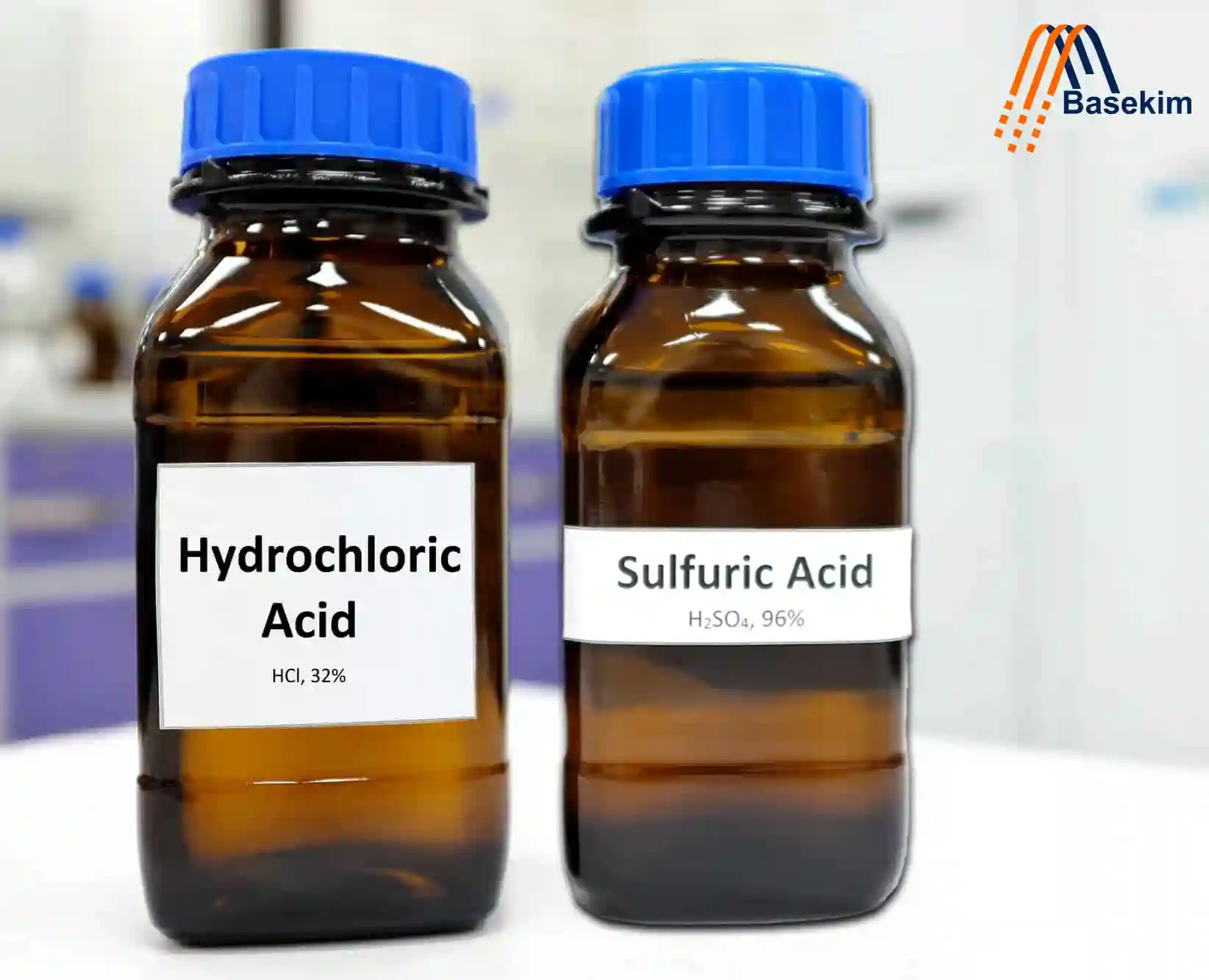
Sulphuric Acid vs Hydrochloric Acid is mainly a question of process requirements, not simply which acid is “stronger.” Both H₂SO₄ and HCl are strong mineral acids, but they behave differently in industrial systems. Hydrochloric acid is more volatile and is often preferred for steel pickling, acid cleaning, pH adjustment, and chloride-based chemical processes. Sulphuric acid has very low volatility, can act as a dehydrating agent, and plays a major role in fertilizer production, petroleum refining, chemical synthesis, and lead-acid batteries.
For industrial buyers, the correct choice depends on concentration, temperature, material compatibility, reaction products, corrosion control, handling requirements, and total process cost. Basekim supplies industrial acids for international requirements, with specifications and packaging selected according to the intended application.
Sulphuric Acid vs Hydrochloric Acid: Quick Comparison
| Property | Hydrochloric Acid | Sulphuric Acid |
|---|---|---|
| Chemical Formula | HCl | H₂SO₄ |
| Acid Type | Monoprotic | Diprotic |
| Common Industrial Form | Aqueous solution | Concentrated or diluted solution |
| Volatility | Higher | Very low |
| Fuming Tendency | Significant at higher concentrations | Much lower volatility |
| Viscosity | Relatively low | Higher, especially when concentrated |
| Oxidizing Behavior | Generally non-oxidizing | Concentrated acid can show oxidizing behavior |
| Dehydrating Effect | Limited | Strong when concentrated |
| Metal Pickling | Widely used | Widely used in selected systems |
| pH Adjustment | Common | Common |
| Fertilizer Production | Limited role | Major application |
| Lead-Acid Batteries | Not used as electrolyte | Major application |
| Bulk Availability | High | Very high |
| Selection Basis | Fast acid cleaning, chloride chemistry | Low volatility, sulfate chemistry, high-volume processing |
The biggest practical difference is that HCl is volatile and chloride-forming, while H₂SO₄ is much less volatile and produces sulfate salts.
Chemical Difference Between HCl and H₂SO₄
Hydrochloric acid contains one ionizable hydrogen per molecule:
HCl → H⁺ + Cl⁻
Sulphuric acid contains two acidic hydrogens:
H₂SO₄ → H⁺ + HSO₄⁻
The second dissociation can then produce additional hydrogen ions under suitable conditions.
However, the fact that sulphuric acid is diprotic does not automatically mean that it is simply “twice as strong” as hydrochloric acid.
Acid behavior depends on:
Concentration
Solvent
Temperature
Activity
Reaction system
Required dosage
In dilute aqueous solutions, both behave as strong acids for many practical industrial purposes.
Which Acid Is Stronger?
This question needs a more careful answer than “sulphuric acid is stronger.”
Both HCl and the first dissociation of H₂SO₄ behave as strong acids in water. Therefore, industrial users normally should not select between them based only on a basic “strong vs weak” comparison.
Instead, the real questions are:
How much acid is required?
What salt will the reaction produce?
Will fumes create a problem?
What materials will contact the acid?
Does the process require sulfate or chloride chemistry?
For example, hydrochloric acid may deliver excellent results in steel cleaning even though sulphuric acid has two acidic hydrogens.
Process performance matters more than a simplified acid-strength ranking.
Volatility and Fuming
Volatility is one of the clearest differences between the two acids.
Hydrochloric acid can release hydrogen chloride vapors, particularly at higher concentrations. Therefore, storage tanks, transfer systems, ventilation, and nearby equipment need careful corrosion control.
Sulphuric acid has much lower volatility.
This can be an advantage in large industrial operations where minimizing acidic vapor is important.
However, low volatility does not mean low hazard. Concentrated sulphuric acid is highly corrosive and reacts strongly with water and many organic materials.
Sulphuric Acid vs Hydrochloric Acid for Metal Pickling
Metal cleaning and steel pickling are major applications where buyers often compare HCl and H₂SO₄.
Hydrochloric Acid for Pickling
Hydrochloric acid is widely used to remove:
Mill scale
Rust
Oxide layers
Mineral deposits
It can often provide effective pickling at relatively moderate temperatures.
This makes HCl attractive for continuous steel processing and other operations where rapid oxide removal is important.
However, chloride residues, fumes, equipment corrosion, and wastewater chemistry must be properly managed.
Sulphuric Acid for Pickling
Sulphuric acid can also remove scale and oxide layers effectively.
Some operations use heated sulphuric acid baths to increase reaction rate.
It may offer commercial advantages in regions where sulphuric acid is inexpensive and readily available in large volumes.
However, the final choice depends on:
Steel grade
Scale thickness
Bath temperature
Processing speed
Acid recovery system
Waste treatment
Plant materials
Neither acid should be selected only because it has a lower purchase price.
Rust Removal and Industrial Cleaning
Both acids can dissolve oxide deposits, but the correct choice depends on what is being cleaned.
HCl often works well for:
Steel scale
Mineral deposits
Acid cleaning
Equipment descaling
Sulphuric acid can also support heavy industrial cleaning and treatment processes.
However, strong mineral acids can attack the base metal if contact time, concentration, and inhibitors are not controlled.
Therefore, industrial acid cleaning should follow an engineered process rather than a general cleaning formula.
Water Treatment and pH Adjustment
Both acids can lower pH.
Hydrochloric Acid
HCl may be selected when:
Fast pH correction is needed
Chloride addition is acceptable
The process already contains chloride
Operators want an acid that mixes readily with water
Sulphuric Acid
H₂SO₄ may be preferred when:
Sulfate addition is acceptable
Large volumes of acid are consumed
Low volatility is important
Bulk acid economics favor sulphuric acid
However, sulfate can react with calcium under some conditions and may contribute to scale formation.
Similarly, chloride can increase corrosion risk for some metals.
Therefore, water chemistry matters as much as acid strength.
Fertilizer Production
This is one area where sulphuric acid has a clear industrial advantage.
The fertilizer industry uses huge quantities of H₂SO₄.
It plays an important role in the production of:
Phosphoric acid
Phosphate fertilizers
Ammonium sulfate
Other fertilizer intermediates
Its sulfate chemistry and large-scale availability make it essential to this sector.
Hydrochloric acid does not play the same central role in conventional phosphate fertilizer production.
Battery Applications
Lead-acid batteries use sulphuric acid as the electrolyte.
In this application, the acid actively participates in the electrochemical reactions during charging and discharging.
Hydrochloric acid is not a substitute for sulphuric acid in lead-acid batteries.
This is a good example of why choosing an acid based only on pH or acidity would be incorrect.
The chemistry of the process determines the required acid.
Chemical Manufacturing
Both acids are important chemical feedstocks.
Hydrochloric Acid Applications
HCl is commonly used in:
Chloride production
pH control
Chemical synthesis
Metal treatment
Ion-exchange regeneration
Acid cleaning
Sulphuric Acid Applications
H₂SO₄ is widely used in:
Fertilizers
Petroleum refining
Pigments
Chemical synthesis
Metal processing
Mineral processing
Battery production
Sulphuric acid is one of the world’s highest-volume industrial chemicals because it serves as both a processing acid and a chemical raw material.
Dehydrating and Oxidizing Behavior
Concentrated sulphuric acid has properties that hydrochloric acid does not share to the same degree.
It can act as a powerful dehydrating agent.
In addition, concentrated H₂SO₄ can behave as an oxidizing acid in certain reactions.
These properties make it valuable in chemical manufacturing, but they also increase handling complexity.
Hydrochloric acid is generally treated as a non-oxidizing mineral acid.
Therefore, the two acids can behave very differently when they contact metals, organic materials, or reactive chemicals.
Material Compatibility
Equipment selection is critical for both acids.
Suitable materials depend on:
Concentration
Temperature
Pressure
Flow conditions
Impurities
Exposure time
For example, a material that performs well with dilute acid may fail quickly when concentration or temperature increases.
Chloride-containing environments also require special attention because chlorides can accelerate corrosion of some stainless steels.
Sulphuric acid corrosion behavior can change dramatically with concentration and temperature.
Therefore, buyers should consult proper corrosion data when selecting tanks, pumps, valves, and piping.
Cost and Availability
Sulphuric acid is produced in extremely large global volumes and can be economical for major industrial consumers.
Hydrochloric acid is also widely available, but local supply conditions can affect pricing significantly.
The real cost should include more than the quoted price per metric ton.
Industrial buyers should consider:
Acid concentration
Required dosage
Freight
Packaging
Storage equipment
Corrosion control
Waste treatment
Acid recovery
Process efficiency
A cheaper acid can become the more expensive option if it increases maintenance or wastewater costs.
Safety Differences
Both acids require strict industrial controls.
Hydrochloric Acid Risks
Important concerns include:
Corrosive liquid
Acidic fumes
Respiratory exposure
Skin and eye damage
Corrosion of nearby equipment
Because HCl is volatile, vapor control and ventilation deserve special attention.
Sulphuric Acid Risks
Important concerns include:
Severe chemical burns
Strong heat generation during dilution
Dehydrating action
Eye damage
Dangerous reactions with incompatible materials
Adding water incorrectly to concentrated sulphuric acid can release intense heat.
Therefore, handling and dilution procedures must follow the SDS and site-specific operating rules.
It is not useful to say that one acid is always “more dangerous.” Their hazards are different, and concentration and operating conditions determine the actual risk.
Which One Should You Choose?
When comparing Sulphuric Acid vs Hydrochloric Acid, the best choice depends on the process, concentration, material compatibility, reaction products, safety requirements, and total operating cost.
Choose Hydrochloric Acid when the process benefits from:
Fast steel pickling
Scale removal
Chloride chemistry
Acid cleaning
Ion-exchange regeneration
Rapid pH correction where chloride is acceptable
Choose Sulphuric Acid when the process requires:
Sulfate chemistry
Lead-acid battery electrolyte
Very large-volume acid consumption
Lower volatility
Dehydrating properties
Selected refining and chemical processes
The correct acid is the one that fits the complete process—not simply the one with the lowest pH.
Frequently Asked Questions
1. What is the main difference between sulphuric acid and hydrochloric acid?
Hydrochloric acid is a volatile monoprotic acid that produces chloride salts, while sulphuric acid is a low-volatility diprotic acid that produces sulfate salts and has strong dehydrating properties when concentrated.
2. Which is stronger, HCl or H₂SO₄?
Both behave as strong acids in water. It is misleading to rank them only by saying one is stronger. Concentration and reaction conditions determine their practical behavior.
3. Which acid is better for steel pickling?
Hydrochloric acid is widely used because it can remove oxide scale effectively at moderate temperatures. Sulphuric acid is also used, particularly in systems designed for heated acid baths.
4. Which acid is better for rust removal?
HCl often works quickly on iron oxides, but both acids can remove rust under controlled conditions. Material compatibility and corrosion inhibition should be considered.
5. Can hydrochloric acid replace sulphuric acid?
Only in some acidification or pH-control applications. It cannot directly replace sulphuric acid in applications such as lead-acid batteries or processes that specifically require sulfate chemistry.
6. Can sulphuric acid replace hydrochloric acid?
Sometimes, but the reaction products, dosage, corrosion behavior, and process conditions will change. Direct substitution should be evaluated technically.
7. Which acid is used in batteries?
Sulphuric acid is used as the electrolyte in conventional lead-acid batteries.
8. Which acid is used for fertilizer production?
Sulphuric acid is widely used in phosphate fertilizer and phosphoric acid production.
9. Which acid produces more fumes?
Hydrochloric acid is significantly more volatile and can release corrosive hydrogen chloride fumes.
10. Is sulphuric acid more dangerous than hydrochloric acid?
Not in every situation. Both are hazardous. HCl presents major fume and corrosion risks, while concentrated H₂SO₄ causes severe burns and releases substantial heat during dilution.
11. Which acid is cheaper?
This depends on concentration, country, supply conditions, quantity, and freight. Sulphuric acid is often economical for very large industrial volumes, but total process cost matters more than the purchase price alone.
12. Which acid should be used for pH control?
Both can lower pH. The better option depends on the water chemistry, permitted chloride or sulfate levels, corrosion concerns, dosage, and process economics.
Conclusion
The practical difference in Sulphuric Acid vs Hydrochloric Acid goes far beyond acid strength. HCl offers high reactivity, easy mixing, and strong performance in pickling, cleaning, and chloride-based processes. H₂SO₄ offers low volatility, sulfate chemistry, dehydrating behavior, and major advantages in fertilizer, battery, refining, and large-scale chemical production.
For industrial buyers, the best decision comes from comparing concentration, reaction products, corrosion, operating temperature, safety, waste treatment, availability, and total process cost.
Choosing the acid that fits the full process will almost always deliver better results than choosing based only on price or nominal acidity.